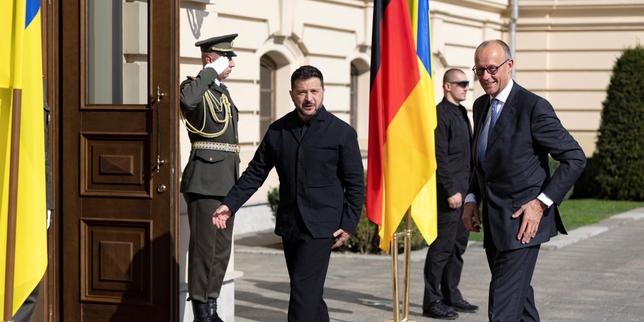
The diplomatic cadence inside government corridors often tells a sharper story than any battlefield dispatch. When Friedrich Merz touched down in the Ukrainian capital, the political landscape shifted beneath the feet of European defense planners. President Volodymyr Zelensky made a blunt economic and military commitment during those high-level talks, announcing that Kiev will procure substantially more weaponry and military hardware directly from Germany. This is not merely a routine transactional arms deal between allies. It represents a profound structural realignment of European defense manufacturing, moving Ukraine away from total reliance on emergency stockpiles and toward a long-term procurement dependency on Berlin's industrial heartland.
For months, the friction points between Berlin and Kiev centered on hesitation, delayed deliveries, and cautious political calculus within the German Chancellery. Those days are fading into the background. The reality on the ground demands a permanent industrial footprint. Ukraine's military leadership has watched foreign aid appropriations face political bottlenecks in various Western capitals, realizing that security guarantees must be anchored in direct, contract-bound manufacturing output. By formalizing a deeper pipeline with German defense contractors, Kiev is attempting to insulate its supply lines from the volatile political winds blowing across democratic electorates.
Germany’s defense sector is waking up to a generational transformation. For decades, the nation's industrial output operated under strict export controls and a cultural aversion to large-scale military production. Now, major defense conglomerates are expanding production lines, scaling up fabrication plants, and integrating real-world battlefield feedback directly into their engineering blueprints. When Ukrainian commanders place larger orders for armored vehicles, precision artillery systems, and advanced air defense components, they are not buying shelf items. They are funding a re-industrialization of European defense capabilities that will permanently alter the balance of continental security.
The logistical friction of this pivot cannot be overstated. Integrating sophisticated German hardware into an armed forces apparatus still transitioning from Soviet-era platforms requires extensive maintenance infrastructure, specialized supply chains, and specialized training academies. Mechanics on the eastern edge of Europe are learning to service complex transmissions and electronics under field conditions that punish mechanical systems. Yet, the necessity overrides the friction. Every Leopard tank and Gepard system operating on the front lines proves its worth through sheer operational endurance, creating an institutional appetite for more.
Financial mechanisms behind these expanded acquisitions remain complex. Direct procurement requires sustained capital flows, drawing on a mix of European Union financial architectures, frozen asset interest revenues, and bilateral credit lines extended by Berlin. Fiscal sustainability remains a pressing question for a nation whose economy operates under the constant pressure of wartime devastation. How Kiev intends to sustain long-term payment structures for high-end military hardware without permanently crippling its post-war budget is a calculus that financial analysts in Frankfurt and Washington are quietly studying.
This growing reliance on German manufacturing also alters the geopolitical architecture of Europe. For years, the traditional security axis swung heavily between Washington and London, with continental Europe often playing a supporting role in defense policy formulation. By positioning itself as the primary industrial arsenal for Ukraine's protracted defense, Germany is stepping into a leadership role that matches its economic weight. Berlin is no longer just a financial contributor; it is the central operational backbone for eastern European deterrence.
Moscow is watching these industrial expansions with acute concern. The Kremlin's strategic calculus has long relied on the assumption of Western fatigue, betting that democratic societies would eventually grow tired of writing multi-billion-dollar checks for endless military stockpiles. Commercial procurement contracts shift the paradigm. When a nation buys weapons through formal, multi-year industrial orders, it transforms a charity-based aid model into a durable economic partnership. Factories running three shifts in Munich or Düsseldorf are much harder to shut down with a single diplomatic veto than an emergency aid package up for congressional debate.
The consequences of this industrial marriage will echo across Europe for decades. When the active hostilities eventually subside, Ukraine will possess a military apparatus deeply integrated with German technical standards, logistics protocols, and maintenance doctrines. European defense manufacturing will be larger, faster, and permanently altered by the harsh crucible of modern high-intensity conflict. What began as an emergency response to an invasion has evolved into the blueprint for a new European security order, forged in the factories of Germany and tested on the steppes of Ukraine