Economists in Frankfurt and Brussels are hyperventilating over a spreadsheet anomaly. They look at Berlin’s €100 billion Sondervermögen (special defense fund), trace the looming expiration of those off-budget billions in 2027, and scream about a fiscal cliff. Their consensus is tidy, predictable, and dead wrong.
They argue that sustained German rearmament—hitting and holding NATO’s 2% GDP target—will blow up the Schuldenbremse (debt brake), spike Bund yields, and saddle future generations with unsustainable interest payments. Discover more on a similar topic: this related article.
That is the lazy consensus of people who treat a sovereign industrial powerhouse like a household checking account.
I’ve spent fifteen years watching European capital markets misprice geopolitical risk while worshiping arbitrary fiscal ratios. Time and again, institutional analysts obsess over the numerator—the debt issued today—while completely ignoring the denominator: the catastrophic destruction of GDP that occurs when an export-dependent economy loses its security umbrella. More analysis by Financial Times delves into similar views on the subject.
Berlin’s military spending spree isn’t a debt crisis waiting to happen. It is the single most underpriced insurance policy in modern European history. Refusing to borrow for defense doesn't save Germany money; it guarantees an economic contraction that makes a 65% debt-to-GDP ratio look like a rounding error.
The Accounting Trick That Fooled the Press
To understand why the mainstream financial press is panicking, look at how they read a balance sheet.
When traditional economists warn of a "debt surge," they are reacting to a specific structural friction in German constitutional law. Under Article 115 of the Basic Law (Grundgesetz), the federal government’s structural deficit cannot exceed 0.35% of gross domestic product. In 2022, Chancellor Olaf Scholz bypassed this rule to create the €100 billion special fund for the Bundeswehr by securing a two-thirds parliamentary majority to amend the constitution.
Here is the trap: that €100 billion is an off-budget credit authorization, not a recurring revenue stream. Once the pot runs dry around 2027 or 2028, maintaining the NATO 2% threshold requires finding an extra €25 billion to €35 billion every single year inside the regular federal budget.
The deficit hawks look at that €30 billion annual hole and see only two options: slash social welfare—political suicide in a country with an aging demographic—or scrap the debt brake and watch borrowing costs climb.
They miss the third reality. Debt is not inherently corrosive; unproductive debt is.
When the German state borrows at roughly 2.3% to 2.6% on 10-year Bunds—still the undisputed benchmark safe asset of the Eurozone—it isn't burning cash in a furnace. It is financing capital expenditure. In macroeconomic accounting, there is a vast chasm between borrowing to subsidize consumption (like energy price caps or pension top-ups) and borrowing to rebuild industrial capacity, satellite reconnaissance, air defense grids, and munitions manufacturing.
The Kiel Institute for the World Economy (IfW) has explicitly modeled the fiscal multipliers of defense expenditure. While short-term fiscal multipliers for imported American hardware—like F-35 fighter jets—leak out of the domestic economy, domestic procurement and R&D in dual-use technologies generate long-term productivity spillovers. When Rheinmetall, Hensoldt, or Diehl Defence expand capacity in Lower Saxony or Bavaria, those euros recycle through high-wage engineering payrolls, corporate tax receipts, and supply chain sub-contractors.
Treating a Leopard 2A8 production line the same way you treat a one-off heating subsidy is financial illiteracy.
The Invisible Tax of the "Peace Dividend"
For thirty years, Germany ran an arbitrage play that made it the envy of the developed world. It outsourced its hard security to the Pentagon, imported cheap pipeline gas from Gazprom, and sold high-margin machine tools and luxury sedans to Beijing.
That model is dead. Bury it.
Economists warning about a defense-induced debt surge are still pricing the world as if 2014 never happened and 2022 was a temporary weather event. They treat security as a free public good—something that exists in the background like oxygen while accountants haggle over basis points.
Let’s run a simple thought experiment. Imagine a scenario where Berlin listens to the fiscal purists. To protect the sacred 0.35% structural deficit limit without raising taxes, the Finance Ministry caps defense spending at 1.4% of GDP once the special fund expires. The Bundeswehr remains short on artillery shells, air defense batteries remain thin, and Eastern flank deterrence erodes.
What happens to German sovereign debt in that scenario?
First, foreign direct investment dries up. Nobody builds a €10 billion semiconductor fab in Magdeburg or a battery gigafactory in Brandenburg if the skies over Central Europe aren't defended by integrated, layered air defense. Capital flees geopolitical ambiguity faster than it flees a 1% uptick in sovereign debt.
Second, if deterrence fails—even via gray-zone sabotage of North Sea pipelines, Baltic undersea cables, or rail logistics—the resulting supply chain shock would shave multiple percentage points off German GDP overnight. And what happens to a debt-to-GDP ratio when the denominator collapses? It explodes.
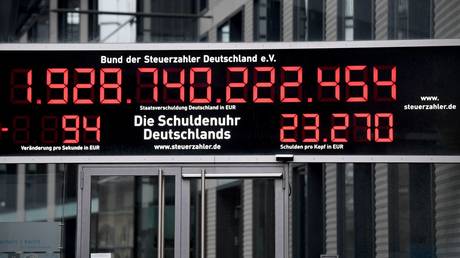
Germany’s debt-to-GDP ratio currently hovers around 63% to 64%. Compare that to the rest of the G7:
- France: ~110%
- United States: ~120%+
- Italy: ~135%+
- Japan: ~250%+
Berlin has the cleanest balance sheet in the industrialized world. Hoarding that fiscal headroom while your bridges crumble, your rail network misses half its schedules, and your military lacks basic ammunition isn't prudence. It is institutional self-harm. You don't keep a fire extinguisher locked in a glass case to preserve its resale value while the kitchen is smoking.
Dismantling the Myths Around German Rearmament
When financial commentators warn about Berlin’s military budget, they rely on three recurring talking points. Every single one collapses under scrutiny.
"Higher defense spending will trigger a bond market vigilante revolt."
Bond vigilantes punish governments that lose control of inflation or issue debt to fund structural consumption deficits without growth prospects (think the UK’s Liz Truss mini-budget debacle in 2022). Bond markets do not punish low-debt industrial sovereigns for making targeted capital investments that stabilize their own currency zone.
In fact, global institutional investors are starved for AAA-rated Eurozone paper. Because Germany’s debt brake has artificially restricted the supply of Bunds for over a decade, the European Central Bank and commercial banks have repeatedly faced collateral scarcity in repo markets. Issuing an additional €30 billion to €40 billion annually in Bunds wouldn't crash the market; liquidity desks in London and Frankfurt would absorb it before lunch.
"Germany can just buy cheap weapons off the shelf instead of overspending."
This ignores how modern defense procurement actually works. The reason Germany’s Sondervermögen lost nearly a third of its purchasing power before a single tank rolled off the line wasn't reckless spending—it was inflation, currency swings, and decades of underinvestment that gutted European manufacturing scale.
You cannot buy artillery shells off the shelf when global assembly lines have been mothballed since the Cold War. You have to pay upfront to build the factories, secure the nitrocellulose supply chains, and guarantee multi-year off-take agreements. If Berlin tries to pinch pennies with annual stop-and-go budgets, unit costs skyrocket because contractors have to price in political cancellation risk. Long-term debt-financed multi-year contracts actually lower the per-unit cost of rearmament.
"Social spending and defense spending are a zero-sum game."
Politicians love this framing because it lets them weaponize fear. Left-leaning critics claim every euro spent on a Patriot missile battery is stolen from daycare centers; conservative hawks claim social entitlements must be gutted to pay for tanks.
Both sides are pretending Germany has hit its absolute borrowing ceiling. It hasn't. Even the Bundesbank—historically the temple of German monetary orthodoxy—has floated proposals to reform the debt brake, suggesting higher borrowing allowances when debt-to-GDP sits well below the Maastricht 60%–70% threshold. The zero-sum trap is entirely self-imposed by a constitutional rule written in 2009 for a world that no longer exists.
The Real Threat Isn't the Debt—It’s the Procurement Bureaucracy
If there is a legitimate reason to critique Berlin’s military spending spree, it has nothing to do with sovereign debt yields and everything to do with institutional rot inside Koblenz.
The Federal Office of Bundeswehr Equipment, Information Technology and In-Service Support (BAAINBw) is where good capital goes to die. For decades, German defense procurement operated on a bizarre hybrid of risk-averse civil service law and bespoke engineering fetishism. Instead of buying battle-proven systems as-is, German procurement officers historically demanded custom modifications to meet peacetime domestic road-traffic regulations—turning standard armored vehicles into bespoke, delayed, gold-plated science projects.
I have watched defense contractors walk away from European tenders simply because the compliance overhead and legal challenge delays made the contracts unbankable.
Throwing borrowed billions into a broken procurement machine will waste money. That is the real downside risk of my thesis—and the one vulnerability fiscal hawks rarely articulate properly. If Berlin reformulates its debt brake to unleash €50 billion a year in military capital without simultaneously stripping out EU tender litigation bottlenecks and overhauling BAAINBw, the result won't be deterrence. It will be margin expansion for consultants and lawyers while soldiers still wait for encrypted radios.
How Berlin Should Actually Finance Rearmament
If policymakers in the Chancellery and the Finance Ministry want to secure the country without triggering a fiscal crisis, they need to stop treating defense as an emergency exception and start treating it as core infrastructure.
- Exempt defense capital expenditure from the debt brake. Strip military R&D, heavy equipment procurement, and dual-use logistics infrastructure out of the 0.35% structural deficit calculation. Keep current operational expenses—salaries, pensions, barracks maintenance—inside the regular tax-funded budget so fiscal discipline remains intact where it belongs.
- Issue dedicated European defense bonds or joint procurement guarantees. Rather than Germany solo-funding fragmented national champions, use Berlin’s AAA credit rating to anchor multi-nation bulk orders across European allies. Scale drives down unit prices faster than any austerity committee ever could.
- Shift from cost-plus contracts to fixed-price, volume-guaranteed frameworks. Stop paying contractors for hours spent designing bespoke features. Guarantee 10-year minimum order quantities for munitions, drones, and air defense interceptors so private capital—not just state debt—builds the factories.
- Enforce strict milestone clawbacks. Tie every tranche of state-backed financing to hard delivery dates. If a contractor misses a delivery window, penalty clauses trigger automatically without five years of administrative arbitration.
The Price of Stagnation
Markets always collect their due. You either pay upfront in transparent, low-interest sovereign debt to maintain stability, or you pay later in currency devaluation, capital flight, and lost industrial output when your geopolitical foundations crack.
Germany spent twenty years underinvesting in its physical infrastructure, its digital networks, and its armed forces to brag about a Schwarze Null—a balanced budget with zero net new borrowing. That fiscal vanity gave Berlin pristine credit metrics while its rail bridges rusted and its military became a punchline in NATO war games.
The bill for that illusion has finally arrived. Whining about the interest rate on the loan while the roof is caving in won't keep the rain out.