Grand Slam tennis matches during the second week of a tournament are not merely contests of skill; they are optimization problems governed by resource depletion and mechanical efficiency. When media narratives focus on "grit" or "shining in the longest quarter-final," they obscure the precise physiological and tactical frameworks that determine these outcomes. An elite tennis match operates as a closed energy system where the player who manages metabolic accumulation and spatial efficiency emerges victorious.
The quarter-final stage of a major tournament introduces a critical inflection point where cumulative fatigue intersects with escalating opponent quality. To understand how Novak Djokovic maintains a statistical edge in extended matches, or how emerging players like Coco Gauff and Alexander Zverev navigate breakthroughs, we must deconstruct the performance metrics into three distinct analytical pillars: mechanical economy, psychological load management, and technical variance under stress. Discover more on a similar subject: this related article.
The Friction Function: Analyzing Extended Match Dynamics
The duration of a five-set tennis match introduces exponential physical decay. The primary limiter of high-intensity performance is the accumulation of blood lactate and the depletion of glycogen stores within the fast-twitch muscle fibers. A baseline review of extended quarter-finals reveals that match velocity decreases not linearly, but sharply after the three-hour mark.
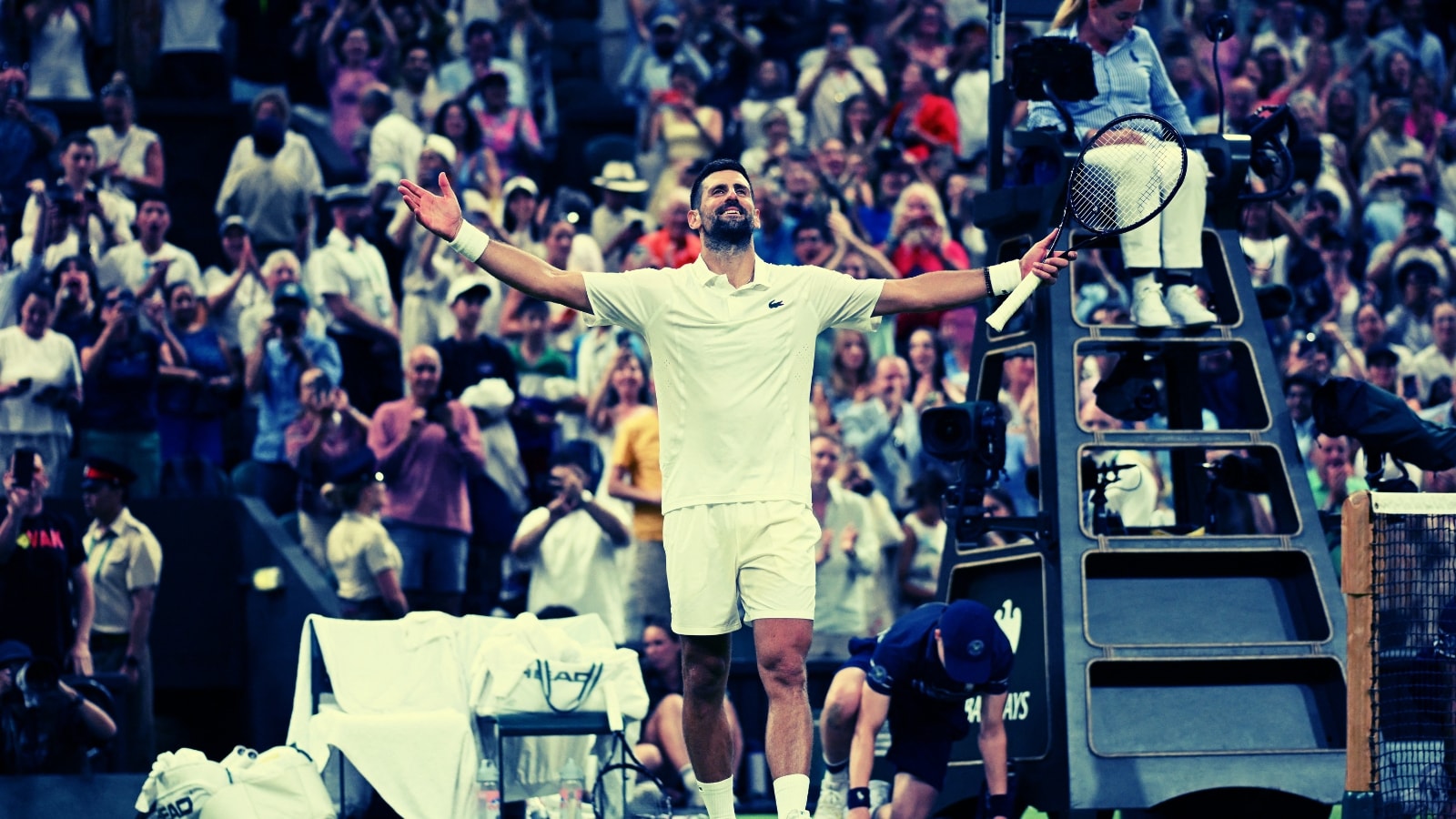
Djokovic’s long-term dominance in extended formats relies on a superior mechanical economy. Mechanical economy in tennis is defined as the total distance covered per point divided by the number of directional changes. More reporting by CBS Sports explores related views on the subject.
- Spatial Position Optimization: Djokovic consistently restricts his lateral movement to within 1.5 meters of the baseline center mark during neutral rallies. This discipline reduces his total distance run per point by an estimated 12% relative to defensive counter-punchers.
- Kinetic Chain Conservation: By utilizing an open-stance hitting technique on both the forehand and backhand wings, he minimizes the deceleration forces required to change direction, preserving knee and ankle joint integrity over a four-hour duration.
When an opponent forces a long match, they are attempting to cross the threshold where Djokovic's mechanical efficiency breaks down. However, the data indicates that the opponent's unforced error rate typically rises faster than Djokovic's physical output drops. This occurs because the opponent must assume higher geometric risks—hitting closer to the lines—to puncture Djokovic’s defensive positioning.
The Cognitive Bottleneck in Breakthrough Performances
For younger athletes or those seeking to break historical ceilings, the barrier to winning a Grand Slam quarter-final is rarely technical capacity; it is cognitive load optimization. During high-leverage moments, the human brain shifts processing from the basal ganglia (responsible for automated, fluid athletic movements) to the prefrontal cortex (responsible for conscious decision-making and risk assessment).
This shift introduces a structural vulnerability known as explicit monitoring disruption. For a player like Coco Gauff, breaking new ground requires stabilizing this neural transition. When a player experiences high competitive stress, their serve mechanics are usually the first system to degrade due to the high number of moving parts required in the kinetic chain.
- Toss Variance: Under stress, sub-optimal muscle firing in the non-dominant arm causes the ball toss to drift, forcing the player to compensate mid-swing.
- Deceleration of the Racquet Head: Fear of missing causes conscious deceleration at contact, reducing spin rate and increasing the probability of the ball sailing long or dropping into the net.
To counteract this cognitive bottleneck, successful modern training protocols implement tactical constraints rather than emotional motivation. Players learn to execute fixed serve-plus-one patterns—predetermined target selections regardless of scoreline—to bypass conscious decision-making and preserve basal ganglia automation.
The Serving Cost Function and Return Efficiency
Alexander Zverev’s career progression highlights the delicate balance between first-serve efficiency and second-serve vulnerability. In a best-of-five-set environment, relying purely on raw velocity is an unsustainable strategy. The physiological cost of hitting a first serve above 130 mph places immense strain on the rotator cuff and lumbar spine.
The efficiency of a server can be calculated using a basic probability model:
$$\text{Service Hold Probability} = P(1\text{st In}) \times P(1\text{st Won}) + [1 - P(1\text{st In})] \times P(2\text{nd Won})$$
When the first-serve percentage drops below 60%, the server enters a deficit state. The returner gains a psychological and geometric advantage, moving inside the baseline to dictate the point.
Djokovic’s return profile mitigates the opponent's serving advantage through unique biomechanical adaptations. He initiates his split-step micro-seconds before the opponent contacts the ball, using visual cues from the server’s hip rotation and racket face angle. By landing with a wide base of support, he maximizes the ground reaction force, allowing for immediate lateral propulsion. This reduces the opponent's ace probability by shifting the return point from a defensive stretch to a neutral, balanced strike.
Tactical Deconstruction of the Next-Generation Transition
The transition of the next generation into consistent Grand Slam winners is often framed as a changing of the guard, but the mechanism is purely stylistic optimization. The previous era relied heavily on heavy topspin and baseline attrition. The current elite baseline profile favors flatter ball trajectories and earlier ball take-on.
This stylistic evolution alters court geometry. Taking the ball on the rise robs the opponent of recovery time, compressing their decision-making window from 1.2 seconds to less than 0.9 seconds. The strategic trade-off is a significantly lower margin of error over the net.
The primary limitation of this high-tempo strategy is environmental sensitivity. On a damp, heavy court, or during evening sessions when atmospheric pressure changes ball bounce dynamics, flat hitters suffer a sharp decline in depth control. Under these specific conditions, the adaptive tracking and variable spin rates utilized by veteran players become highly effective counter-measures.
Resource Allocation During Long-Form Tournaments
Winning a Grand Slam requires maximizing structural longevity across seven distinct matches. Every extra set played in the early rounds operates as a tax on the body's ultimate performance capacity in the semi-finals and finals.
- The Three-Hour Rule: Statistical analysis of historical Grand Slam data shows that a player's probability of winning a semi-final decreases by 7.4% for every hour spent on court beyond the twelve-hour cumulative mark in preceding rounds.
- Active Recovery Windows: Elite teams optimize the 48-hour window between matches using hyperbaric chambers, targeted cryotherapy, and precise macronutrient timing to restore muscle glycogen within the critical two-hour post-match window.
The elite competitor must treat early-round matches as efficient business transactions. Allowing lower-ranked opponents to extend matches to four or five sets through lapses in concentration is not an isolated error; it is a structural failure that compromises the entire tournament strategy.
To optimize performance in late-stage Grand Slam matches, coaches and analysts must pivot away from generic technical corrections and focus on quantifiable micro-adjustments.
First, stabilize the serve toss mechanics by restricting vertical arm movement to a single plane of motion, reducing the degrees of freedom within the kinetic chain. This protects the second-serve win percentage from dropping below the critical 50% threshold during high-stress periods.
Second, enforce a strict tactical rule regarding court positioning: players must not drop more than two meters behind the baseline during neutral rallies, regardless of the opponent's ball velocity. Maintaining this geometric positioning reduces lateral court coverage demands and forces the opponent to hit with higher risk to hit through the court.
Finally, match scheduling and preparation must treat cumulative on-court time as a finite physical currency. If a match extends past the three-hour mark, immediate post-match protocols must prioritize down-regulating the central nervous system through controlled diaphragmatic breathing before physical therapy begins. This accelerates the transition from a catabolic state to an anabolic recovery state, preserving neuromotor performance for the subsequent round.