Political consultants are professional addicts chasing a fix that no longer exists. Every election cycle, they roll out the exact same tired script for swing-state Senate races. They point to a candidate walking a factory floor, talking softly about bipartisan cooperation, nodding sympathetically to union workers, and simultaneously winking at populist firebrands. They call it triangulation. They call it building a broad coalition. I call it an electoral suicide pact disguised as strategy.
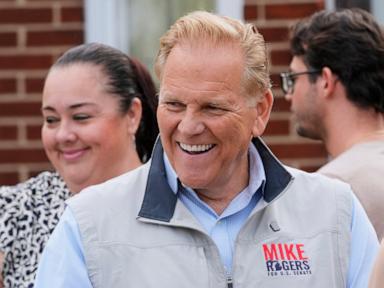
The mainstream political press eats it up every single time. When a high-profile Republican like Mike Rogers makes a play for Michigan Democrats while trying to keep Trump loyalists happy, the pundits write glowing profiles about high-wire acts and disciplined messaging. They treat politics like a middle-school debate tournament where the kid who uses the nicest words wins the room. You might also find this related story interesting: Why Pouring Millions Into Protecting Green Spaces Is Actually Destroying Our Cities.
It is complete garbage.
The entire premise rests on a statistical ghost: the persuadable moderate voter who sits around waiting for a candidate to say the magic words about supply chains and infrastructure before casting a split-ticket ballot. That voter is gone. They packed up and left years ago. In a hyper-nationalized, tribalized electorate, trying to be all things to all factions does not make you a consensus builder. It makes you invisible. It makes you a blank screen onto which voters project their deepest suspicions. As extensively documented in detailed articles by Reuters, the implications are significant.
Let us look at the math that the consultants refuse to run.
In a state like Michigan, electoral outcomes are not decided by winning over a mythical flock of suburban centrists who care deeply about Senate procedure. They are decided by asphalt-and-gravity turnout. Every single precinct is locked in a cage match of raw enthusiasm and tribal identity. When you spend months trying to convince a lifelong labor Democrat that you care about their pension while also reassuring a rally full of populist populists that you are an America First hardliner, you achieve a remarkable feat of political physics. You depress both bases.
The lazy consensus says that elections are won in the center. The data says elections are won by intensity, contrast, and narrative dominance.
If you try to triangulate, you force your campaign to speak in consultant-approved mush. You get talking points that sound like they were generated by a committee of terrified risk-averse cowards who haven't stepped foot outside a country club or a Washington steakhouse since 2012. Voters smell that caution a mile away. They do not reward you for trying not to offend them; they punish you for lacking a spine.
The Death of Split-Ticket Voting
Look at the federalization of American politics over the last three election cycles. The correlation between presidential voting and Senate voting has approached near-absolute alignment. The days of the independent-minded ticket-splitter who votes for a conservative governor and a liberal senator—or vice versa—belong in a museum alongside rotary phones and phonebooks.
Yet, the consultant class treats every cycle like it is 1996. They still believe that if a candidate talks enough about local economic development or manufacturing jobs, the partisan armor of the voter will melt away.
It will not.
When a voter walks into a polling booth or fills out an absentee ballot, they are not evaluating local credentials. They are making a referendum on national power, cultural direction, and systemic survival. They are asking a simple question: Which side are you on?
When a candidate answers that question with a ten-minute disquisition on bipartisanship and committee assignments, the voter hears evasion. They hear a professional politician protecting their own career options rather than fighting an existential fight. Bipartisanship used to be a brand asset. Today, to an electorate convinced that the system is rigged against them, bipartisanship looks like complicity. It looks like an admission that you are willing to compromise with the very people they hold responsible for their economic stagnation.
The Two-Target Impossibility
Let us examine the specific mechanics of the straddle. How do you court union Democrats in Macomb County while simultaneously locking down the most zealous MAGA foot soldiers in rural Michigan?
You do not. It is a mathematical and rhetorical impossibility.
The union voter is looking for structural economic protection, collective bargaining strength, and tangible proof that trade policy will not gut their livelihood. The populist Trump voter is looking for systemic disruption, cultural combat, and an absolute rejection of the institutional establishment.
If you lean too hard into the economic protectionism that appeals to the union hall, you sound like big government to the market-fundamentalist wing of the party. If you lean too hard into cultural grievance to fire up the base, you instantly trigger the immune response of the working-class voter who just wants their kid's school to work and their local plant to stay open without being dragged into a national culture war.
The attempt to bridge this gap produces a linguistic fog. Candidates resort to generic buzzwords about growth, opportunity, and unity. They talk about working across the aisle to get things done.
Nobody wakes up in the morning fired up about getting things done. People get fired up about winning. People get fired up because they believe their enemy is about to ruin everything they care about, and they need a champion who will smash the table, not one who wants to negotiate a compromise over the debris.
The Power of Asymmetry
Winners do not win by apologizing for who they are or trying to sand down their edges to make themselves palatable to the editorial board of a regional newspaper. They win by defining the battlefield on their own terms.
I have watched well-funded campaigns blow millions of dollars on targeted mailers and focus-grouped ads designed to prove that their candidate is a reasonable, level-headed moderate who loves puppies and bipartisan highway bills. Every single dollar spent on that message is money set on fire.
Contrast beats consensus every single day of the week.
If you are running in a state as politically contested and culturally polarized as Michigan, you cannot win by playing prevent defense. You cannot run out the clock by avoiding mistakes. The electorate is too volatile, and the information ecosystem is too hostile. If you do not give people a sharp, unmistakable reason to believe in your worldview, they will stay home, or they will vote for the other monster because at least that monster is honest about what they are.
The obsession with courting the opponent's base is a symptom of deep ideological cowardice. It assumes that voters are movable objects if you just push them with enough gentle persuasion.
They are not objects. They are actors reacting to cues of authenticity and strength.
The Myth of the Neutral Arbiter
Another favorite fantasy of the political establishment is that voters care deeply about institutional norms and checks and balances. We are told that candidates must position themselves as neutral arbiters who will restore dignity to the Senate.
Dignity is a luxury good. When people are worried about inflation, crime, housing costs, and the general direction of the country, dignity sounds like a polite way of saying you do not care about their grocery bills.
The Senate is not a gentlemen's club where wise statesmen gather to debate the finer points of administrative law. It is a trench in a permanent civil war over the future of the republic. Pretending otherwise is either staggering naivety or deliberate deception.
When a candidate tries to be the adult in the room, they usually end up looking like the principal at a high school dance: irrelevant, stiff, and deeply resented by everyone having a good time outside the rules.
Voters do not want an adult supervisor. They want an advocate. They want someone who looks at the opposition not as a collection of well-meaning colleagues with whom they disagree on marginal tax rates, but as architects of national decline who must be stopped.
Why the Old Playbook is Dead
The old playbook worked when the two political parties shared a baseline consensus on the fundamental architecture of American capitalism, foreign policy, and cultural norms. In that world, an election was a dispute over management style. Who could run the DMV better? Who could trim the budget by two percent? Who could negotiate a better trade deal?
That world is gone. We are living through an era of structural realignment.
The parties are no longer coalition parties representing broad, overlapping economic interests. They are ideological and cultural blocs locked in an existential struggle over national identity. In this environment, triangulation is not moderation; it is desertion.
When a politician tries to split the difference between two irreconcilable visions of America, they abandon both. They become a non-player character in a game where everyone else is playing for keeps.
Look at how campaigns are actually funded and fueled today. They are powered by viral moments, grassroots outrage, and absolute clarity of purpose. A fundraising email that says "We need to work together across party lines to find common-sense solutions" raises zero dollars and inspires zero volunteers. A message that says "The other side is trying to destroy everything you built, and I am the only one willing to stand in their way" fills arenas and floods campaign accounts.
Campaigns are marketing exercises for political power. If your marketing message is "We're pretty much like the other guys, but slightly more polite," you deserve the defeat you are going to get.
The Cost of Compliance
The tragedy of candidates who buy into the consultant narrative is that they ruin their natural political instincts in pursuit of a ghost. They start talking like press releases. They stop answering direct questions. They look over their shoulder at every stop to make sure they haven't violated some unwritten rule of polite political discourse.
And in doing so, they drain all the oxygen out of their own candidacy.
Authenticity cannot be simulated by a media consultant with a focus group. Real political weight comes from conviction—even a mistaken conviction is often more potent than a calculated, poll-tested compromise. At least a candidate with real convictions gives the voter something to grapple with. A triangulator gives them nothing.
If you are going to win a major Senate seat in a battleground state, you have to choose a side of the mountain and start climbing. You cannot camp out in the valley trying to convince the climbers on both the left and the right that you are really one of them. They will both throw rocks at you until you move.
The lesson that every future candidate needs tattooed on the inside of their eyelids is simple: Stop apologizing for your gravity. Stop pretending that the middle is a safe place to hide. The middle is not a sanctuary; it is a firing range.
Until campaigns realize that polarization is not a bug in the system to be engineered away with nice words, but the very fuel of modern democratic politics, they will continue to run the same losing plays and wonder why the scoreboard keeps flashing the same dismal results.
Stop trying to please everyone. Start giving your people a reason to bleed for you.