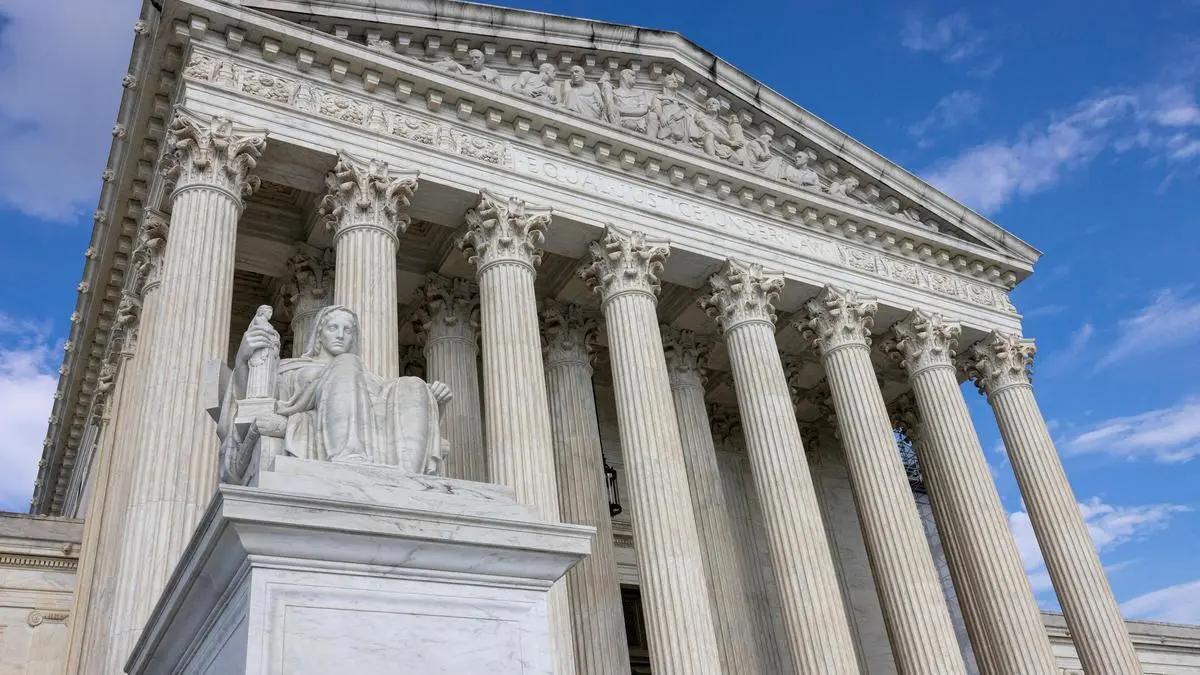
The media is currently obsessing over a Supreme Court case regarding birthright citizenship as if it’s a simple tug-of-war between "tradition" and "Trumpism." They’ve missed the point. Most legal analysts are operating on a 19th-century mental operating system, trying to apply the 14th Amendment to a 21st-century world of global mobility and digital sovereignty.
The consensus view—that birthright citizenship is an unshakeable, self-evident pillar of American identity—is just as intellectually lazy as the opposing view that an executive order can magically erase a century of precedent. We are arguing about the plumbing of a house while the foundation is shifting beneath us.
The Jurisdiction Trap Everyone Ignores
Every cable news pundit loves to quote the opening of the 14th Amendment: "All persons born or naturalized in the United States, and subject to the jurisdiction thereof, are citizens."
They stop at the comma. They treat "subject to the jurisdiction" as a geographical marker. If your feet are on the soil, you’re under the jurisdiction. Simple, right?
Wrong.
Historically and legally, "jurisdiction" wasn't just about GPS coordinates. It was about political allegiance. If you were the child of a foreign diplomat or an invading soldier in 1868, you weren’t "subject to the jurisdiction" in the way the framers intended. You owed allegiance elsewhere.
The lazy consensus ignores that the 14th Amendment was written to solve a very specific, horrific problem: the status of formerly enslaved people who were born here but denied the rights of men. It wasn’t a blueprint for birth tourism or a global open-house policy. By pretending the "jurisdiction" clause is just a synonym for "physical presence," the legal establishment has bypassed a century of necessary debate on what it means to belong to a sovereign state.
The 1898 Ghost Haunting the Court
The case everyone points to is United States v. Wong Kim Ark (1898). The mainstream narrative says this settled the matter forever. Wong Kim Ark was born in San Francisco to Chinese parents, and the Court ruled he was a citizen.
But look closer at the "battle scars" of that ruling. Justice Fuller’s dissent in that case is more relevant today than the majority opinion. He argued that citizenship should not be an accidental byproduct of travel. He saw the coming era of mass migration and warned that a purely territorial definition of citizenship would decouple the rights of a citizen from the duties of a patriot.
We are seeing that decoupling happen in real-time. When we treat citizenship as a prize won by crossing a finish line before giving birth, we turn the American social contract into a lottery. The Supreme Court isn't just looking at "Trump's order"; they are looking at the massive, unresolved tension between jus soli (right of the soil) and jus sanguinis (right of blood/parentage) in an age where borders are increasingly porous.
Why the Tech Elite Want You to Keep Arguing About Soil
Here is the counter-intuitive angle: the loudest proponents of absolute, unrestricted birthright citizenship aren't just human rights activists. They are the architects of the borderless digital economy.
For the Silicon Valley set, the "right of the soil" is a relic they’re happy to weaponize because it undermines the very idea of a cohesive national identity. If citizenship is just a clerical outcome of birth location, the state becomes nothing more than a service provider.
Imagine a scenario where we shift to "Digital Birthright." If your parents are productive members of a digital economy, paying taxes into a decentralized treasury, why should the physical location of your birth matter? This is the conversation we should be having. Instead, we are arguing about whether a 150-year-old document covers people who flew here on a 747 for a two-week "medical vacation."
The legal establishment is terrified of this because it threatens the monopoly of the state. If we admit that the 14th Amendment might have a narrower "jurisdictional" scope than we thought, we have to actually define what makes an American. And nobody in D.C. has the courage to do that.
The Brutal Reality of Global Precedent
The U.S. is an outlier. Most of the developed world—including almost every country in Europe—does not offer unrestricted birthright citizenship. France, the UK, Ireland, and New Zealand have all tightened their rules in recent decades.
They didn't do this because they became "alt-right" overnight. They did it because they realized that in a world of 8 billion people, a "soil-only" policy is a mathematical impossibility for a welfare state.
You cannot have a robust social safety net and a completely open door based on the location of a delivery room. Those two things are fundamentally at odds. If the Supreme Court rejects the challenge to birthright citizenship, they aren't "saving democracy." They are merely kicking the can down the road until the system's internal contradictions force a much more violent correction.
Dismantling the "People Also Ask" Nonsense
You’ve seen the Google snippets.
"Can the President end birthright citizenship?"
Short answer: No, not by a single stroke of a pen.
But that’s the wrong question. The right question is: "Can the Supreme Court reinterpret 'subject to the jurisdiction' to exclude those here temporarily or illegally?"
The answer is a resounding maybe.
Legal "experts" will tell you the stare decisis (precedent) is too strong. These are the same people who said Roe v. Wade was settled law. Precedent is a house of cards when the cultural and economic winds shift. If the Court decides that "jurisdiction" requires more than just being within range of a U.S. cell tower, the entire legal landscape of the last 100 years changes overnight.
The Hidden Cost of the Status Quo
Let’s talk about the damage the current "lazy consensus" does. It creates a tiered system of belonging.
On one hand, you have millions of people who follow the rules, wait years for visas, and go through the grueling process of naturalization. On the other, you have a system that rewards the circumvention of those very rules.
I’ve seen legal immigration firms charge five-figure fees to help families navigate the "correct" way, only to see their clients disillusioned by a system that prioritizes a geographical accident over a demonstrated commitment to the country. This isn't just a "right-wing" talking point; it's a structural flaw in how we value our own society.
We treat citizenship like a commodity. And when you treat something like a commodity, you shouldn't be surprised when people find ways to arbitrage it.
The Technological Solution No One Wants
If we were serious about solving this, we wouldn't be looking at 19th-century law. We’d be looking at blockchain-verified identity and tiered residency.
We could easily move to a system where birth on U.S. soil grants "Provisional Residency," with full citizenship contingent on a period of contribution or a ceremony of allegiance once the child reaches adulthood. This would preserve the humanitarian spirit of the 14th Amendment while closing the "loophole" that critics (and many average citizens) find so egregious.
But the political class thrives on the conflict. The Left wants the "soil" to be a sacred, untouchable boundary because it ensures a demographic shift they find favorable. The Right wants to scream about "illegal babies" because it’s a potent fundraising tool. Neither side actually wants to solve the jurisdictional ambiguity at the heart of the 14th Amendment.
Stop Waiting for the Court to "Save" the Constitution
The Supreme Court isn't a group of impartial priests. They are nine people in robes trying to manage a PR crisis for the American state.
If they uphold birthright citizenship in its current, broadest form, they are ignoring the historical reality of the word "jurisdiction." If they strike it down or narrow it, they risk a constitutional crisis that could tear the federal government apart.
They will likely find a middle path—a "coward's exit"—that tightens some requirements without touching the core of the 14th Amendment. They’ll tweak the definition of "permanent residence" or "lawful presence" to satisfy the base without actually addressing the fundamental question:
Does the United States have the right to define its own members, or is it merely a plot of land where anyone who happens to be born there is entitled to a piece of the treasury?
Stop looking at the Supreme Court as the final arbiter of truth. They are just the janitors cleaning up the mess left by a century of legislative cowardice. The real debate isn't about Trump or the 14th Amendment; it’s about whether the concept of a "nation" can survive in a world where we’ve replaced allegiance with residency.
Citizenship is either a sacred covenant or it’s a geographical accident. It cannot be both. Choose one.