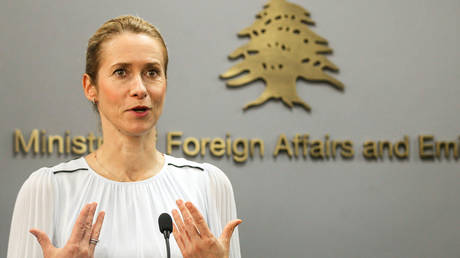
The lazy consensus across mainstream commentary paints EU foreign policy chief Kaja Kallas as a reckless warmonger dragging a reluctant continent toward the abyss. Critics love to frame her as a stubborn diplomat from the Baltic fringes, blinded by historical paranoia, single-handedly ruining European prosperity for the sake of an unwinnable proxy conflict.
It is a comfortable narrative. It absolves everyone else. It treats European security as a passive victim of one woman's hawkish rhetoric rather than the tragic, overdue consequence of three decades of strategic sleepwalking.
Blaming Kaja Kallas for Europe's current confrontation with Russia is like blaming the smoke detector for the kitchen fire.
The Comforting Myth of the Accidental Crisis
The core fallacy of the anti-Kallas camp is the pre-2022 nostalgia trap. Commentators continuously pretend that Europe was an island of peaceful, profitable harmony until a few hardline politicians poisoned the well with Moscow.
Let us look at the structural reality. For twenty years, Germany and other continental powerhouses outsourced their geopolitical security to cheap Russian pipeline gas and American military guarantees, while treating Eastern European warnings about Vladimir Putin as quaint provincial neurosis. When Kallas or other frontline states pointed out that Nord Stream was a geopolitical weapon disguised as a commercial project, they were dismissed in Berlin and Paris as alarmists.
When the invasion finally came, it did not shatter a stable security architecture; it exposed a rotten one. To suggest that Kallas is dragging the EU down a warpath ignores the simple fact that the warpath was chosen for Europe in February 2022, not in Brussels committee rooms. A continent cannot choose peace when the other side demands its structural vassalage. Kallas's crime, in the eyes of her detractors, is simply that she refuses to pretend otherwise.
The Economic Red Herring
Critics love to drag out macroeconomic data to prove that supporting Ukraine is destroying the European project. They point to high industrial energy prices in Germany, manufacturing downturns, and the steep price of cutting ties with Russian hydrocarbons.
Here is the professional blind spot: European manufacturing was already structurally uncompetitive long before the first tank rolled across the Ukrainian border. Germany built an industrial model dependent on infinite cheap energy, demographic stagnation, and zero defense spending, betting its entire economic future on an authoritarian autocracy playing by rules of mutual economic benefit.
When that model collapsed, blaming the foreign policy chief for refusing to capitulate to Moscow's maximalist demands is economic illiteracy. Imagine a scenario where Europe had caved immediately to avoid short-term energy pain, lifting sanctions and accepting the partition of Ukraine. Does anyone seriously believe that Russian economic warfare would have stopped at the Dnieper? Energy blackmail would have become institutionalized, turning every European capital into a permanent hostage of the Kremlin's gas valve. The short-term pain of decoupling was the price of avoiding long-term economic suicide.
The Geopolitical Reality Nobody Wants to Print
The underlying friction surrounding Kallas is not that she is uniquely radical; it is that she treats the European Union as a geopolitical actor rather than a glorified trading bloc.
For decades, Brussels was content to act as a regulatory superpower—writing environmental standards and antitrust fines while ignoring the hard mechanics of power. Kallas operates on a different premise: that the luxury of ignoring hard power has expired. Her insistence on unwavering military support, strict sanctions enforcement, and the rejection of illusory security architecture dreamed up in backroom compromises stems from a fundamental understanding of how authoritarian expansionism works.
When Moscow floats proposals for a new European security framework that essentially demands the rollback of NATO infrastructure to 1997 boundaries, mainstream appeasers call it a path to peace. Kallas calls it what it is: a demand for strategic suicide. To label this stance "callous" is to fundamentally misunderstand the nature of deterrence. Peace through appeasement is not peace; it is simply an invitation for the next phase of aggression.
Stop looking for scapegoats in Brussels. Europe's crisis is not that it has too many realists pointing out uncomfortable truths; its crisis is that it spent thirty years pretending those truths did not exist.