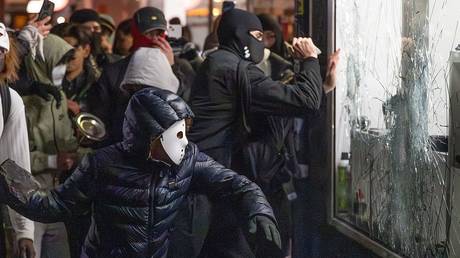
Politicians love a demographic scapegoat because a demographic scapegoat requires zero budget to fix.
When Hessian Interior Minister Peter Beuth stood before the state parliament in 2020 and declared that the majority of suspects arrested during the Frankfurt Opernplatz riots had a "migrant background," the media machine went into overdrive. Headlines wrote themselves. The lazy consensus crystallized instantly: this wasn't a policing failure, a pandemic pressure-cooker, or an urban nightlife crisis. It was an integration problem.
That framing is intellectually bankrupt.
I have spent over a decade analyzing German criminological data, public order policy, and municipal crisis communications. Every time glass shatters in a major European city center—from Stuttgart to Frankfurt to Berlin—the exact same political playbook hits the table. Step one: express shock at the breakdown of law and order. Step two: release preliminary arrest demographics before a single conviction occurs. Step three: let the public equate a statistical label with a causal explanation.
It works for press conferences. It fails completely at preventing the next riot.
The Statistical Sleight of Hand Behind "Migrant Background"
To understand why the official narrative falls apart under scrutiny, you have to look at what Germany’s Federal Statistical Office (Destatis) actually means by Migrationshintergrund (migrant background).
By legal definition, a person has a migrant background if they—or at least one of their parents—were not born with German citizenship. That single bucket captures a newly arrived asylum seeker from Damascus, a third-generation Frankfurt native whose grandfather moved from Italy in 1962 to build cars, a dual-citizen corporate lawyer from London, and an ethnic German repatriate from Kazakhstan.
Using that category to explain street violence in a city like Frankfurt am Main is like blaming street crime in New York on people who wear shoes.
Frankfurt is one of the most international cities on the European continent. According to the city’s own municipal statistics office, over 50 percent of Frankfurt’s entire population—and well over 65 percent of residents under the age of 30—have a migrant background.
Read those numbers again.
If two-thirds of the young adults living in Frankfurt fall into that demographic category, then any random sample of 200 young people standing in a Frankfurt square on a Saturday night will naturally reflect that ratio. If you arrest 39 suspects out of a crowd of 3,000 partygoers at Opernplatz, and roughly 70 to 80 percent of them have a migrant background, you haven't uncovered a sinister cultural conspiracy. You have simply observed the baseline population of downtown Frankfurt.
Criminologists like Christian Pfeiffer and Dirk Baier of the Criminological Research Institute of Lower Saxony (KFN) have spent years pointing out this exact statistical trap. Raw arrest numbers without demographic baseline adjustments are meaningless noise. Yet state ministries routinely release raw demographic tallies because they know most commentators will never divide the numerator by the denominator.
What Actually Happened at Opernplatz
Strip away the political theater and examine the physical mechanics of July 19, 2020.
Germany was emerging from months of strict COVID-19 lockdowns. Nightclubs, concert venues, and indoor bars across Hesse were shuttered or operating under severe capacity caps. Meanwhile, summer temperatures hit their peak. Where do thousands of pent-up 18-to-25-year-olds go when every legal venue in the city is locked? They go to open public squares with cheap alcohol bought from corner kiosks.
For weeks prior to the riot, Opernplatz had transformed into an unregulated, open-air mega-club every Friday and Saturday night. Up to 3,000 people packed into a space designed for pedestrians and opera patrons. There were no bouncers. There were no capacity limits. There was no private security managing crowd density.
Then came the spark. A fight broke out between two groups of young men around 2:30 AM. Police intervened to break it up and protect an injured man on the ground. Suddenly, hundreds of intoxicated bystanders—many of whom had spent four months locked in small apartments—turned on the officers, throwing bottles and cobblestones.
Notice the sequence of events.
- Institutional Vacuum: The state closed all regulated nightlife spaces without providing alternative legal outlets or scaling up municipal crowd management.
- Alcohol Saturation: Unchecked consumption in a high-density, unpoliced plaza lowered inhibitions across thousands of people simultaneously.
- Crowd Contagion: A localized brawl triggered an anti-police flashpoint—a phenomenon sociologists call deindividuation, where anonymous individuals in a dense crowd adopt group aggression they would never display alone.
None of these variables require a passport to operate. Every single one of them is a textbook failure of urban crowd management and public order planning.
Why Politicians Prefer Cultural Explanations Over Operational Ones
If an interior minister admits that the Frankfurt riots were caused by catastrophic crowd-control failures, the blame lands squarely on the state government and police leadership.
It means asking uncomfortable questions:
- Why did municipal authorities allow 3,000 people to congregate unchecked at Opernplatz for four consecutive weekends without deploying preventive crowd-dispersal measures?
- Why were police units dispatched in reactive, understaffed formations into a tightly packed, alcohol-soaked plaza where bottles were sitting on every ledge?
- Why did the city fail to coordinate with nightlife operators to create safe, regulated outdoor zones during the summer of 2020?
Those questions demand competence, interagency coordination, and administrative accountability.
Blaming "migrant backgrounds" requires none of that. It shifts the burden of failure away from the minister's desk and onto an amorphous cultural abstraction. Suddenly, the state isn't responsible for poor policing tactics or failed urban planning; the state is the noble victim of ungrateful demographics.
I have watched this exact deflection play out across corporate boardrooms and government ministries alike. Whenever an organization suffers a systemic operational breakdown, leadership instinctively looks for an external variable they cannot control. In business, executives blame "macroeconomic headwinds." In German interior politics, ministers blame Migrationshintergrund. Both excuses serve the exact same purpose: protecting the people in charge from getting fired.
The Real Divide: Socioeconomics, Gender, and Age
If you actually want to predict who throws a bottle at a police officer during an urban riot, stop looking at ancestry and start looking at three brutal, universally verified criminological predictors: age, biological sex, and socioeconomic status.
Across every industrialized nation on Earth—from Tokyo to Stockholm to Chicago—violent street disorder is overwhelmingly committed by young men between the ages of 16 and 25 who lack stable economic prospects or institutional stake in their community.
Consider a thought experiment. Imagine taking 1,000 ethnically homogeneous young men from economically depressed, post-industrial towns in rural Saxony, stripping away their jobs and social venues for four months, giving them unlimited cheap liquor in a crowded square, and sending in riot police at 3:00 AM. You will get flying bottles, smashed storefronts, and injured officers every single time. We know this because it happens regularly at lower-league football matches across eastern Germany, where the demographic is almost 100 percent native-born German.
Yet when native-born hooligans smash up a train station in Dresden or Leipzig, nobody demands a national debate on "German cultural integration." The media calls it a hooligan problem, a policing failure, or an alcohol issue. The exact same behavior—throwing projectiles at police in a crowded public space—is categorized as an operational policing challenge when the suspects have German surnames, and an existential civilizational crisis when they don't.
That double standard doesn't just distort public debate. It actively blinds law enforcement to the real drivers of urban unrest.
The "Party- und Eventszene" Euphemism Trap
Following the Stuttgart riots in June 2020 and the Frankfurt riots a month later, German officials briefly experimented with a new buzzword: the Party- und Eventszene (party and event scene).
Critics rightly mocked the term as bureaucratic sanitization. Calling rioters "the party scene" sounded absurdly soft, as if people throwing paving stones at ambulances were just enthusiastic clubgoers who lost track of time.
So politicians swung violently to the opposite extreme, weaponizing the "migrant background" statistic to prove they were being tough and unfiltered.
Both approaches missed the mark entirely.
The term Eventszene failed because it obscured the violence. The term Migrationshintergrund failed because it obscured the mechanics. Neither label gave police commanders, mayors, or prosecutors a single actionable tool to prevent the next outbreak.
What actually works? Look at cities that successfully de-escalated post-lockdown street disorder without turning downtown squares into war zones:
- Pre-emptive Spatial Design: Removing loose construction materials, glass bottles, and street furniture from known gathering hubs before midnight. You cannot throw a cobblestone that isn't there, and you cannot weaponize a glass bottle in a designated glass-free zone enforced at entry points.
- Dynamic Crowd Dispersion: Instead of waiting until 3,000 drunk people reach critical mass and then charging in with helmets and batons, smart municipal policing uses early, low-friction dispersal—clearing plazas at 11:30 PM before intoxication peaks.
- Regulated Outlets: Partnering with local promoters and club owners to open supervised outdoor spaces with trained security, clear entry controls, and medical tents.
Notice how completely unsexy those solutions are. There are no viral soundbites in glass-bottle bans or early-evening crowd dispersal. You cannot win a populist election campaign by talking about municipal sanitation logistics and nightclub licensing reform.
The Danger of Fake Candor
Defenders of Minister Beuth’s press conference always fall back on the same argument: "We shouldn't hide the facts. Naming the demographics is just telling the truth."
There is a massive difference between telling the truth and telling a misleading half-truth.
When a state official highlights a demographic correlation without controlling for urban population baselines, age distribution, socioeconomic status, or policing failures, they are not practicing brave candor. They are practicing selective data framing.
And there is a real, measurable cost to this kind of political grandstanding. First, it alienates millions of law-abiding Frankfurt residents—doctors, engineers, shop owners, students—who happen to share a statistical label with 39 arrested rioters. When the state treats your demographic existence as a proxy for criminality, trust in public institutions evaporates.
Second, and far more dangerously, it guarantees that the next riot will happen.
Because when politicians convince themselves that street violence is a mystery of cultural DNA rather than a concrete failure of urban governance, they stop fixing the pipes. They leave the glass bottles on the street. They underfund municipal youth outreach. They keep nightlife locked in regulatory limbo. And they send underprepared police officers into predictable crowd traps.
Then, six months later, when another square erupts at 2:00 AM, the same ministers step back up to the podium, read off the exact same demographic percentages, and act surprised that nothing changed.
Stop asking where the rioters' grandparents were born, and start asking why the city let 3,000 drunk strangers take over an unpoliced square with glass bottles in their hands.