The dirt on the South Lawn is dry. It smells of dust, gasoline, and power-washed stone. For decades, this specific patch of grass was treated like a secular cathedral, manicured to a golf-green perfection so Marine One could land without kicking up loose debris. Every spring, thousands of children would roll dyed hard-boiled eggs across its blades while their parents snapped pictures against the backdrop of the Truman Balcony.
That grass is gone.
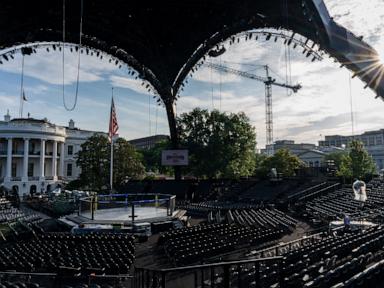
In its place is a massive excavation of earth, flattened to support thousands of gray metal folding chairs, rising in tiered stands toward the sky. Walk closer, past the security perimeter where the National Park Service is currently defending a furious federal lawsuit, and the shape of the modern presidency becomes literal. It is an eight-sided cage. Thirty feet in diameter. Wire mesh. Standard MMA regulation, except the logos stamped onto the padded corners include prediction markets and multinational corporate brands, all sitting squarely in the shadow of the Washington Monument.
Donald Trump is turning 80 years old.
To understand the sheer weight of what is happening on Pennsylvania Avenue, one must look up. Hovering ninety feet above the dirt is a four-sided steel monolith known simply to the construction crews as The Claw. It resembles the mechanical grabber from a seaside arcade game, heavy with miles of thick, serpentine wiring, massive speakers, and four colossal video screens. On Sunday night, as the humid Washington summer threatens thunderstorms, The Claw will ignite. It will project a swirling pattern of red, white, and blue across the sky, casting a neon glare directly into the Oval Office.
A hypothetical visitor from any other era of American history would assume the government had fallen. They would see the heavy cranes moving pieces for a separate $400 million permanent ballroom nearby and assume a monarchy was being carved out of the Potomac mud. But for those who have watched the steady convergence of American populism, combat sports, and the reality-television era, the cage on the lawn feels less like an invasion and more like an inevitability.
Politics has always been a blood sport. Now, the blood is real.
Consider the physical reality of the space. The yellow patio umbrellas and wrought-iron tables have been cleared from the Rose Garden. Crews spent the week power-washing the colonnade where heads of state once held hushed, polite press conferences. They were cleaning away the grime to make way for two world championship fights.
On one side of the ledger, the event is framed as "Freedom 250," a celebration marking a quarter-millennium since the signing of the Declaration of Independence. On the other side, it is an eighty-year-old man’s ultimate birthday party, a sixty-million-dollar spectacle funded by corporate allies and broadcast rights, requiring the mobilization of seven federal agencies, including the Department of Homeland Security and the Federal Aviation Administration.
The juxtaposition is jarring, perhaps even sickening, depending on your view of the office. John Quincy Adams used to shed his clothes and take solitary, freezing swims in the Potomac to clear his mind. Abraham Lincoln wrestled in his youth, a frontier brawler who used his physical stature to command respect long before he took the oath. Theodore Roosevelt built a tennis court on these very grounds because his family worried he was working himself into an early grave; he needed to sweat to stay sane. Later, Herbert Hoover’s doctor invented "Hoover-ball"—a brutal game involving a six-pound medicine ball thrown over a net—to keep the executive branch from getting soft.
Those pastimes were private. They were exercises in personal discipline or quiet recreation, hidden behind the hedges.
This is different. This is an arena built for four thousand screaming VIPs, supplemented by a secondary lottery crowd of over one hundred thousand people gathered on the nearby Ellipse just to watch the simulcast on towering screens. The fighters will walk through curtained tunnels running out of the West Wing driveway itself, their bare feet stepping onto the same asphalt where cabinet secretaries park their sedans.
There is a strange, vulnerable honesty to it all. For years, the American public has harbored deep doubts about the true nature of Washington. We suspect that behind the tailored suits, the prepared statements, and the polite handshakes lies a savage, no-holds-barred struggle for survival. We watch politicians tear into each other on cable news, trading rhetorical blows that mimic the theatricality of professional wrestling.
Trump simply stopped pretending.
He has always gravitated toward the cage. He was the first sitting president to sit ringside at a UFC event back in 2019, watching a match that was eventually stopped because one fighter’s face was pouring too much blood to continue. He recognized something in that cage that mirrored his own worldview: a universe stripped of nuance, where there are only winners, losers, and those who tap out. It is a philosophy that helped him secure a second term in 2024, leaning heavily on a demographic of young, cynical, politically unengaged voters who view traditional governance as a scam but understand the raw clarity of a fistfight.
Now, that philosophy has a permanent address. Or at least, a semi-permanent one.
The president has already mused publicly that the structure shouldn't be taken down. He compared it to the Eiffel Tower—a temporary eyesore built for the 1889 World’s Fair that became so iconic the city of Paris couldn't bear to dismantle it. It is a classic piece of branding, reframing a disruptive steel cage as an architectural marvel for the ages.
Whether the National Park Service loses its court battle or the local residents succeed in their protests matters very little now. The stakes have already shifted. The dirt is exposed. The wire mesh is locked into place.
On Sunday at eight o'clock, the heat index will hover in the muggy, oppressive zone typical of a Washington June. The sky will darken, and the first notes of walkout music will thud through the columns of the executive mansion. Fighters like Alex Pereira and Justin Gaethje will step onto the canvas, competing for titles while a president celebrates eight decades of life from a covered, protected viewing area just steps from his bedroom.
As the spotlights swirl and the rain begins to fall, the audience will look past the fighters’ straining bodies. They will see the white columns of the residence illuminated by the glare of the digital screens. They will see sweat and fluid spray against the wire fencing, backlit by the American flag pattern looping on The Claw.
The grass can always be resodded. Soil can be raked, seed can be scattered, and the green can be coaxed back out of the earth by next spring. But some changes aren't cosmetic. Once you invite the world to watch a fistfight in your backyard, the backyard ceases to be a lawn. It becomes an undercard.