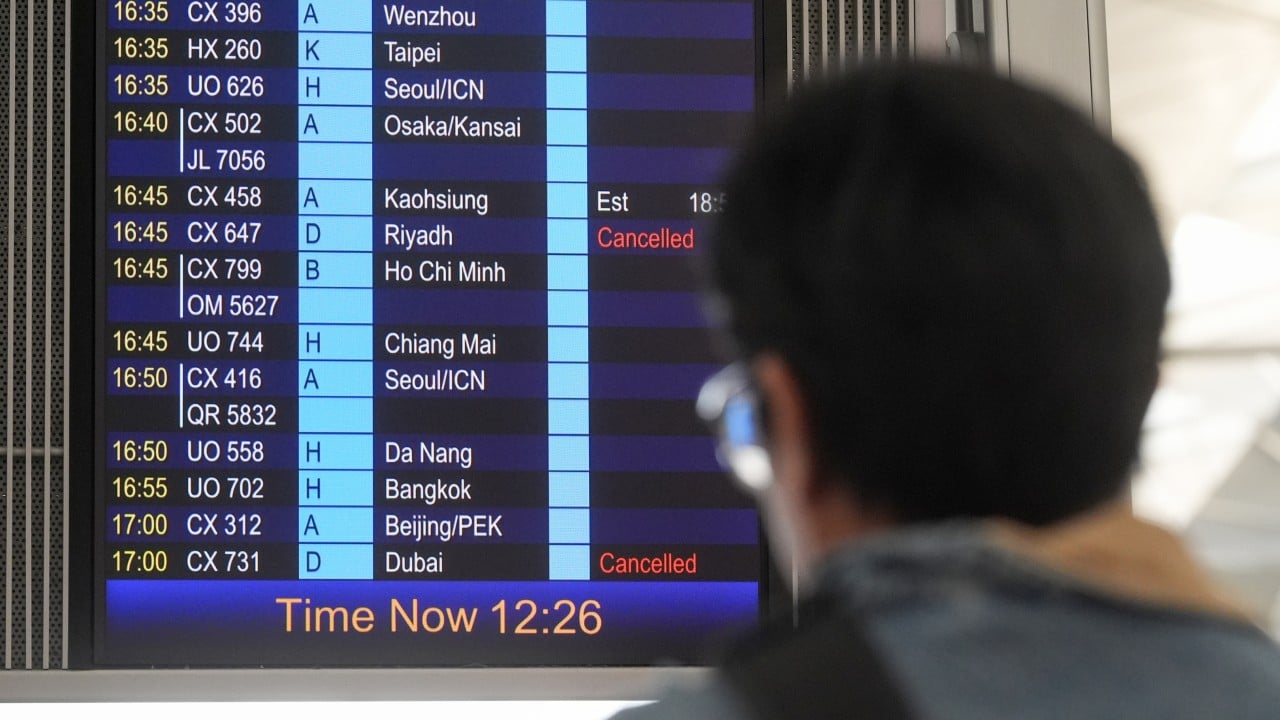
The air inside Dubai International Airport doesn't feel like the desert. It smells of expensive oud, pressurized oxygen, and the faint, metallic tang of industrial cooling. It is a climate-controlled cathedral of movement. But when the flight boards start bleeding red, that manufactured serenity shatters.
A flight board is a heartbeat. When it pulses with "Delayed" or "Cancelled" across forty rows of text, the pulse of the city stops.
Imagine a traveler named Elias. He is not a statistic, though the news reports will eventually group him into a "mass of stranded passengers." Elias is sitting on his carry-on bag near a terminal pillar because the lounge chairs were claimed six hours ago. He has a wedding in London to attend, a suit pressed in a plastic bag that is slowly wrinkling, and a smartphone battery hovering at 12%.
For Elias, and thousands like him, the geopolitical tensions of the Middle East aren't abstract maps on a news broadcast. They are the physical wall between him and his life. When airspace closes, the world doesn't just get smaller. It stops.
The Invisible Architecture of the Sky
We take the sky for granted. We view it as a vast, empty vacuum where planes move in straight lines from point A to point B. The reality is far more fragile. The sky is carved into invisible corridors, a complex three-dimensional highway system governed by treaties, safety protocols, and the shifting whims of international relations.
When a missile is launched or a drone enters a restricted zone, those highways disappear.
Consider the geography. The Gulf serves as the world’s transit hub—the "super-connector." If you are flying from Sydney to New York, or Delhi to Paris, there is a high statistical probability you will touch down in the sand. When the corridor over Iran or Iraq becomes a "no-go" zone, the ripple effect is violent. It’s not just about one canceled flight. It’s about the displacement of the giant metal birds themselves.
A Boeing 777 stuck on a tarmac in Doha is a 300-ton paperweight. It cannot be where it needs to be for its next leg. The crew times out. Their legal working hours expire. The catering goes cold. The fuel math changes.
The Calculus of the Long Way Around
Airlines are currently playing a high-stakes game of Tetris with the planet’s surface. When traditional routes over the Levant or the Persian Gulf are deemed too risky, pilots have to go "the long way."
This isn't a minor detour. Taking the scenic route around a conflict zone can add three, four, or five hours to a journey. For a flight already pushing fourteen hours, this creates a logistical nightmare.
- Fuel weight: You need more fuel to fly longer. But fuel has weight. To carry more fuel, you might have to leave fifty passengers—and their luggage—behind on the tarmac.
- Tankering: Some airlines "tanker" fuel, carrying enough for the return trip so they don't have to buy expensive or scarce fuel at a disrupted destination. This adds even more weight, making the plane less efficient and harder to maneuver.
- The Pilot's Burden: Flying through or around a zone of tension requires a different kind of focus. You aren't just watching the autopilot; you are listening to frantic radio chatter and monitoring "NOTAMs"—Notices to Air Missions—that can change while you are at 35,000 feet.
Elias, sitting on his suitcase, doesn't see the fuel math. He sees his bank account draining as he buys a $9 sandwich. He sees the "Sold Out" signs on every hotel within thirty miles of the airport. He feels the crushing weight of being "in-between."
The Human Cost of Dislocation
There is a specific kind of exhaustion that only exists in an airport terminal during a crisis. It is a mixture of boredom and adrenaline. You cannot sleep because you might miss an announcement, but you cannot do anything productive because your mind is looping on the same question: How do I get out?
We spoke to families who spent forty-eight hours sleeping on yoga mats provided by ground staff. They spoke of the "information vacuum." In the age of instant connectivity, the most agonizing part of being stranded isn't the lack of a bed—it’s the lack of the truth.
Airlines, wary of liability and the fluid nature of military actions, often remain silent. A "Technical Issue" is the standard euphemism. But everyone looking at their phones knows the truth. They see the headlines. They see the maps. The silence from the gate agents only fuels the anxiety.
It is a breakdown of the social contract of travel. You give an airline money; they give you a different coordinate on the map. When that contract breaks, the vulnerability of the modern human is exposed. We are entirely dependent on these aluminum tubes and the political stability of people we will never meet.
Seeking the Alternative Route
When the sky fails, people look to the ground. But in the Middle East, the ground is rarely an option for the casual traveler. You cannot simply rent a car and drive across certain borders. The geography of the region is a series of hard stops.
Some travelers have attempted to pivot to sea routes, or long-winded bus journeys through neighboring countries that remain stable. But these are desperate measures. They are expensive, slow, and often carry their own set of bureaucratic hurdles.
The real "route out" for most is a digital one. It is the frantic refreshing of a booking app at 3:00 AM, hoping a seat opens up on a flight heading the opposite direction—back home, or to a neutral third country like Cyprus or Turkey.
The Fragility of the Super-Hub
For decades, the business model of the Gulf has been built on being the world's crossroads. Dubai, Doha, and Abu Dhabi have transformed themselves into the shimmering centers of global movement. They are the nodes where East meets West.
But this model has a glass chin.
The current tensions have exposed how quickly a "hub" can become a "bottle-neck." If the crossroads are blocked, the traffic doesn't just slow down; it piles up until the system collapses. The economic stakes are staggering. We aren't just talking about lost ticket revenue. We are talking about the disruption of global supply chains. The belly of those passenger planes is often full of high-value cargo: medicine, electronics, and perishables.
When Elias’s flight is canceled, a pharmacy in London might not get its shipment of insulin. A factory in Germany might stop because a specific sensor is sitting in a cargo hold in the heat of the desert.
The Ghost in the Machine
The tech we use to navigate these crises—the apps, the rebooking algorithms, the AI chatbots—often fails when we need it most. An algorithm cannot empathize with a mother whose toddler has run out of diapers. It cannot understand the urgency of a funeral or a once-in-a-lifetime job interview.
During these surges of cancellations, rebooking systems often crash. The "Wait time: 4 hours" message on a customer service line is a psychological torture device.
The only thing that actually works in these moments is human intervention. The gate agent who stays past her shift to find one last seat. The stranger who shares their power bank. The local who offers a couch to a family they’ve never met.
The tension in the Gulf will eventually ebb. The red text on the boards will turn back to green. Elias will eventually make it to London, though he will miss the ceremony and arrive only for the tail end of the reception, his suit a map of wrinkles, his eyes bloodshot.
But the memory of the "In-Between" remains. It is a reminder that our global, interconnected life is a miracle of logistics held together by the thin thread of peace. We move across the world with the arrogance of gods, forgetting that we are ultimately at the mercy of the map.
Elias looks out the floor-to-ceiling windows at the rows of grounded jets. They look like sleeping giants, silver and silent under the desert stars. He realizes then that he isn't just waiting for a plane. He is waiting for the world to make sense again. Until then, he is just another soul in the oud-scented purgatory of Gate B24, watching the blue light of his phone fade to black.