Silence.
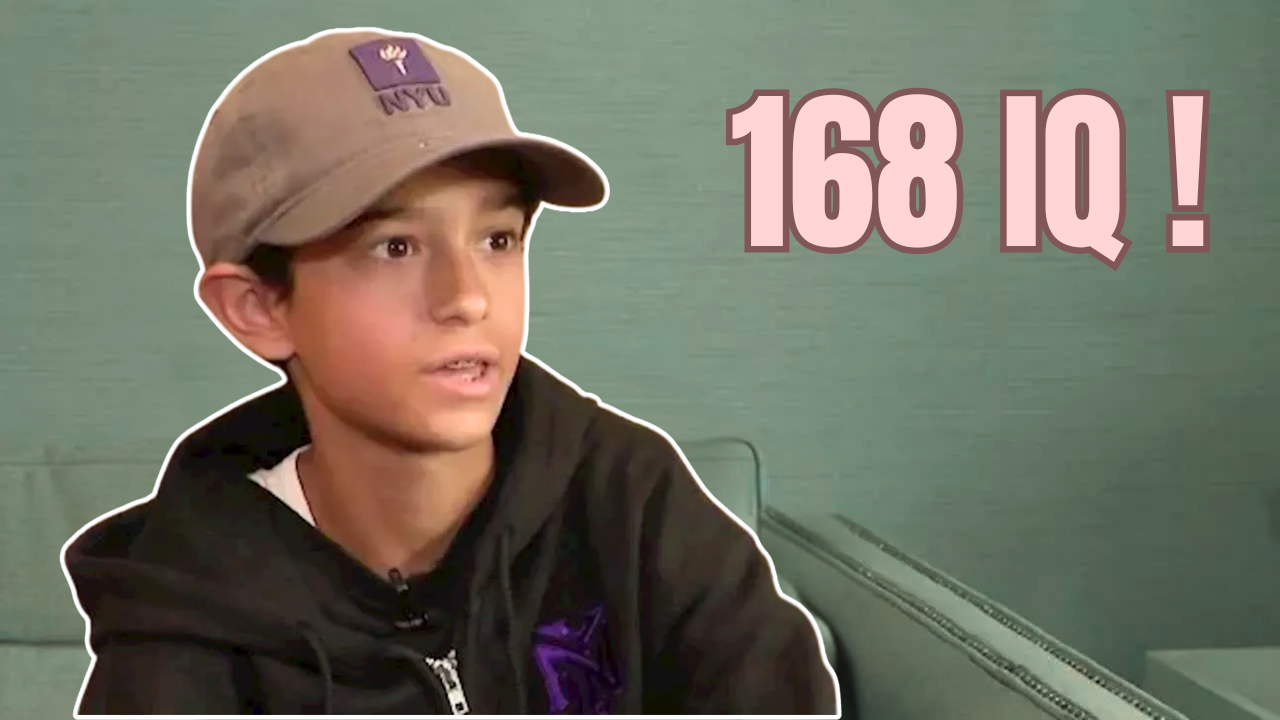
That is what a room usually offers when a number like one hundred and sixty-eight enters the conversation. It is a figure that sounds less like a score and more like a coordinate pointing toward some distant, uncharted star. In the standard timeline of human development, a person does not typically encounter the architecture of a university master's program until they have spent more than three decades walking the earth. Thirty-three is the average. Thirty-three brings bills, mortgages, coffee-stained desks, and the slow accumulation of worldly fatigue. For a different look, consider: this related article.
Thirteen does not.
Thirteen smells like old sneakers, unsharpened pencils, and the faint, persistent anxiety of adolescence. Yet, somewhere between the ordinary geometry of a Long Island bedroom and the sprawling academic machinery of New York University, a teenager named Joe Petraro-Hyppolite has chosen to shatter every conventional clock we possess. Further analysis regarding this has been published by Al Jazeera.
When people hear his story, they immediately reach for the comfort of fiction. They whisper about television characters, drawing neat, tidy lines to fictional prodigies who solve complex equations on classroom chalkboards before the bell rings. It is an easy trap. Human beings crave narratives that fit inside neat little boxes. We want our exceptions to be neatly packaged anomalies who arrived on this planet fully formed, untouched by struggle, operating with the cold perfection of a machine.
The truth is infinitely messier. And infinitely more human.
Before the university acceptance letters arrived, before the media microphones were pushed into his face, before the world decided to slap the heavy, blinding label of genius onto his shoulders, Joe’s life looked entirely different. It looked terrifying.
Consider what happens when a mind operates at a velocity that the surrounding environment refuses to accommodate. Long before he was dazzling professors, he was a young child struggling to bridge the gap between internal thought and external speech. There were physical tics. There were communication barriers that made the simple act of navigating a standard classroom feel like trying to run underwater through wet cement. The educational system, built for the comfortable middle of the bell curve, did not know what to do with him. So, it did what institutional systems often do when faced with the unfamiliar: it placed him in special education.
In those rooms, the world narrowed. Children can be merciless mirrors, reflecting back our differences with sharp, unyielding edges. Joe faced relentless bullying. Not just for his intellect, which flickered like a stray current in a house wired for dim bulbs, but for the visible manifestations of Tourette syndrome that rattled his physical frame. The weight became suffocating. There was a dark, hollow period—a suicide attempt that stands as a stark reminder of the invisible agony carried by young people whose brains outrun their emotional safety nets.
And then, as if the universe had decided to test the structural integrity of his spirit to its absolute breaking point, cancer entered the frame.
Leukemia.
In September of 2021, while most children his age were worrying about middle school social dynamics or video game scores, Joe was facing chemotherapy. He wore the universal uniform of the hospital ward: a shaved head, pale skin, and an IV pole rattling beside a sterile bed. During those months, the absurdity of his situation reached its peak. He would sit in treatment rooms, intentionally failing tests and spelling words incorrectly just to blend into the wallpaper, only to return home and devour complex texts on coding and advanced mathematics. It was a quiet rebellion. A child hiding his own brilliance because standing out had already brought him too much pain.
How does a person survive that kind of collision? How do you rebuild a shattered timeline after cancer, bullying, and systemic misunderstanding have tried to erase your confidence?
You change the room.
A turning point arrived in third grade when an observant teacher looked past the tics, past the diagnostic labels of dyslexia and obsessive-compulsive disorder, and saw the engine humming beneath the hood. Evaluations followed. The numbers emerged from the fog: an IQ score of one hundred and sixty-eight. A score of one thousand five hundred and ninety on the SAT, achieved when he was just ten years old. A high finished diploma secured at eleven.
Yet, numbers are cold things. They do not capture the sound of a mother’s voice breaking when she describes her son’s trajectory as surreal. Anne Petraro-Hyppolite watched her child endure the crucible of illness and isolation only to emerge with an insatiable hunger to understand how the universe is put together. When they pulled him out of the rigid environments that sought to flatten his edges and placed him into a self-paced learning model, the transformation was seismic.
He didn't just catch up. He left the horizon behind.
Enrolling remotely at Louisiana State University, Joe began chipping away at his undergraduate degree while still navigating the awkward middle ground of being a child in an adult’s intellectual arena. When he sits in virtual lectures or interacts with peers, the reactions are almost always the same. A double glance. A momentary suspension of disbelief. Wait, what?
Older students look at him and try to reconcile the physical reality of a thirteen-year-old boy with the sophistication of the papers he submits. But Joe is remarkably grounded about the mechanics of his own mind. When interviewers ask him about being a genius, he offers a dry, self-aware smile.
"I am not biased, but, yeah, if you say so," he replies.
He actively dismantles the myth of effortless grace. People assume that high intelligence means information simply downloads into the brain like an automatic software update. Joe is quick to correct that misconception. He speaks about the labor of learning with the pragmatic fatigue of a seasoned scholar.
"It's not like I was shot out the womb knowing everything I know," he says. "I have to learn it once or twice. Then I'll know."
That distinction matters. It separates the human reality from the myth of the superhero. Joe does not possess magic; he possesses velocity and retention. He is a sponge dropped into an ocean of data, absorbing kinesiology, biology, and sports management with a voracious appetite. His undergraduate studies at Louisiana State University are set to wrap up in May, clearing the runway for his next massive leap: entering a master’s program at New York University before he is legally old enough to sit behind the wheel of an automobile on the highway.
Think about that logistical absurdity for a moment. He will graduate with a master’s degree around the exact chronological milestone where most teenagers are stressing over driver's ed tests and prom proposals.
And yet, beneath the academic accolades and the staggering metrics, there are moments where the teenage boy breaks through the surface of the prodigy. He volunteers at a local nursing home in the Five Towns area of Long Island, sitting with elderly residents, trading stories, anchoring himself in human connection that has nothing to do with differential equations or GPA benchmarks. He talks about a future far beyond the corporate boardrooms or sports management offices—he dreams of paleontology, of digging into the ancient, silent earth to unearth bones that have been sleeping for millions of years.
There is a profound poetry in that desire. A boy who has survived disease, neurological hurdles, and the cruelties of social alienation wants to spend his life listening to the stories told by the dead.
When asked if he feels nervous about stepping into the massive, echoing halls of NYU graduate classes, he does not pretend to be fearless. He admits to the butterflies in his stomach, acknowledging that fear is simply the price of admission for walking through a new door.
"Yeah, I mean, who wouldn't be?" he asks.
That is the truest thing he has said. Beneath the 168 IQ, beneath the SAT records, beneath the early diplomas and the university transitions, there is still a kid standing at the edge of a vast, intimidating room, taking a deep breath, and deciding to step inside anyway. He is racing against a clock of his own creation, yet his heart beats with the exact same vulnerable, resilient rhythm as anyone else trying to find their place in a confusing world.
The master’s lectures will start soon. The lecture halls will fill with adults twice his age. And Joe Petraro-Hyppolite will open his notebook, ready to learn it once or twice, until he knows.