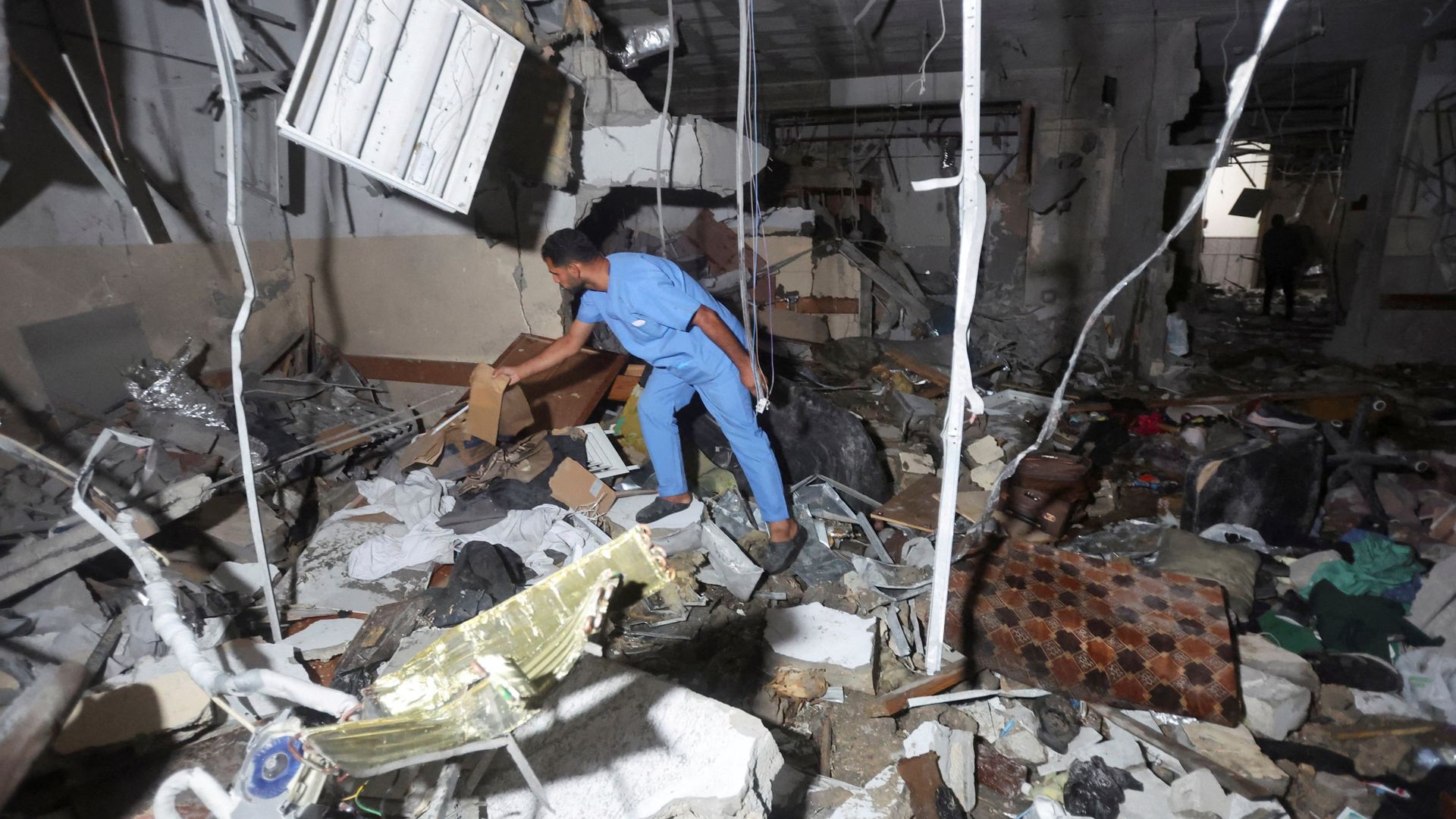
The headline arrives within minutes of the explosion: a strike hits a hospital compound in Gaza, casualties are reported by local health authorities, and the global media cycle locks into a familiar, binary script. One side reports a direct hit on a protected medical facility; the other states it targeted militant infrastructure operating inside or adjacent to civilian zones.
Both narratives rely on immediate, unverified shorthand. Both miss the complex legal, technical, and operational mechanics that govern modern urban warfare and conflict reporting.
When newsrooms rush to publish casualty figures and initial blame under the pressure of real-time digital publishing, they flatten a multifaceted crisis into a single, easily digestible—and often incomplete—frame. Understanding what actually happens when military operations intersect with medical infrastructure requires stepping back from the breaking-news ticker and examining international humanitarian law, intelligence verification, and the structural limitations of wartime journalism.
The Verification Trap in Modern Conflict Reporting
In active war zones, independent journalists rarely have immediate physical access to the site of a strike. In Gaza, strict entry restrictions and severe security risks mean international outlets rely heavily on local stringers, eyewitness accounts, hospital administrators, and statements from the Gaza Health Ministry—which operates under the Hamas-run government—alongside briefings from the Israel Defense Forces (IDF).
According to journalism standards organizations like the Reuters Institute and the Committee to Protect Journalists, attributing claims accurately is the baseline requirement when independent verification is impossible. Yet attribution often gets lost in headline compression. Saying "health ministry says" in a subhead does not cure the reader's impression of established fact when the accompanying analysis treats initial casualty numbers or point-of-origin claims as definitive.
Consider how early reporting unfolds after an incident at a medical facility:
- Immediate Casualty Reports: Hospital directors and health ministry officials release preliminary death and injury tolls within hours. While these figures reflect the chaotic reality inside overwhelmed emergency rooms, they rarely distinguish between combatants and non-combatants, nor do they separate direct blast victims from those injured in secondary explosions or structural collapses.
- Military Counter-Claims: The IDF routinely responds hours later, asserting that strikes targeted command-and-control nodes, weapons caches, or militants embedded within hospital complexes. These statements are frequently accompanied by aerial surveillance footage or intercepted communications, which independent analysts cannot immediately authenticate.
- The Missing Middle: Between the initial casualty announcement and the military rebuttal sits a vacuum of forensic evidence. Munitions fragments, crater analysis, and satellite imagery take days or weeks for organizations like Human Rights Watch, Amnesty International, or independent open-source intelligence (OSINT) researchers to evaluate.
By the time forensic clarity emerges, public opinion has already calcified around the first headline.
How International Humanitarian Law Actually Treats Hospitals
A widespread misconception in public debate is that hospitals enjoy absolute, unconditional immunity under international law regardless of how they are used. The Geneva Conventions establish a far more specific, conditional framework.
Under Article 18 of the Fourth Geneva Convention and Article 12 of Additional Protocol I, civilian hospitals are strictly protected objects and may not be the target of attack. However, Article 19 of the Fourth Geneva Convention explicitly outlines when that protection ceases: if a medical facility is used to commit, outside its humanitarian duties, "acts harmful to the enemy."
Legal scholars at the International Committee of the Red Cross (ICRC) emphasize that even when a hospital loses its protected status due to military use, attacking forces are not granted a blank check. Three strict legal obligations remain in force:
- Duty to Warn: Protection may cease only after a due warning has been given, naming a reasonable time limit, and after such warning has gone unheeded.
- Proportionality: Under customary international humanitarian law, an attack is unlawful if the expected incidental loss of civilian life or damage to civilian objects would be excessive in relation to the concrete and direct military advantage anticipated.
- Precaution in Attack: Parties to a conflict must take all feasible precautions in the choice of means and methods of attack to avoid, and in any event to minimize, incidental loss of civilian life.
When news articles report on a hospital strike without explaining these interlocking legal thresholds—warning, proportionality, and precaution—they leave readers with the false impression that the legal analysis begins and ends with the building's designation as a hospital.
The Operational Reality of Dense Urban Battlespaces
Understanding the friction between military objectives and civilian protection requires examining the physical geography of Gaza. With over two million people living in roughly 141 square miles, Gaza is one of the most densely populated urban environments in the world.
Military analysts at institutions such as the Modern War Institute at West Point have documented how dense urban terrain alters the mechanics of armed conflict. In open terrain, military infrastructure is separated from civilian centers. In dense cities, subterranean tunnel networks, residential high-rises, schools, and medical complexes exist within meters of one another.
This proximity creates two simultaneous, compounding dynamics:
- Asymmetric Entrenchment: Armed groups operating against a technologically superior military frequently utilize civilian infrastructure for cover, logistics, and staging, knowing that international scrutiny constrains conventional military strikes near sensitive sites.
- Collateral Risk of Precision Munitions: Even when militaries deploy precision-guided munitions designed to strike specific rooms or courtyard structures, the blast radius, fragmentation, and potential secondary detonation of stored munitions pose severe risks to adjacent wards filled with patients, medical staff, and displaced civilians sheltering on hospital grounds.
A strike on a courtyard tent encampment or an administrative wing inside a hospital perimeter is operationally distinct from leveling a main surgical building, yet broad headlines often collapse these distinctions into a single phrase: "strike on hospital."
Evaluating Competing Information Streams
For readers trying to separate verified facts from strategic messaging, consuming breaking conflict news requires an analytical filter. Both state militaries and non-state actors view information operations as an extension of the battlefield.
| Information Source | Primary Value | Inherent Limitation |
|---|---|---|
| Gaza Health Ministry | Direct access to hospital intake logs, morgue records, and immediate emergency room conditions. | Operates under Hamas governance; does not differentiate between civilian and militant casualties; initial counts fluctuate during mass-casualty events. |
| Israel Defense Forces (IDF) | Access to targeting intelligence, drone feeds, munitions data, and operational objectives. | Party to the conflict with strategic incentives to justify strikes; underlying raw intelligence is rarely released in full for independent audit. |
| UN Agencies & NGOs (WHO, MSF) | On-the-ground eyewitness testimony from international medical staff and logistics personnel regarding facility conditions. | Presence is often restricted to specific wards; staff generally lack forensic expertise to determine munition types or trajectories. |
| OSINT & Forensic Investigators | Geolocated video analysis, satellite imagery comparison, and munition fragment identification. | Requires days or weeks to process; limited by the availability and quality of user-generated footage from the scene. |
Relying exclusively on any single row in this matrix guarantees a distorted picture. Accurate assessment requires cross-referencing immediate eyewitness accounts from medical staff with delayed satellite imagery and forensic munitions analysis.
How to Read Conflict Headlines Without Getting Played
When the next breaking alert hits your screen regarding an airstrike near a protected facility, apply a disciplined verification checklist before drawing conclusions about legality or intent:
- Separate the "What" from the "Why": Treat physical damage and immediate medical casualties reported by on-site doctors as high-confidence facts, while treating initial claims regarding the intended target or munition origin as provisional until corroborated by physical evidence.
- Check the Exact Point of Impact: Look beyond the headline to see whether the strike hit the main clinical building, an adjacent courtyard, an ambulance convoy, or a neighboring residential block. International humanitarian law evaluates these locations differently depending on their proximity and functional relationship to medical care.
- Look for Verification Language: Pay attention to whether major wire services (such as Reuters or the Associated Press) use phrases like "could not independently verify." That phrase is not boilerplate filler; it is an explicit signal that the reporting relies entirely on assertions from parties to the conflict.
- Wait 72 Hours for Forensic Updates: Early casualty numbers are frequently revised upward or downward as rubble is cleared and duplicate hospital entries are reconciled. Similarly, satellite imagery from commercial providers like Maxar or Planet Labs typically surfaces two to three days after an incident, offering an objective view of structural damage.
Breaking news rewards speed, not precision. Real clarity only begins when the initial headlines stop trending and the forensic record starts to speak.