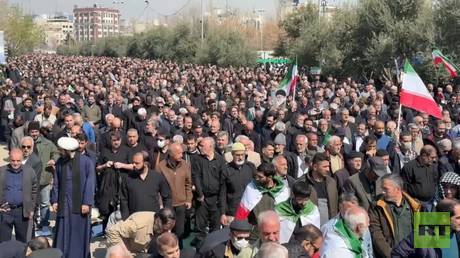
The scent of rosewater usually wins. In the narrow alleys leading toward the Tehran University campus, it drifts from the stalls, momentarily masking the sharp, metallic tang of exhaust fumes and the smell of toasted sangak bread. But today, the air carries something heavier. It is the scent of a city holding its breath.
Friday in Tehran is rarely quiet, but this particular Friday carries a weight that the scales of history will be measuring for decades. It is the first time the faithful have gathered for communal prayer since the shadow of a direct, open conflict between the United States, Israel, and Iran shifted from a theoretical nightmare to a daily reality.
The carpeted ground of the prayer space is a sea of bent backs and bowed heads. To an outsider, it looks like a monolith. To those standing in the rows, it is a collection of individual anxieties woven into a single, massive tapestry of defiance.
The Geometry of Prayer
Consider a man named Hassan. He is not a political strategist or a high-ranking official. He is a grandfather whose joints ache when the dampness of the early spring air hits the concrete. He has lived through the 1979 Revolution. He has lived through the grueling eight-year war with Iraq. He has seen the currency tumble and the sanctions tighten like a garrote.
When Hassan presses his forehead to the mohr—the small clay tablet used during prayer—he isn't thinking about geopolitical leverage or enrichment percentages. He is thinking about his daughter’s pharmacy in Isfahan, which is running low on imported insulin. He is thinking about the sonic booms that rattled his windows three nights ago.
His story is the story of millions.
The "Friday Prayer" in the Islamic Republic has never been just a religious obligation. It is the beating heart of the state’s communication network. It is where the "General of the Word" delivers the sermon that sets the tone for the week's domestic and foreign policy. But today, the rhetoric has reached a fever pitch. The loudspeakers crackle with the weight of it.
The facts of the conflict are well-documented by the news tickers. Missiles have been traded. Red lines have been crossed, erased, and redrawn in blood. The United States has surged carrier groups into the Mediterranean, and the Israeli cabinet remains in a perpetual state of high-alert session. These are the "cold facts." They are the data points of a spreadsheet.
The reality, however, is the tremor in the hand of the woman sitting in the back row, clutching a photo of her son who is currently stationed near the border.
The Language of the Street
Walking through the crowd, you hear a linguistic dance. There is the official language—the slogans of "Death to America" and "Death to Israel"—which roar with a practiced, rhythmic intensity. These are the expected beats of the ceremony. They are the armor.
But beneath that armor, the private conversations are different. They are conducted in hushed tones, centered on the price of meat, the possibility of the internet being cut off, and the terrifying math of modern warfare.
"Do you think they will hit the refineries?" one young man asks his friend, his voice barely audible over the chanting.
"If they do, we won't have bread by Tuesday," the friend replies.
This is the invisible stake. While analysts in Washington and Tel Aviv debate the "proportionality" of a strike, the people in the prayer rows are calculating the shelf life of flour. They are the ones who will inhabit the "collateral damage" statistics that the world will read about over morning coffee.
The disconnect between the geopolitical chess move and the human square on the board is vast. When a missile is launched, it is an engineering feat. When it lands, it is a shattered kitchen.
The Ritual as a Shield
There is a specific psychological phenomenon that happens in moments of existential threat. We flock to the familiar. For some, it is the community of the mosque. For others, it is the stubborn insistence on keeping their shops open even when the sirens are tested.
The gathering this Friday serves a dual purpose. For the state, it is a projection of strength—a visual proof that the population remains mobilized and unbowed. The cameras pan across the thousands of faces, capturing the optics of unity that are then beamed to every capital city on the globe.
For the people, however, the ritual is a way to process the unthinkable. When you stand shoulder-to-shoulder with five thousand strangers, the individual fear of a drone strike becomes a shared burden. It is easier to carry when you aren't carrying it alone in a darkened living room.
But there is a cost to this unity.
The tension in the air is thick enough to taste. It is the realization that the "first Friday" signifies a beginning, not an end. It marks the transition into a new era where the "shadow war" has stepped into the blinding light of noon. The ambiguity that allowed for a strained kind of peace has vanished.
The Logic of the Inevitable
History suggests that once the cycle of direct retaliation begins, the momentum is difficult to arrest. It behaves like a physical law. Every action demands an equal and opposite reaction, until the participants are exhausted or the room is empty.
Logic dictates that neither side truly wants a full-scale regional conflagration. The economic costs would be catastrophic for the global market, and the human toll would be immeasurable. Yet, nations are not always governed by logic; they are governed by the perception of strength and the fear of appearing weak.
In the Friday sermon, the orator speaks of "divine victory." He uses metaphors of light overcoming darkness. He speaks of the "Zionist entity" as a crumbling wall. This is the rhetoric of the certain.
Outside the gates, the uncertainty remains.
The students at the nearby cafes—those who chose not to attend the prayers—stare at their phones. They are refreshing Telegram channels, looking for the latest movement of the Israeli Air Force or the latest statement from the White House. They represent a different side of the same coin: a generation that has known nothing but "maximum pressure" and is now watching the pressure cooker start to crack.
The Sound of the Silence
After the slogans fade and the crowds begin to disperse, a strange silence falls over the city. It isn't a peaceful silence. It is the silence of an intermission.
People fold their prayer rugs. They find their shoes. They buy a juice from a street vendor. They check on their children. They perform the mundane, beautiful tasks of being alive in a world that feels increasingly fragile.
The images captured by the international press show the fire and the fury. They show the burning flags and the clenched fists. What they miss is the look in the eyes of the people as they walk back to their cars. It is a look of profound, quiet exhaustion.
They are tired of being the focal point of a global crisis. They are tired of their lives being used as variables in an equation written by people who will never set foot in a Tehran bazaar.
As the sun begins to dip behind the Alborz mountains, the shadows stretch long across the city. The Friday prayers are over, but the prayer for a tomorrow that looks exactly like today—boring, safe, and predictable—continues in every heart.
The world watches the maps. The people watch the sky.
The most terrifying thing about a powder keg isn't the explosion itself. It is the sound of the match striking the box, that tiny, scratching friction that signals the end of the quiet. That scratch has been heard. Now, everyone is just waiting to see if the wind will blow it out or if the flame will take hold.
Hassan walks home, his knees still aching, wondering if he should buy an extra bag of rice on the way. Just in case. He stops at the corner, looking at a group of children playing soccer with a deflated ball. They are laughing, oblivious to the fact that their playground is currently a coordinate on a target list.
He watches them for a long time, the rosewater scent finally losing its battle to the smell of dust and the coming night.


