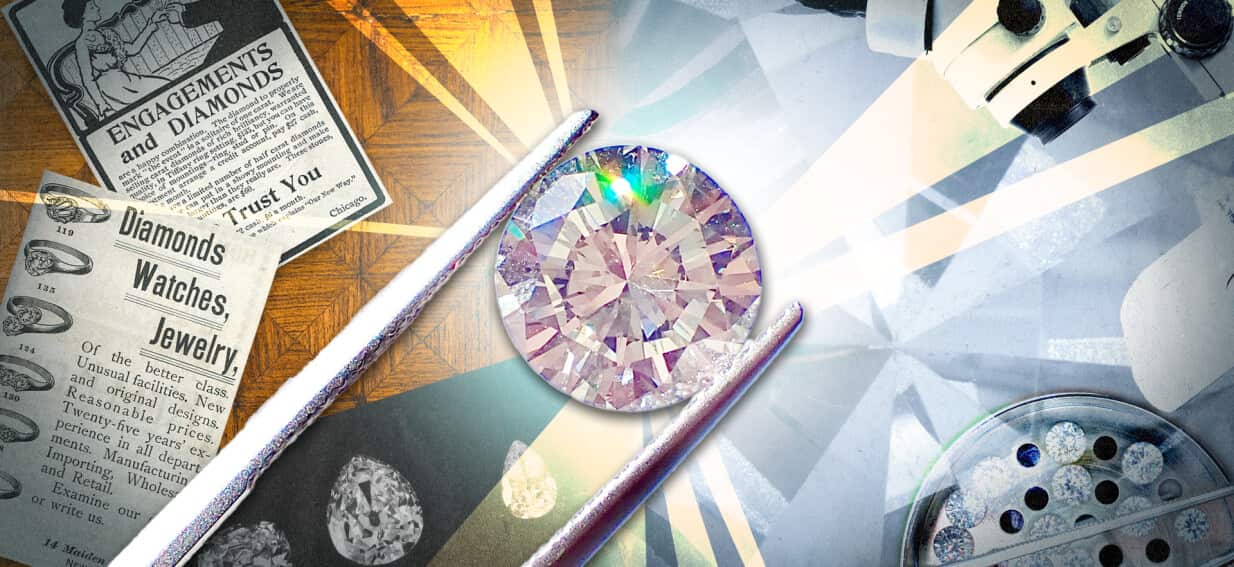
The velvet box snaps shut with a crisp, final sound. Inside, a two-carat diamond catches the overhead track lighting of a brightly polished showroom and throws a razor-sharp beam of light against the white wall. It looks deep. It looks ancient. It looks like a fortune traded hands to pull it from the dark belly of the earth.
It did not. Meanwhile, you can read similar developments here: Why Being Able to Bike Through Los Angeles Doesn't Make It Bikeable.
To understand what is happening to the jewelry industry, you have to look at Clara. Clara is thirty-two, lives in a third-floor walk-up in Chicago, and spends her days managing logistics for a mid-sized software firm. She has a sharp mind for supply chains and a keen eye for what things actually cost to make versus what people are asked to pay. Last autumn, Clara decided she wanted an engagement ring for herself and her partner of five years. Not as a traditional symbol of subservience or patriarchal tradition, but simply because she liked the way a stone looked against her skin when she typed at her keyboard.
When Clara walked into her first retail jeweler, she experienced a profound shock. The price tag on a natural diamond of the size and clarity she wanted hovered near twelve thousand dollars. Twelve thousand dollars for compressed carbon. She felt a knot tighten in her stomach. She thought about her savings account. She thought about the unexpected car repair bill from three months prior. She walked out of the store empty-handed, feeling slightly foolish for ever thinking luxury was meant for people like her. To see the complete picture, check out the detailed article by ELLE.
Then she found the laboratory.
Not a metaphor. A literal, high-tech facility where machines recreate the crushing heat and volcanic pressure of the Earth's mantle inside chambers humming with microwave plasma.
Consider what happens next: Clara bought a diamond nearly identical to the one in the showroom, indistinguishable even to a jeweler squinting through a loupe, for less than the cost of a weekend getaway.
The very affordable diamond is no longer a fringe curiosity. It is a seismic shift in how humanity buys, wears, and thinks about precious stones. For generations, the market was governed by a simple, ironclad rule of scarcity. If you wanted a brilliant stone, you paid a king's ransom because extraction required moving millions of tons of earth, burning vast amounts of diesel, and navigating a tightly controlled global supply network designed to keep supply low and prices high.
(Note: When I speak of a tightly controlled network, I am referring to the historical monopoly models that dominated the twentieth century, where a single entity managed the bulk of global rough diamond distribution.)
The machine-grown alternative short-circuits that entire apparatus. It takes a tiny sliver of carbon—often called a seed—places it in a reactor, and bombards it with carbon-rich gases. Over a few weeks, atom by atom, layer by microscopic layer, a crystal builds itself. It is chemically, physically, and optically identical to something pulled out of a kimberlite pipe in Botswana or Canada.
The industry tried to fight back. In the early days of laboratory-grown gems, traditional merchants pushed a narrative of hesitation. They called them "synthetic," a word heavy with connotations of cheap plastic and artificial imitation. They argued that stones born in a lab lacked a soul. They suggested that true love required a certain level of financial suffering, as if the depth of an emotion could be measured by the size of the debt incurred to celebrate it.
Clara did not care about the soul of a carbon lattice. She cared about rent. She cared about groceries. She cared about the fact that paying twelve thousand dollars for a ring meant delaying homeownership by another two years.
Economics always wins in the end.
When manufacturing processes scale, prices plummet. This is the fundamental law of industrial progress. The same thing happened to ice when artificial refrigeration was invented. Natural ice was harvested from frozen lakes in winter, packed in sawdust, shipped across oceans, and sold at a premium. Once machines could freeze water on demand, the natural ice trade collapsed overnight. Ice stopped being a luxury status symbol and became something you put in a lukewarm glass of tea on a Tuesday afternoon.
Diamonds are undergoing that exact transformation.
We are watching the democratization of sparkle. Walk down any major metropolitan shopping street today and look at the hands of people in their twenties and thirties. The stones are getting larger. The clarity is getting better. The designs are becoming bolder, more geometric, less tethered to the traditional solitaire setting that was popularized when stones were too expensive to waste on avant-garde styling.
Jewelers who adapted to this shift are thriving. Jewelers who stubbornly insisted that only dirt-mined stones held value are watching their customer base evaporate.
There is an emotional liberation that comes with this change. For decades, wearing expensive jewelry meant carrying a low-grade hum of anxiety. People worried about losing a stone down a restaurant sink drain, or getting mugged on the subway, or accidentally chipping a piece of generational wealth while moving furniture.
When a two-carat stone costs a fraction of its mined counterpart, the anxiety lifts. It becomes an accessory again. It becomes art. It becomes something you wear to the grocery store without checking your rearview mirror every ten seconds.
Critics will argue that this destroys the romance. They will tell you that a diamond needs a history, that it needs to have spent a billion years underground waiting for us to find it. But human romance has always been adaptable. We do not mourn the loss of handwritten parchment letters just because email is faster. We do not demand that our clothes be woven on hand-looms from unwashed fleece just to feel authentic.
The value of a symbol has never resided in the raw material itself. It resides in the meaning we project onto it.
Clara wears her ring every day now. It catches the light when she pours her morning coffee. It gleams when she gestures during tense video calls with her engineering team. No one asks her if it came from the ground or a machine. No one cares. They only see the light.
And that light is getting brighter, cheaper, and infinitely more common by the day.