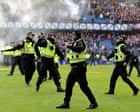
The air in Glasgow on derby day doesn’t just carry the scent of rain and fried onions; it carries a charge. It is a static electricity that raises the hair on your arms long before the first whistle blows at Ibrox. For ninety minutes, the city holds its breath. But lately, when that breath is released, it comes out as a snarl.
Consider a steward named David. He is a hypothetical composite of the men and women who stand with their backs to the pitch, dressed in neon nylon, watching the stands instead of the ball. David isn't there for the glory of the Scottish Premiership. He is there to earn a shift's wage and go home to his kids. On a recent Sunday, David didn't just watch a football match. He watched a tribal implosion. He felt the spray of saliva as insults turned into physical projectiles. He saw the flash of a coin spinning through the grey light, aimed at a player’s head, and heard the sickening thud of a glass bottle shattering near the dugout.
This isn't sport. It is a fever.
The Cost of the Shards
The police call it "shameful." That is a tidy, sterile word for the chaos that unfolded. When the authorities release statements condemning the "disgraceful scenes" at the latest meeting between Celtic and Rangers, they are describing a reality where the game has become a secondary concern to the vent of ancient, inherited animosities.
The facts are stark. Arrests were made for sectarian brief-cases, acts of violence, and the throwing of missiles. One particular incident saw a member of the visiting staff required stitches after being struck by a bottle. We have to ask: at what point did a rectangular plot of grass become a sanctioned zone for assault?
The "Old Firm" is often sold to the world as one of the greatest spectacles in global athletics. It is marketed on its intensity. But there is a thin, fraying line between intensity and pathology. When fans begin to target the very athletes they claim to support—or the staff members who facilitate the event—the spectacle becomes a crime scene.
The Invisible Stakes
Why does it matter if a few people lose their heads in a crowd of fifty thousand?
It matters because of the ripple effect. When the stands at Ibrox or Celtic Park descend into bile, the toxicity doesn't stay trapped inside the concrete bowl. It travels down the Govan Road. It sits at the dinner tables in Pollokshields and Easterhouse. It colors the way a child sees their neighbor.
The invisible stakes are the civic health of a city that has spent decades trying to outrun its reputation for sectarian strife. Every time a bottle is thrown, Glasgow takes a step backward. The narrative of the "passionate fan" is a mask. Underneath it lies a more uncomfortable truth: for a vocal minority, the football is merely an excuse to bypass the basic social contract of human decency.
Imagine the perspective of a young player, perhaps an international signing who arrived in Scotland with dreams of playing in a historic derby. He expects noise. He expects booing. He does not expect to have to scan the perimeter for flying glass. He does not expect to see his coaches bleeding because of the color of their tracksuit. The psychological toll on the participants transforms the pitch from a stage into a cage.
The Architecture of Hate
This behavior is not accidental. It is built. It is cultivated in pubs and private message boards, where the "other" is dehumanized until they are no longer a person, but a target. The police reports from the recent clashes mention "vile chants." These aren't just words; they are the soundtrack to a breakdown in order.
The clubs themselves face a grueling paradox. They rely on this atmospheric pressure to sell tickets and broadcasting rights. The "edge" is what makes the Glasgow derby a global brand. Yet, they find themselves unable to control the monster they've helped feed. When the boards of Rangers and Celtic issue their inevitable condemnations, there is a hollow ring to the rhetoric. Without a fundamental shift in how these clubs manage their supporters—and how the law treats these "shameful" acts—the cycle remains unbreakable.
Consider the logistics of the policing. Hundreds of officers are diverted from neighborhoods that actually need them to babysit grown men who cannot watch a game without attempting to incite a riot. The financial cost is borne by the taxpayer, but the social cost is paid by everyone who has to live in the shadow of the stadium.
A City at a Crossroads
We often hear that football is more important than life and death. It’s a catchy quote, but it’s a lie. Football is a game. It is a beautiful, heart-wrenching, transcendent game, but it is not worth a scar on a man's face or a night in a holding cell.
The recent clashes weren't a lapse in judgment; they were a symptom. They reflect a segment of the fan base that feels entitled to violence under the guise of loyalty. They believe that their "passion" grants them immunity from the rules of a civilized society.
The real tragedy is that the majority of fans—the ones who just want to sing their songs and head home—are being held hostage by the actions of the few. The atmosphere of intimidation makes the stadium a hostile environment for families, for the elderly, and for anyone who doesn't wish to spend their Sunday afternoon ducking for cover.
Beyond the Condemnation
We have seen the headlines before. We have read the "shameful" quotes from the Chief Superintendent. We have heard the clubs promise to "investigate and ban" those responsible. But the glass keeps breaking.
True change doesn't come from a press release. It comes when the person sitting next to the bottle-thrower speaks up. It comes when the culture of the terrace decides that the dignity of the club is more important than the destruction of the rival. Until then, the police will keep making arrests, the doctors will keep stitching up wounds, and the beautiful game will continue to be stained by a very ugly reality.
The sun sets over the Clyde, the blue and green scarves are tucked away, and the broken glass is swept into piles. The city moves on, but the tension remains, humming quietly in the dark, waiting for the next whistle to wake it up again.
A shard of green glass sits on the grey pavement, catching the light of a streetlamp, a small, sharp reminder that some wounds in Glasgow never quite get the chance to heal.