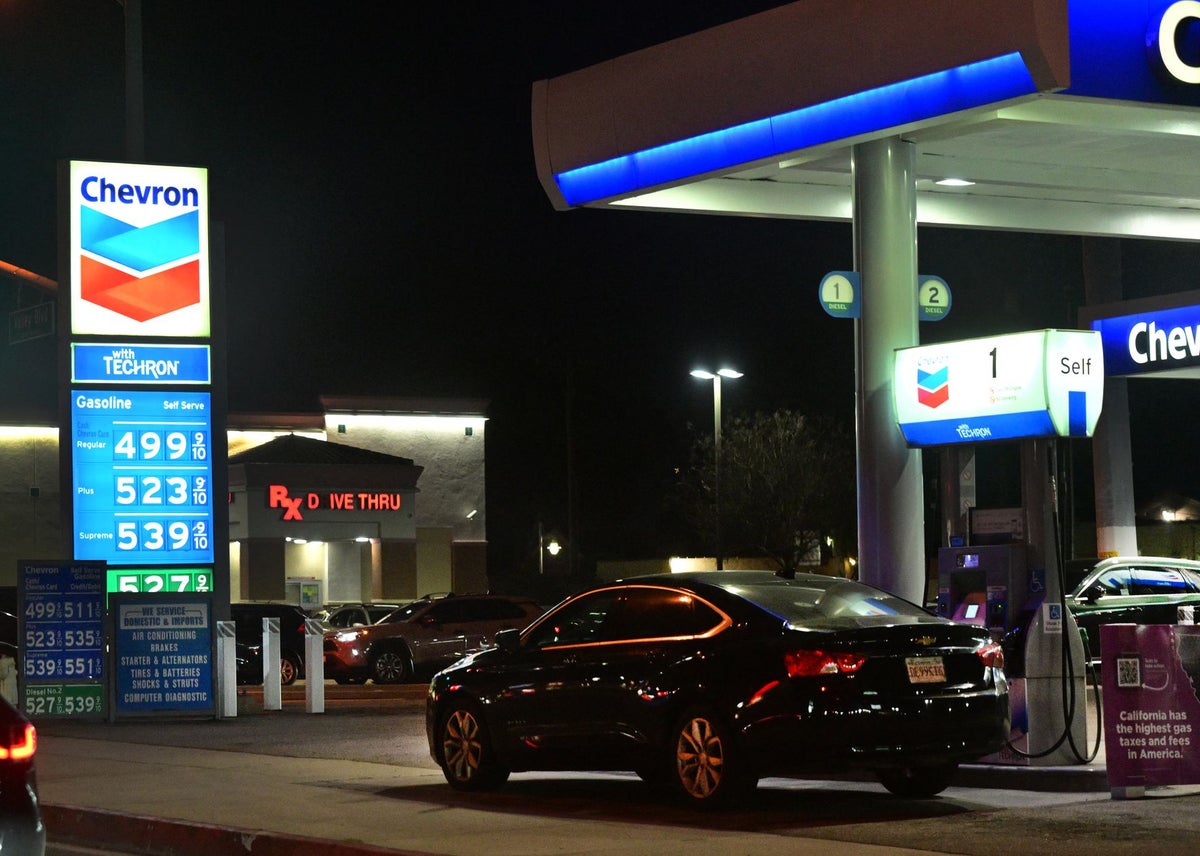
The sticker shock at the pump is hitting American voters with the force of a physical blow. After a campaign season defined by the promise of two-dollar-a-gallon gas and absolute energy independence, the reality of 2026 has taken a sharp, violent turn. Gas prices are surging across the country, fueled not by domestic policy failures alone, but by a direct military confrontation with Iran that has upended the global crude market. The administration finds itself trapped between its "America First" energy rhetoric and the cold, hard mathematics of a globalized oil supply chain that does not care who sits in the Oval Office.
Energy security is a myth when the Straits of Hormuz are under fire.
While the White House points to record-high domestic production levels as proof of its commitment, the market is reacting to the immediate threat of a supply chokepoint. Iran’s influence over the world’s most critical maritime oil artery means that any kinetic conflict in the region adds an instant "war premium" to every barrel of Brent and West Texas Intermediate (WTI) traded globally. American consumers, who were told that more drilling at home would insulate them from Middle Eastern volatility, are discovering that their local gas station is still tethered to the geopolitical whims of Tehran and Riyadh.
The Mirage of Total Energy Independence
The fundamental misunderstanding in the current political discourse is the idea that the United States can "drill its way" to price immunity. The U.S. is indeed the world’s largest producer of crude oil, but the global market functions as a single, interconnected bathtub. When a plug is pulled in the Persian Gulf, the water level drops everywhere.
American refineries are often configured to process heavy, sour crude from abroad rather than the light, sweet crude produced in Permian Basin shale plays. This structural mismatch means we must export much of what we dig up and import what we actually need to keep the lights on and the trucks moving. When conflict with Iran escalates, the cost of those imports skyrockets, and the price of domestic oil follows suit because American producers would rather sell to the highest bidder on the international market than offer a "patriot discount" at home.
The administration’s promise to bring prices down was built on the assumption of a stable, or at least manageable, Middle East. That assumption has evaporated. By engaging in a direct escalatory cycle with Iran, the U.S. has effectively taxed its own citizens at the pump. It is a self-inflicted wound that highlights the gap between campaign trail populism and the brutal mechanics of energy arbitrage.
The War Premium and the Strait of Hormuz
Why does a drone strike in the Gulf translate to an extra fifty cents a gallon in Ohio? It comes down to the Strait of Hormuz. Roughly one-fifth of the world’s total oil consumption passes through this narrow waterway daily. Iran knows this is its only real leverage. By threatening to close the strait or by harassing tankers, they trigger an immediate spike in insurance premiums for shipping companies.
- Shipping Rates: When a region becomes a war zone, the cost to insure a VLCC (Very Large Crude Carrier) can jump by 500% overnight.
- Speculative Bidding: Commodity traders don't wait for the oil to stop flowing; they trade on the fear that it might.
- Inventory Hoarding: Nations begin to shore up their strategic reserves, further reducing the supply available for immediate commercial use.
This is the "Why" that many news outlets skip. It isn't just about the oil that is lost; it's about the cost of the oil that is still moving. The Trump administration’s aggressive stance toward Iran was marketed as a show of strength, but in the oil markets, it is viewed as a disruption of the status quo. Strength is expensive.
The Infrastructure Bottleneck
Even if we ignored the Middle East entirely, the U.S. domestic oil industry is facing internal pressures that make the "cheap gas" promise nearly impossible to keep. Years of underinvestment in refinery capacity mean that even if we pumped ten times more oil, we lack the "kitchens" to cook it into gasoline.
Most American refineries are running at near-total capacity. When one goes down for maintenance or is hit by a seasonal hurricane, the system has no slack. We are operating on a razor’s edge. The administration has pushed for more leasing on federal lands, but a lease is not a well, and a well is not a gallon of gas. It takes years to bring new production online and even longer to build the infrastructure to move it.
The Role of Wall Street
There is also the matter of capital discipline. For a decade, shale drillers burned through investor cash to chase production growth. Now, shareholders are demanding returns. Instead of spending every cent on new rigs, oil companies are using their record profits to buy back shares and pay out dividends. They have no incentive to flood the market and drive prices down; their loyalty is to the bottom line, not the political survival of the presidency.
Inflation and the Political Fallout
Rising energy costs are the ultimate "silent killer" of political capital. Because energy is an input for almost everything—from the plastic in your phone to the diesel in the truck delivering your groceries—gasoline inflation quickly becomes food inflation.
The voter who was promised a return to the economic "golden age" of 2018 is now looking at a grocery bill that has doubled. The anger being directed at the White House isn't just about the price of a fill-up; it's about the perceived betrayal of a core economic pledge. When the President says the economy is "booming" while a family spends $100 to fill their SUV, a credibility gap opens that no amount of social media messaging can bridge.
Strategic Reserves and Short Term Fixes
In a desperate bid to blunt the impact, there have been discussions about further releases from the Strategic Petroleum Reserve (SPR). This is a dangerous game. The SPR is intended for true national emergencies—interruptions in supply so severe they threaten national security—not for managing a president’s approval ratings.
Draining the reserve to lower prices by a few cents is a temporary sedative, not a cure. It leaves the country vulnerable if the "Cold War" with Iran turns into a full-scale regional conflagration. Furthermore, refilling the reserve later will require buying oil at market prices, likely higher than what it was sold for, creating a long-term deficit for the taxpayer.
The Transition That Is Not Happening
The irony of the current crisis is that it provides the strongest possible argument for a diversified energy grid, yet the political climate has made the word "renewables" toxic in many circles. If more of the American transport fleet were insulated from oil prices, the moves of the Iranian Revolutionary Guard would have less power over the American economy.
Instead, the discourse has devolved into a binary choice: drill more or suffer. This is a false equivalence. Drilling more in a globalized market does not guarantee lower prices at the pump if the global market is on fire. True energy independence requires a system where the "fuel" isn't traded on a global exchange susceptible to the whims of foreign dictators.
The Hard Reality of 2026
The American public is currently receiving a masterclass in the limitations of executive power. A president can sign executive orders to open lands and can bully OPEC+ on social media, but they cannot dictate the price of a global commodity in the middle of a shooting war.
The escalation with Iran was a choice. The "America First" energy policy was a promise. Those two things are now in direct conflict. As long as the U.S. remains entangled in the Middle East’s security architecture while remaining dependent on a global oil price, the American driver will continue to pay the price for Washington’s foreign policy ambitions.
Demand that your representatives explain how they plan to decouple the American economy from the volatility of the Strait of Hormuz, because "drill, baby, drill" has proven to be an insufficient shield against the realities of modern warfare. If the current trajectory continues, the high prices we see today may just be the new floor. Check the data on refinery utilization rates and the daily volume of the SPR before believing the next round of campaign promises.