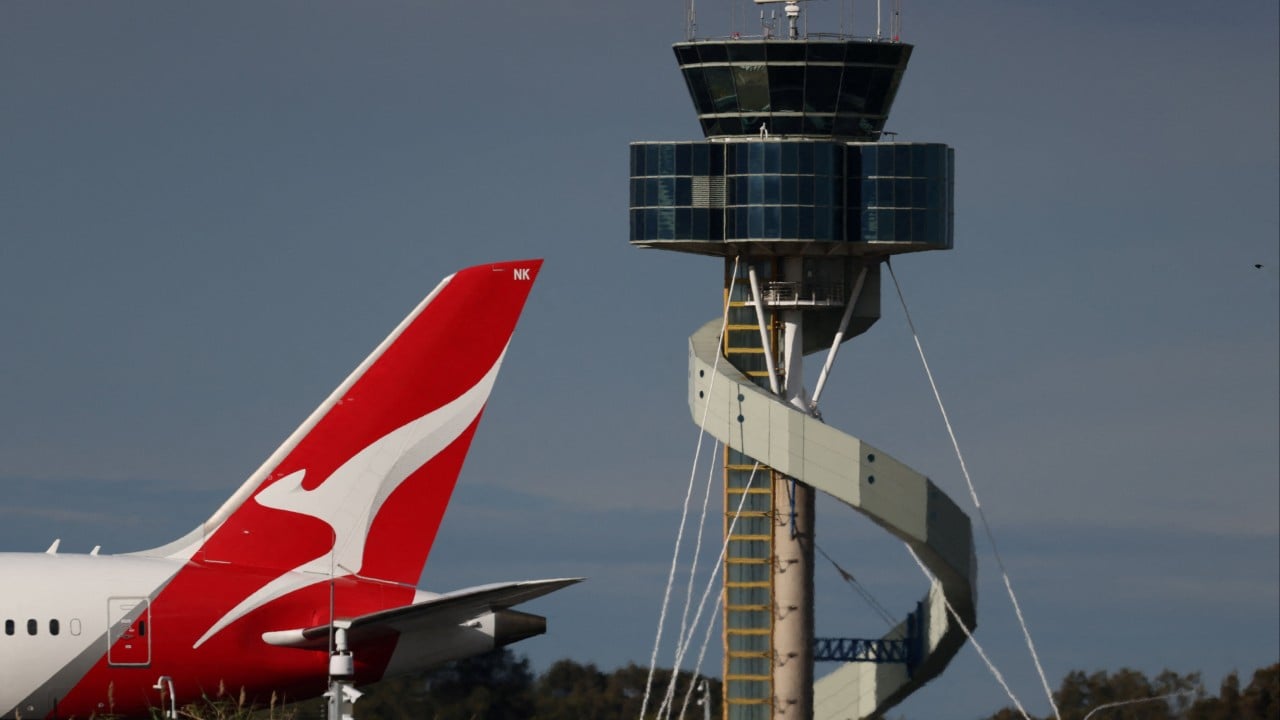
Australia is running out of people to talk to airplanes. Behind the polished facade of major aviation hubs, a quiet institutional decay has reached the glass-walled rooms where thousands of lives are managed hourly. Sydney Airport recently logged at least four terrifying near-misses in a single month, exposing a national air traffic control network stretched to the breaking point. Passenger jets have aborted takeoffs with other aircraft directly in their path. Taxiing airliners have slammed on emergency brakes to avoid catastrophic ground collisions. These are not statistical anomalies. They are the predictable outcome of chronic staff shortages, institutional inertia, and an aviation sector operating on borrowed time.
The public narrative often defaults to polite euphemisms about post-pandemic recovery. The reality on the floor of the control tower is far more brutal. Airservices Australia, the government-owned corporation responsible for the country's airspace, is caught in a trap of its own making. Years of mismanaged downsizing during the global health crisis collided with surging travel demand, leaving control rooms critically unmanned.
The Anatomy of a Collapse
To understand how Australia arrived at this precipice, look at the roster. On any given day at Sydney Airport, up to twenty percent of scheduled shifts sit vacant before factoring in sick leave or unexpected absences.
The math is unforgiving. When positions are empty, the remaining workforce absorbs the burden. Controllers routinely work up to ten consecutive shifts without a proper break, staring at radar screens and managing intersecting runways while operating under severe cognitive fatigue.
Aviation safety relies on redundancies, with human attention acting as the final, vital barrier against disaster. When that human element is exhausted, the safety margin shrinks from a wide buffer to a razor-thin wire.
Consider the sequence of events that rattled the system. In late July, an international flight was cleared to cross an active runway just as another commercial jet was completing its landing roll. Weeks later, a domestic flight taxiing for departure nearly struck a widebody aircraft being towed across a crossing taxiway, generating an abrupt stop that injured a cabin crew member. Shortly after, a Virgin Australia pilot had to slam on the anchors to avoid a conflicting movement on the tarmac.
Each event shares a common DNA. Controllers are juggling excessive workloads, managing complex airspace, and relying on institutional muscle memory rather than fully staffed, balanced teams.
Why the Pipeline is Clogged
Fixing a shortage of air traffic controllers is not a matter of posting job listings on a corporate website. You cannot poach experienced operators easily because Australian airspace operates under unique, highly complex local protocols.
Training a new recruit takes years. Candidates must pass rigorous cognitive evaluations, complete months of simulator training, and spend extensive periods under the direct supervision of veteran mentors before earning an endorsement for a major facility like Sydney.
During the pandemic years of 2021 and 2022, approximately four hundred fifty employees took voluntary redundancy packages under corporate cost-cutting measures. The institutional knowledge walked out the door and never returned. While Airservices Australia has ramped up recruitment pipelines, the entry rate of newly minted controllers cannot match the pace of retirements, burnouts, and the relentless growth of flight schedules.
Compounding the problem is an administrative culture prone to sluggish communication. The Australian Transport Safety Bureau recently rebuked Airservices Australia for taking days to officially report critical runway incursions to federal investigators. When transparency is delayed, accountability slows down right alongside it.
The Cost of Silence
Airlines are furious. Passenger groups are anxious. Yet the response from government regulators has largely remained confined to defensive talking points about Australia maintaining a historically safe aviation record.
History shows that institutional arrogance often precedes systemic failure. Whistleblowers inside the tower network have drawn direct parallels to international warnings issued months before fatal midair collisions abroad. They are not crying wolf. They are signaling that the machinery of oversight is cracking under physical and mental exhaustion.
Piling more overtime onto an already depleted workforce is a toxic substitute for genuine structural reform. Standby pools and recruitment campaigns are moving targets that offer little comfort to pilots descending through heavy cloud cover into Sydney's busy corridors today.
The skies above Australia are getting busier, driven by surging passenger volume and the looming activation of new regional gateways. Without a radical overhaul of shift structures, accelerated yet rigorous training pathways, and absolute transparency regarding near-miss data, the country's aviation sector is rolling the dice with hundreds of lives every single day. The margin for error is gone.