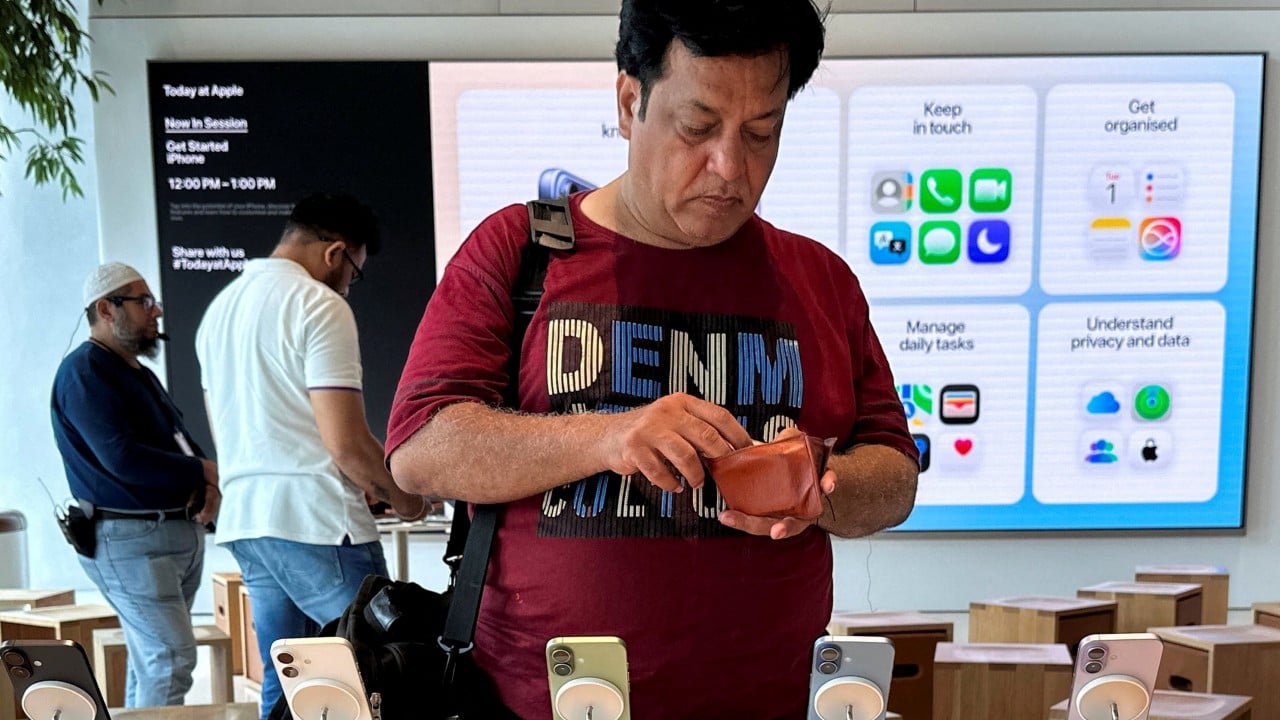
The ritual repeats itself with clockwork precision every autumn outside flagship stores in Delhi and Mumbai. Hundreds queue up for hours, cash in hand or pre-approved lines of credit ready, to purchase an Apple smartphone priced well past ₹1,70,000. But when a viral video captured a buyer admitting he parted with generational family gold to fund an iPhone 18 Pro Max for his spouse, the public discourse shifted from harmless consumer enthusiasm to a stark symptom of India's deeper economic neurosis.
The primary driver behind this phenomenon is not a sudden surge in mobile photography passion or processing demands. It is the hyper-accelerated weaponization of aspiration in an unequal economy where the possession of a premium logo serves as an instant social equalizer.
Understanding why an individual chooses to liquidate an appreciating, tangible family asset—gold handed down through grandmothers and great-grandmothers—for a depreciating piece of silicon requires looking past the surface comedy of viral memes. It exposes a profound shift in consumer psychology where conspicuous consumption overrides wealth preservation.
The Economics of the Upgrade Trap
In traditional households, gold has historically functioned as both cultural anchor and emergency financial bedrock. It is liquid, structurally resilient against inflation, and historically climbs in valuation over decades. A flagship smartphone operates on the exact opposite trajectory. Within thirty-six months, software updates slow down, battery capacities degrade, and trade-in values plummet.
Trading a multi-generational store of value for a three-year gadget lifecycle is an aggressive form of wealth destruction. Yet, millions across India’s burgeoning urban middle class are normalizing this exchange through financial engineering. The proliferation of easy equated monthly installments (EMIs), buy-now-pay-later programs, and zero-cost financing has lowered the psychological barrier to entry.
When a consumer earning a modest five-figure monthly salary locks themselves into a heavy two-year EMI structure for a top-tier handset, they are effectively mortgaging their future liquidity for present-day social validation. Banks and fintech platforms actively encourage this behavior, transforming what used to require substantial accumulated savings into an impulse purchase accessible via a quick digital swipe.
The Status Currency of Silicon
To dismiss this trend as mere foolishness is to misunderstand the social architecture of modern urban India. In environments hyper-saturated by social media, status is broadcasted instantly through visual shorthand. The rear camera module configuration or the specific color tint of the latest Pro Max variant functions as a modern caste marker.
It communicates financial arrival to peers, colleagues, and strangers alike. For young professionals and ambitious families operating in competitive urban spaces, holding a standard mid-range Android device can feel socially invisible. The high-end phone acts as a proxy for success, signaling that the bearer has conquered economic limitation, regardless of the underlying credit statement
The Great Indian iPhone Heist Why Flagship Obsession Outpaces Reality
business, technology
Every autumn, the ritual returns with the predictability of the monsoon. Long queues snake outside sleek glass storefronts in Mumbai, Delhi, and Bengaluru. Inside, buyers flash plastic, sign up for predatory monthly installments, or occasionally trade away generational gold to secure Apple’s newest flagship smartphone. The spectacle routinely prompts moral panic across editorial pages. Observers ask how a nation where millions subsist on welfare can simultaneously fuel record-breaking sales for devices costing upwards of one lakh rupees.
The obsession with owning a status symbol in India is frequently misread as simple consumer madness. It is not. It is an economic symptom, a calculated lifestyle bet, and the direct consequence of a financial credit infrastructure designed to make luxury accessible to anyone willing to mortgage their immediate future.
To understand why the latest iPhone commands such fierce devotion in an emerging market, one has to look past the cultural commentary and examine the mechanics of aspiration.
The Zero Cost Illusion and the Credit Trap
Walk into any authorized electronic retailer in a major Indian metropolis, and the cash price of a device becomes a secondary detail. The sales pitch does not center on what the phone costs; it centers on what it costs per month.
Financial technology firms and institutional lenders have transformed high-end hardware into subscription services through No Cost EMI structures. For a young professional earning a modest entry-level salary, dropping one hundred and twenty thousand rupees outright is impossible. But breaking that sum into twenty-four monthly payments of five thousand rupees feels manageable. It resembles a utility bill or a streaming subscription.
This financial engineering removes friction. It allows individuals to project an image of affluence long before their actual earnings justify it. The smartphone functions as a portable CV. In a hyper-competitive urban economy where networking happens over coffee shops and professional identity is tied to visual curation, holding an older model or a budget device can feel like an invisible career handicap.
Yet the debt is real. Behind the glossy marketing campaigns lie hidden processing fees, balloon payments, and the silent pressure of servicing multiple credit obligations. When a macroeconomic shock hits a household, those monthly obligations do not pause.
Status Signaling in an Expanding Middle Class
Sociologists have long studied conspicuous consumption, but the velocity of modern digital culture has accelerated the phenomenon. In India, the economic expansion of the past two decades has minted millions of first-generation urbanites. These consumers do not inherit generational assets like property or established businesses. Their primary capital is social presentation.
The device serves as a shortcut to belonging. It signals to peers, prospective employers, and marriage markets that the owner has arrived.
Apple understands this dynamic intimately. The company does not market processing speeds or camera megapixel counts to the mass market. It markets an exclusive club. By keeping entry prices high and refusing to discount older models heavily, the brand maintains an aura of untouchability. In secondary cities and tier-two towns, where retail footprints are expanding rapidly, owning the current model is a declaration of upward mobility.
The willingness of some consumers to liquidate family gold—historically the ultimate secure asset in Indian households—to fund a luxury handset highlights a profound shift in priorities. Gold is traditional, quiet, and utilitarian. A flagship smartphone is modern, loud, and immediate. For a segment of the youth, tangible security has taken a backseat to immediate symbolic capital.
The Counter-Argument of Utility and the Creator Economy
Dismissing these purchases as mere vanity ignores the massive structural shift in how young Indians earn a living. The explosion of the creator economy, independent digital agencies, and remote freelance work has turned the smartphone into core capital equipment.
For a content creator, a mobile journalist, or an independent consultant, the camera system and processing power of a high-end device are income-generating assets. A professional video shot on a current-generation flagship can secure brand partnerships, drive e-commerce sales, and build a digital footprint. In this light, spending heavily on hardware is not an indulgence; it is business expenditure disguised as consumer electronics.
Furthermore, the resale market for premium handsets in the region is uniquely robust. Unlike budget devices that lose ninety percent of their value within a year, an Apple device retains a high residual value. Savvy buyers offset the cost of their upgrade every twelve to twenty-four months by trading in their previous hardware, reducing the true cost of ownership significantly.
The Reality Behind the Sales Records
The narrative that entire families are routinely starving themselves to buy mobile phones is a caricature. The reality is more nuanced and, in many ways, more revealing about modern consumer psychology.
The buyers standing in those launch-day queues are navigating a paradox. They live in an economy of profound inequality, where digital infrastructure has outpaced traditional wealth creation. They use global luxury goods to bridge the gap between their current reality and their desired identity.
The craze will not abate when the next iteration launches. As long as credit remains easy, social media demands visual validation, and financial institutions reward leverage, the queue outside the glass doors will form again. The price tag is steep, but for millions, the perceived cost of not having it feels much higher.