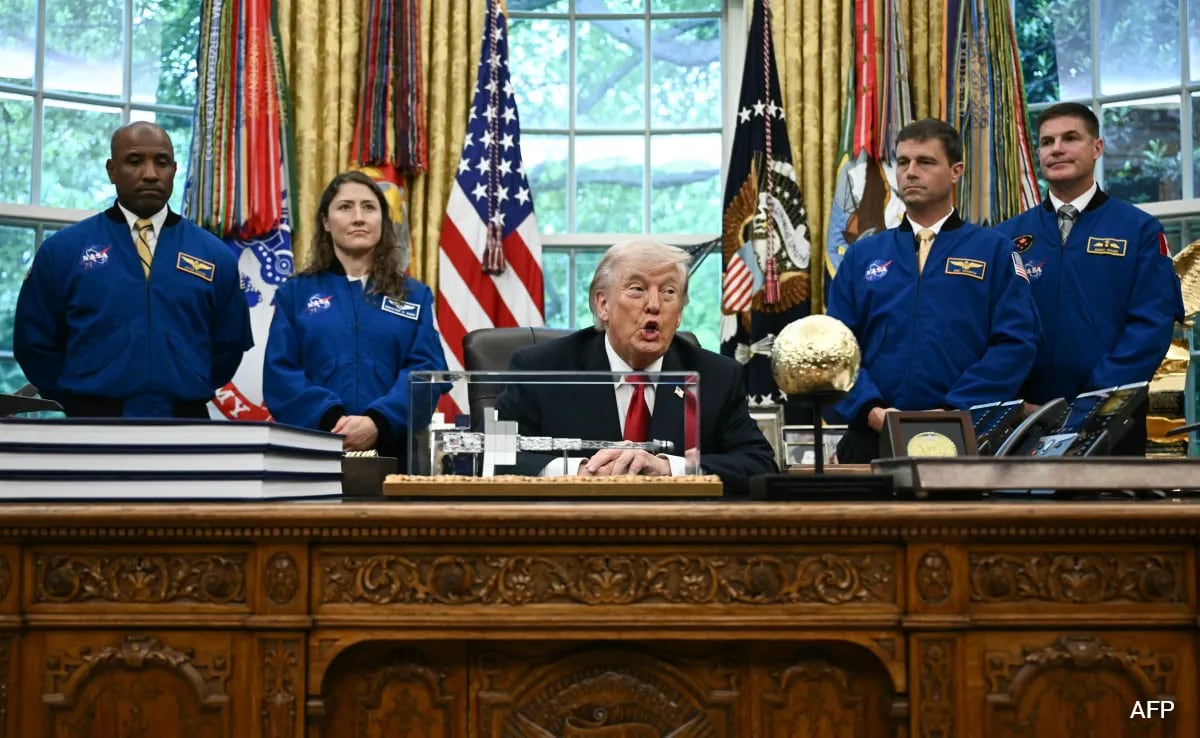
The White House is currently projecting a level of cosmic optimism that hasn't been seen since the mid-1960s. President Trump recently declared that the United States has "a shot" at putting boots back on the lunar surface before his second term expires in January 2029. It is a bold, headline-grabbing claim that ignores the cold, mechanical reality currently sitting on launchpads in Texas and Florida.
While the administration wants a flag-planting ceremony to punctuate its legacy, the aerospace industry is wrestling with a physics and procurement problem that does not care about election cycles. The Artemis II mission successfully looped four astronauts around the Moon in April 2026, a genuine triumph that proved the Space Launch System (SLS) and the Orion capsule can keep humans alive in deep space. However, orbiting the Moon is a world away from landing on it. To bridge that gap by 2028, NASA needs a series of "perfect hands" in a game where the deck is notoriously stacked.
The Starship Bottleneck
The primary obstacle to a 2028 landing isn't NASA’s rocket; it is the elevator. SpaceX’s Starship HLS (Human Landing System) is the only vehicle currently contracted to put Americans on the lunar south pole. As of April 2026, Starship has yet to achieve a full orbital flight that includes a successful "catch" of both stages and, more importantly, a demonstration of orbital refueling.
To get a single Starship lander from Earth to the Moon, SpaceX must launch a fleet of "tanker" ships to fill a depot in low Earth orbit. We are talking about 10 to 15 launches in rapid succession. SpaceX is currently celebrating its 50th launch of 2026, but those are mostly Starlink missions using the reliable Falcon 9. The heavy-lift Starship is still in its "rapid unscheduled disassembly" phase of development. If Elon Musk cannot prove that Starship can dock and transfer cryogenic fuel in orbit by the end of next year, the 2028 window slams shut.
The Suit Problem
Even if the rocket works, the clothes might not. Axiom Space is currently under the gun to deliver the Axiom Extravehicular Mobility Unit (AxEMU). These are not the bulky, stiff suits of the Apollo era. They are pressurized, climate-controlled spacecraft shaped like a human.
Axiom executives insist they will be ready for a 2027 test in low Earth orbit, but the transition from a "qualification suit" to a flight-ready unit is a notorious graveyard for aerospace schedules. The lunar south pole is a brutal environment of jagged shadows and razor-sharp regolith that can chew through seals and bearings. There is no room for a "v1.1" patch when an astronaut is standing in a crater 240,000 miles from home.
The Artemis III Pivot
The most telling sign of the struggle is the recent quiet restructuring of Artemis III. Originally billed as the triumphant return to the surface, the mission is now trending toward a "high-orbit dress rehearsal."
Current NASA manifests suggest Artemis III, slated for late 2027, will likely focus on docking the Orion capsule with a Starship lander in Earth orbit without actually going to the Moon. This move protects the schedule but pushes the actual landing to Artemis IV in early 2028. This leaves the administration with a razor-thin margin. One cracked seal, one sensor glitch, or one launchpad anomaly in 2027 pushes the moonwalk into the next presidency.
The Geopolitical Pressure Cooker
Why the rush? It isn't just about legacy. China’s CNSA has set a firm goal for a crewed landing by 2030. If the U.S. slips past 2028, the "Moon Race" becomes a dead heat. Washington is terrified of a scenario where a Long March 10 rocket delivers Taikonauts to the Shackleton Crater while NASA is still conducting "readiness reviews."
This fear is driving the "shot at the Moon" rhetoric. It’s a signal to private contractors that the blank checks will continue to flow, provided they can bypass the traditional, slow-moving bureaucratic safety checks that have defined NASA since the Challenger era.
A Legacy Built on Volatility
The 2028 goal is technically possible, but it is not probable. It relies on SpaceX achieving a launch cadence for a pre-production rocket that took the Falcon 9 a decade to master. It assumes the SLS rocket—a machine with a $2 billion price tag per launch—will fly without a single hardware hiccup.
The American space program is currently a house of cards held together by political will and private sector ambition. We have the hardware in the bays and the astronauts in the seats. What we don't have is time.
Stop looking at the podium and start watching the fuel gauges in Boca Chica. That is where the 2028 mission will actually be won or lost.