Boarding Amtrak’s Southwest Chief at Los Angeles Union Station is an act of defiance against the efficiency of the modern world. For the next 43 hours, passengers are locked into a slow-motion crawl across 2,265 miles of desert, mountain passes, and prairie. To the data-driven analyst, this is a failure of infrastructure. To the airline executive, it is a relic of a dying age. But to the regular riders—the "train people"—those two days of transit are the only time in their lives they feel truly untethered from a society that demands constant velocity.
The fascination with long-haul rail in the United States isn't about nostalgia. It is about the psychology of the "liminal space," a physical transition where the rules of the work-a-day world no longer apply. While a flight to Chicago takes four hours of cramped discomfort and pressurized air, the train offers a sprawling, messy, and deeply human alternative. People aren't choosing the train because it’s better than flying; they are choosing it because it is the opposite of flying.
The Economics of Inefficiency
Critics often point to Amtrak’s operating deficits as proof that long-distance routes should be shuttered. In 2023, the long-distance business line required significant federal subsidies to stay afloat. However, looking at the balance sheet alone ignores the "essential service" mandate that governs these rails. For dozens of stops in Kansas, Colorado, and New Mexico, the Southwest Chief is not a vacation. It is the only connection to the outside world.
In towns like Lamar, Colorado, or La Junta, there are no regional airports. Uber doesn't operate there. When the train pulls into these stations at 2:00 AM, it isn't just dropping off tourists with cameras; it’s delivering students, veterans heading to medical appointments, and families who cannot afford the surging costs of car ownership and insurance. The inefficiency is the point. By stopping where the market says it shouldn't, the train maintains a ghost of a national network that the private sector abandoned decades ago.
The business model of the Southwest Chief relies on a strange alchemy of high-end sleeper car revenue and low-cost coach seats. A Roomette can cost upwards of $800, providing a bed, meals, and a dedicated attendant. These passengers subsidize the coach riders in the back who are hunkered down for 40 hours with nothing but a blanket and a dream. It is a microcosm of American class structure, vibrating at 79 miles per hour.
The Observation Car as a Social Laboratory
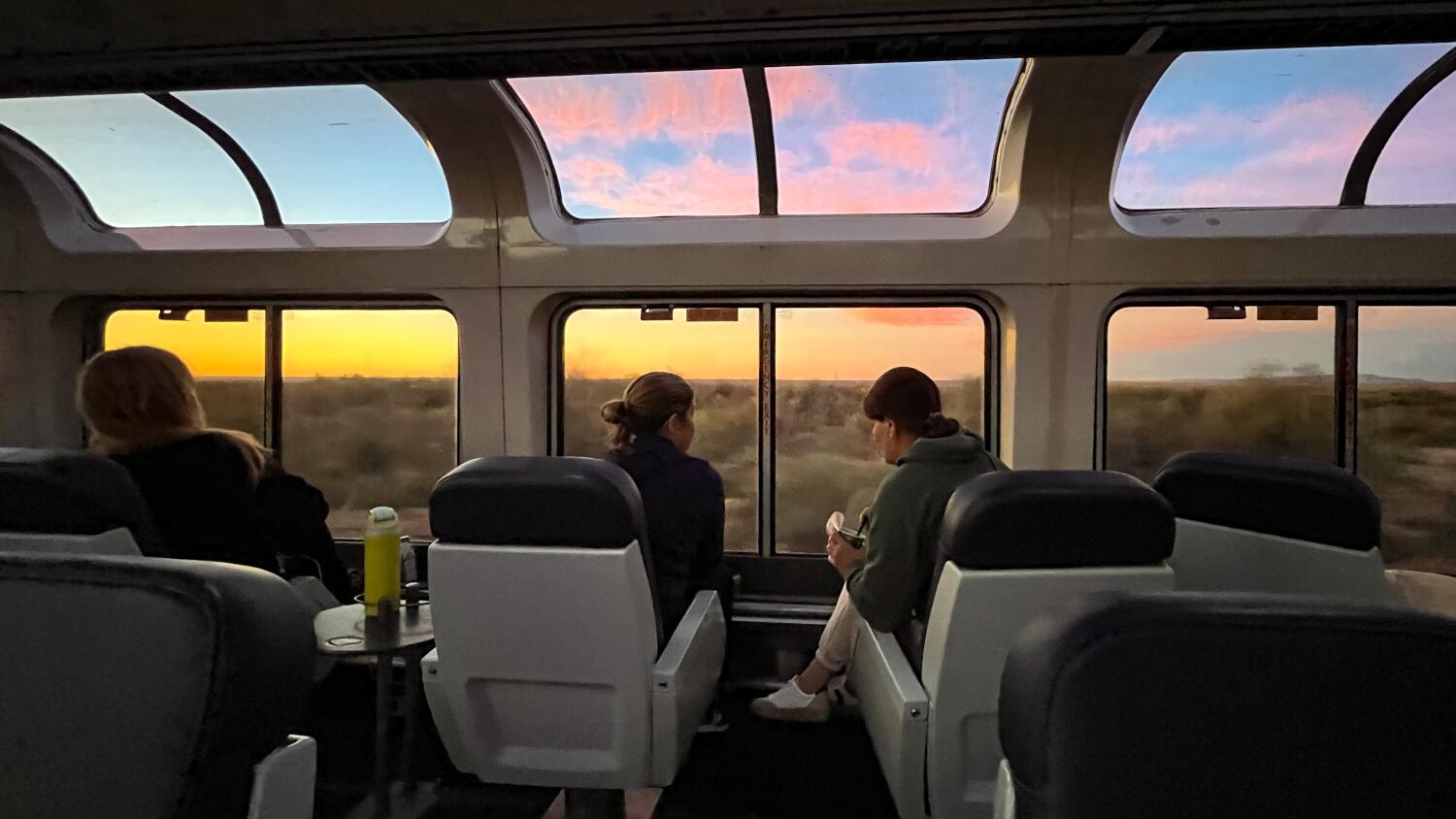
If you want to understand the soul of the American West, you sit in the Sightseer Lounge. This is the double-decker car with floor-to-ceiling windows. Here, the unspoken social contract of the 21st century—ignore everyone, look at your phone—completely dissolves.
The lack of reliable Wi-Fi across the Mojave Desert and the Raton Pass forces a shift in behavior. You see a retired aerospace engineer from Pasadena sharing a table with a Mennonite family from rural Missouri. They talk about the weather, the quality of the beef in the dining car, and the history of the Harvey Houses that once lined these tracks.
- Social Isolation: On a plane, you are a unit of cargo. On a train, you are a neighbor.
- Visual Stimuli: The view from 30,000 feet is a map. The view from a train window is a story. You see the rusted backsides of industrial towns, the sun-bleached skeletons of cattle, and the sheer, terrifying scale of the New Mexico wilderness.
- The Temporal Shift: After 20 hours, the brain stops checking the clock. You begin to measure time by the next smoke stop or the changing color of the soil.
This environment creates a "forced community." Because there is no escape, people become more patient. They become more observant. The veteran investigator sees this not as a travel trend, but as a survival mechanism for a population suffering from digital burnout.
Infrastructure Rot and the Freight Conflict
Despite the romanticism, the reality of the Southwest Chief is often grim. The tracks are not owned by Amtrak; they belong to BNSF Railway. Under federal law, passenger trains are supposed to be given preference, but the reality on the ground is different.
A single 12,000-foot freight train carrying shipping containers from China can sideline the Southwest Chief for hours on a siding. When you hear a passenger complain about a six-hour delay in the middle of a Kansas cornfield, you are hearing the sound of a broken regulatory system. The Department of Justice has rarely enforced the preference laws, leaving Amtrak at the mercy of the freight giants.
This tension is the central crisis of American rail. We are trying to run a 19th-century service on a 20th-century corridor managed by 21st-century corporations focused on "Precision Scheduled Railroading." The result is a schedule that is more of a suggestion than a guarantee.
The Maintenance Backlog
The equipment itself is aging. The Superliner cars, recognizable by their silver siding and two-story height, were largely built in the late 1970s and 1980s. While they are built like tanks, the mechanical systems—HVAC, plumbing, and electrical—are failing.
Imagine a hotel that hasn't been renovated since the Reagan administration, then vibrate that hotel constantly for 40 years. That is a Superliner. Amtrak has finally begun ordering new long-distance equipment with billions in funding from the Infrastructure Investment and Jobs Act, but these cars won't hit the rails in earnest until the end of the decade. Until then, the "train people" will continue to endure leaky windows and temperamental toilets as the price of admission for the view.
Why the "Slow Movement" is Winning
There is a growing segment of the population that views "fast" as a trap. We have optimized our lives for speed to the point where we have no time left. The 43-hour journey is a deliberate rejection of this optimization.
In the 1950s, the Santa Fe Railroad marketed the Chief as "The Train of the Stars." It was the height of luxury. Today, the luxury isn't the food (which is often pre-packaged "flexible dining" on other routes, though the Chief still maintains traditional chef-prepared meals) or the linens. The luxury is the silence of a dead zone where your boss can’t reach you.
It is a psychological reset. By the time the train pulls into Chicago’s Union Station, the passengers have undergone a transformation. They are no longer the frazzled, hurried individuals who boarded in Los Angeles. They have been humbled by the size of the continent. They have been bored—truly, deeply bored—which is a state of mind that is increasingly rare and valuable.
The Myth of the Romantic Rail
We must be careful not to over-sanitize the experience. For many, 43 hours in a coach seat is a grueling endurance test. The air becomes stale. The bathrooms eventually smell like a music festival porta-potty. The "cafe car" diet of hot dogs and microwavable pizzas can wreak havoc on the digestion of anyone over thirty.
But this grit is part of the appeal. High-speed rail in Europe and Asia is a triumph of engineering, but it is also antiseptic. It is a sanitized tube that whisks you between urban centers. The Southwest Chief is the opposite. It is dirty, it is loud, and it is unpredictable. It follows the path of the Santa Fe Trail, a route carved by wagons and blood. To ride it is to acknowledge that the geography between the coasts isn't "flyover country"—it is the substance of the country itself.
The "train people" are often mocked for their obsession with a failing system. Yet, they are the only ones who truly understand the distance between LA and Chicago. To them, 43 hours isn't a delay; it's the correct amount of time it takes to cross half a continent.
The Future of the Long Haul
The survival of the Southwest Chief depends on a fundamental shift in how we value public transit. If we continue to demand that it "turns a profit," it will die. Public roads do not turn a profit. Public parks do not turn a profit. They are civic goods that facilitate the movement of people and ideas.
If the United States wants to maintain a semblance of national unity, it needs these physical threads. When the train disappears, the small towns it serves don't just lose a ride; they lose their relevance to the national conversation. They become isolated islands in a sea of wheat and sagebrush.
The next time you see a Southwest Chief manifest, look at the faces in the windows. They aren't looking at their watches. They are looking at the horizon, waiting for the sun to drop behind the Sangre de Cristo Mountains, content to be exactly where they are: nowhere in particular, moving slowly toward somewhere else.
Stop trying to fix the schedule and start appreciating the scale.