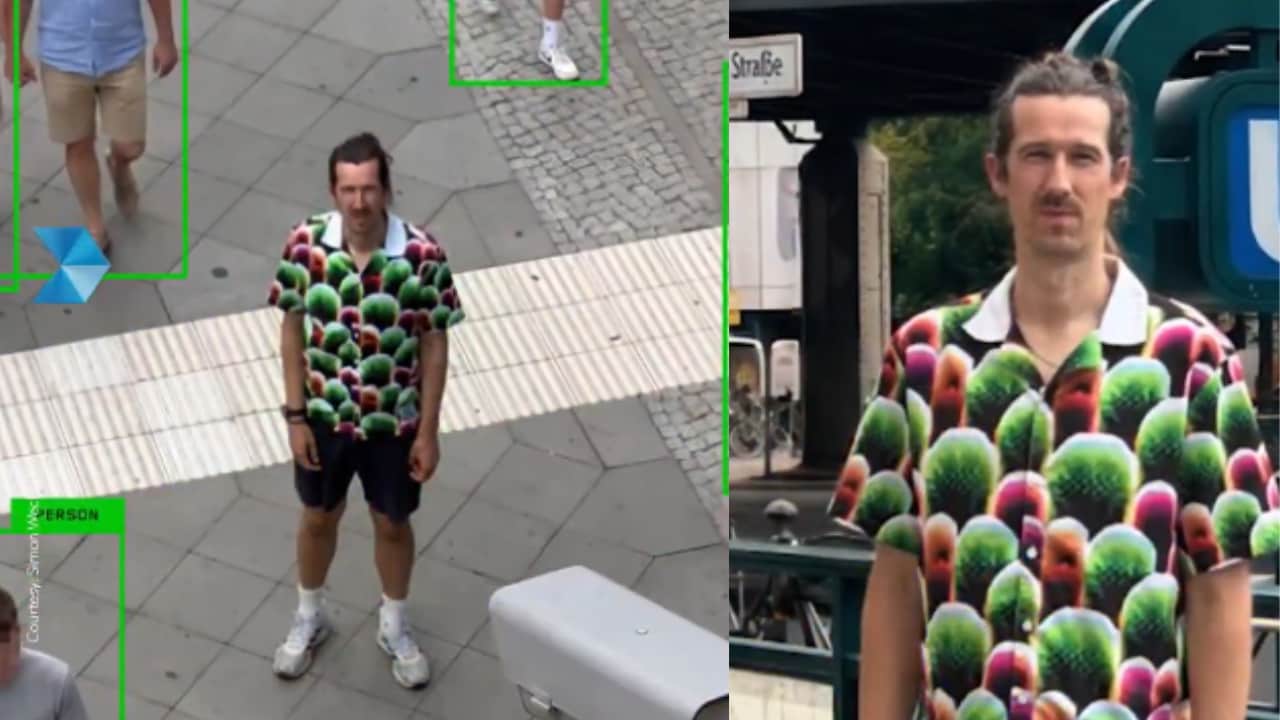
The digital surveillance grid watching modern cities is not actually smart. It is a massive statistical averaging engine that can be fooled by a piece of brightly colored fabric. Berlin-based artist Simon Weckert recently released an anti-surveillance garment named Digital Camouflage, priced around eighty dollars, engineered to make human wearers completely invisible to machine-vision security cameras.
To the naked eye, the button-down shirt is an aggressively garish assembly of pink, orange, and green shapes. To an automated camera running object-detection software, the wearer simply ceases to exist.
This is not magic. It is an adversarial attack on computer vision, and it exposes the profound structural fragility of the infrastructure tracking our public spaces.
Anatomy of a Machine Blind Spot
Computer vision models do not understand the world the way humans do. They do not look at a street corner and think about a person walking home from work, carrying groceries, or waiting for a train. Instead, algorithms like YOLO scan video feeds for specific statistical clusters, matching edges, pixel contrasts, and textures against millions of training images.
When a neural network spots a configuration of shapes that fits its mathematical threshold for a human body, it draws a bounding box around the target and tags it with a label.
Weckert built his pattern by running iterative trials against these exact object-recognition networks. The chaotic layout of the fabric is mathematically optimized to scramble the early layers of the neural network.
The high-contrast transitions confuse edge-detection filters, while the warped geometry prevents deeper layers from stitching the torso, limbs, and head into a single recognizable entity.
The system looks at the shirt, tries to resolve the statistical contradictions, and ultimately decides there is nothing there at all. The garment shouts over the quiet computational whisper that signals a human presence.
The History of Clothing as Subversion
Using apparel to confound tracking technology is a growing field of study, but it has deep literary and historical roots. Science fiction author William Gibson famously imagined the ultimate anti-surveillance garment in his 2010 novel Zero History, describing an intentionally repulsive piece of clothing designed to frustrate corporate and state monitoring through sheer aesthetic hostility.
Real-world engineers have spent years testing similar concepts. Researchers have previously experimented with adversarial patches printed on hoodies, infrared LEDs embedded in baseball caps to blind night-vision lenses, and facial makeup patterns designed to break facial recognition nodes.
Weckert is no stranger to exposing systemic digital vulnerabilities. In 2020, he famously wheeled a red wagon filled with ninety-nine active smartphones down empty streets in Berlin, entirely tricking Google Maps into rendering heavy red virtual traffic jams where no cars existed.
His latest project shifts that disruptive energy from software mapping to physical hardware surveillance, arriving precisely as Berlin expands automated monitoring systems in public transit hubs like Kottbusser Tor.
The Limits of Fabric Resistance
Despite the clever engineering behind the digital camouflage shirt, buying one will not liberate anyone from the modern panopticon. Clothing-based privacy interventions face severe practical and structural limitations that proponents rarely discuss openly.
Surveillance networks are rarely passive optical systems relying on a single camera angle. Modern municipal monitoring relies on multi-camera tracking, thermal imaging, gait analysis, and persistent cross-referencing across vast databases.
Even if a neural network loses the bounding box on a torso because of a loud pattern, an operator tracking movement vectors, height, and velocity can easily re-identify the target.
Furthermore, mass adoption of adversarial clothing faces a social barrier. Walking down a normal city street wearing a blindingly loud, algorithm-breaking shirt marks the wearer out just as effectively as being tracked by a camera. It replaces digital exposure with immediate physical conspicuousness.
The strategy relies on being an anomaly in a sea of traditionally dressed citizens. If everyone wore adversarial prints, surveillance vendors would simply retrain their models to account for the new visual baseline.
A Symptom of a Broken Social Contract
The commercial availability of an anti-surveillance shirt for the price of a standard retail garment points to a wider institutional failure. When citizens feel compelled to treat their daily commute like a tactical counter-intelligence operation, public trust in civic infrastructure has fundamentally collapsed.
Municipal authorities install automated recognition equipment under the banner of public safety, offering vague assurances about data retention and privacy protections. Meanwhile, citizens are left to improvise their own defenses using whatever tools are at hand, whether that means encrypted messaging applications, privacy-focused web browsers, or patterned shirts designed to trick computer code.
The eighty-dollar price tag makes the project accessible, transforming a high-end conceptual art piece into a tangible consumer statement. It proves that the armor protecting state and corporate monitoring systems contains critical design flaws.
The machine vision watching the street is rigid, brittle, and deeply stupid. As long as public spaces remain saturated with uninvited observation, designers will continue finding cheap, creative ways to exploit the blind spots of the algorithm.