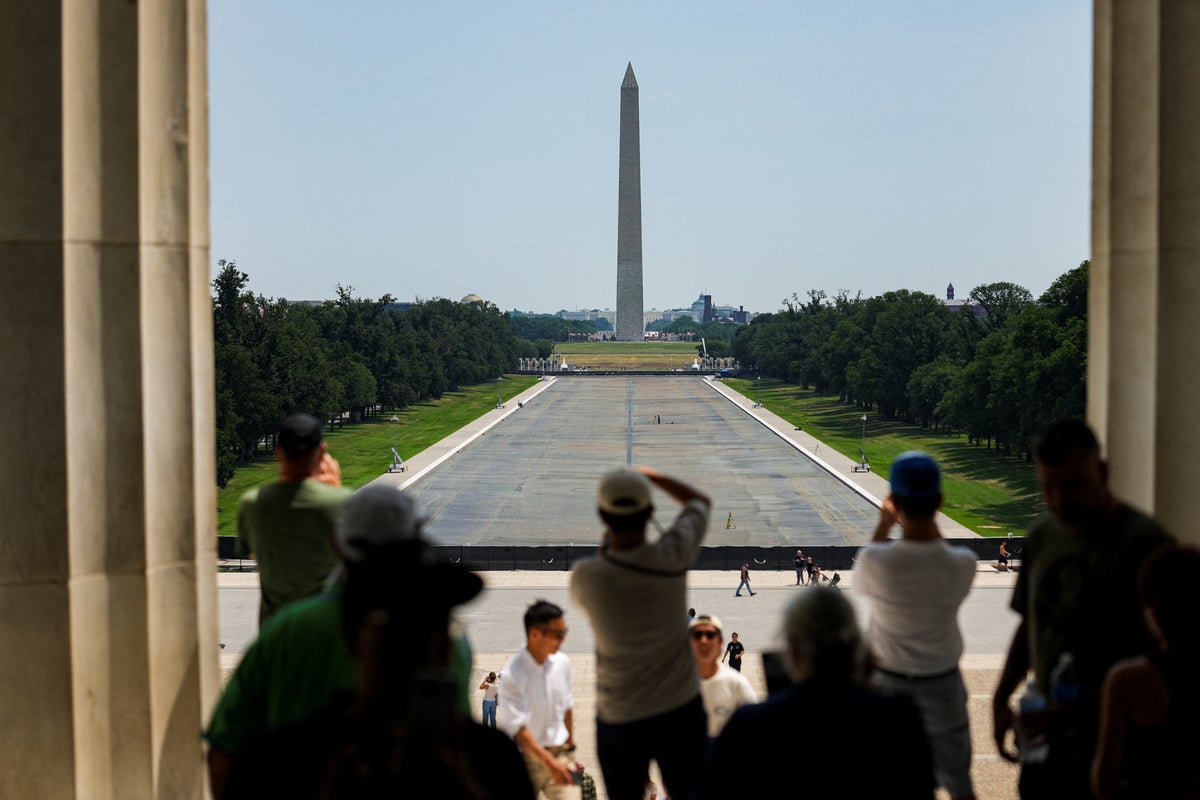
The federal agents sweeping the dry, concrete basin of the Lincoln Memorial Reflecting Pool are not just hunting for evidence of property destruction. They are looking for a political lifeline. For weeks, the White House has maintained that the rapid deterioration of the monument’s newly minted $16.4 million renovation is the work of coordinated saboteurs armed with blades and box cutters. Yet a close examination of public procurement records, engineering realities, and the administration's own promotional stunts tells a far more mundane, though far more damaging, story. The brilliant hue that was supposed to redefine the National Mall is coming apart because of basic chemistry, rushed timelines, and an abuse of the infrastructure itself.
The grand redesign of Washington’s most famous waterway has transformed from a patriotic spectacle into a multi-agency finger-pointing exercise. Millions of visitors arriving this summer have been greeted not by a shimmering body of water reflecting the sky, but by a fenced-off, bone-dry crater. The water was drained because the brand-new bottom liner began peeling away in massive sheets, floating to the surface like dead skin alongside a sudden, aggressive algae bloom. To explain the collapse of a project promised to last a century, the administration deployed the U.S. Park Police and the FBI to hunt down suspects. But the true culprit is not a phantom cell of anti-monument vandals. It is a combination of executive impatience and flawed industrial engineering. You might also find this connected story insightful: The Bandar Abbas Illusion Why US Air Strikes Are Just Expensive Political Theater.
The Cost of American Flag Blue
The transformation began earlier this spring when the executive branch set its sights on the 104-year-old pool. The traditional gray stone bottom, weathered by a century of history, was deemed unacceptable. The administration insisted that the pool should reflect a specific, vibrant shade dubbed "American flag blue". The goal was clear. The pool had to be fully functional and pristine before the massive July 4th celebrations marking the nation's 250th anniversary.
To achieve this, the National Park Service bypassed standard competitive bidding protocols. Citing an urgent national priority, officials awarded a $14.7 million contract to Virginia-based Atlantic Industrial Coatings to handle the waterproofing and application of the blue polymer coating. Another $1.7 million went to Green Water Solutions for a specialized filtration system. The contractors faced a punishing, truncated schedule to prepare the site for the summer crowds. As highlighted in recent reports by NPR, the implications are worth noting.
Industrial coatings applied to large, underwater concrete structures require strict environmental conditions to cure properly. Substrate moisture must be meticulously measured. The concrete must be completely free of contaminants. Temperatures must remain within narrow windows for consecutive days to allow the chemical polymers to cross-link and bond permanently with the underlying stone. When these processes are compressed to meet an unyielding political deadline, the long-term integrity of the material is compromised before the first gallon of water is poured.
Cracks in the Vandalism Narrative
When the pool was refilled in early June, the initial photos were a triumph of public relations. The bright blue basin gave the impression of a pristine tropical resort planted in the center of the nation's capital. The celebration did not last. Within days, park rangers noticed bubbles forming beneath the surface. Soon, sections of the blue liner began lifting completely off the floor.
The political response was immediate. The White House asserted that the pool had been intentionally slashed with a sharp knife or a razor across an area spanning roughly 300 yards. Law enforcement went on a war footing. Federal prosecutors brought charges against several citizens. Among them was a former Olympic canoe racer who was spotted reaching into the water near the edge of the pool.
The legal documents paint a curious picture of the alleged sabotage. According to defense filings, the individual did not possess a heavy-duty cutting tool capable of tearing through industrial-grade polymer sheets underwater. He had simply noticed a piece of the blue coating already peeling off the bottom and pulled at it out of curiosity before being told to step back by a park worker. The administration has used these minor interactions to construct a narrative of sweeping domestic terrorism. They have threatened felony charges against anyone caught carrying away loose paint chips that had washed ashore.
For an industrial coating to peel in large, clean sheets, there must be an underlying failure of adhesion. A simple knife strike on a properly bonded epoxy coating creates a localized scratch or a small chip. It does not cause hundreds of yards of material to separate cleanly from the substrate. When sheets of a liner peel back effortlessly, it indicates that the moisture barrier failed or that the concrete was too damp when the coating was laid down. The material never truly gripped the stone.
The Heavy Footprint of Presidential Publicity
While the administration searches for outside agitators, it has ignored an event that occurred right in front of the television cameras. In May, just as the final layers of the blue coating were being applied, the president made an unannounced visit to the site to inspect the work. He did not merely walk along the gravel paths. He ordered his heavily armored, multi-ton presidential SUV to be driven directly across the dry basin of the pool so he could speak to reporters from the center of the monument.
The sheer weight of an armored executive vehicle puts immense localized pressure on any surface it traverses. For a freshly applied industrial liner that is still undergoing its multi-week curing process, such a load is catastrophic. The weight can easily create micro-fractures in the unbonded material, breaking the delicate chemical seal and creating tiny pockets where air and moisture can settle. Once the pool was filled with millions of gallons of water, the hydrostatic pressure found those exact weak points, pushing under the liner and ballooning the coat until it ruptured.
The public was told that the vehicle transit was a routine inspection. Engineering specialists know better. Driving heavy machinery over uncured pool liners violates every basic installation manual provided by coating manufacturers. Yet the political necessity of the photo opportunity overrode technical protocols, and the public is now paying the price for that brief moment of television footage.
The Procurement Puzzle
The handling of the aftermath raises even more questions about how public funds are being managed. Following the post-July 4th draining, the Department of the Interior announced that it would not open the repair work to a new round of competitive bidding. Instead, the administration intends to retain the exact same contractors to fix the damage, using the justification that they already understand the layout of the project.
This decision insulates the original builders from accountability. In a standard federal infrastructure project, if a contractor's work fails within weeks of completion, the government initiates an independent review to determine if the failure was due to material defects or poor workmanship. If the contractor is found negligent, they are required to remediate the site at their own expense or face debarment. By declaring the failure an act of God or vandalism, the administration allows the contractors to claim that the destruction was outside their control, opening the door for them to receive even more taxpayer money to fix their own botched installation.
Congressional oversight committees have launched inquiries into the financing of the facelift. Lawmakers are demanding to see the daily logs kept by the National Park Service during the application process, specifically looking for weather delays that should have pushed the timeline back but were ignored to meet the July 4th deadline. The records will likely show that science was sacrificed for schedule.
The Cost of Looking Good
The crisis at the Reflecting Pool is a case study in a broader philosophy of governance that prioritizes superficial optics over structural permanence. The pool was never designed to look like a Caribbean swimming pool. Its original architects selected gray granite precisely because it absorbed light, allowing the water to act as a dark, mirror-like surface that perfectly doubled the image of the Washington Monument and the Lincoln Memorial. The bright blue paint destroyed that optical illusion, turning a solemn historical space into something resembling an empty amusement park attraction.
Worse still, the vivid blue backdrop has exacerbated the environmental problems plaguing the stagnant water. The shallow basin sits under the intense summer sun of Washington, creating a perfect incubator for biological growth. The bright blue floor reflects more light through the water column, accelerating the photosynthesis of cyanobacteria. The $1.7 million filtration system was instantly overwhelmed by an explosion of bright green algae, which looked even more garish against the artificial blue background.
The FBI agents can continue to comb the concrete for knife marks, and prosecutors can continue to pursue citizens who picked up stray pieces of debris. None of it will change the underlying reality. You cannot arrest your way out of a bad paint job, and you cannot use a federal investigation to rewrite the laws of chemistry. The reflecting pool stands empty today because the individuals trusted with its preservation forgot that a monument's true value lies in its endurance, not its color.


