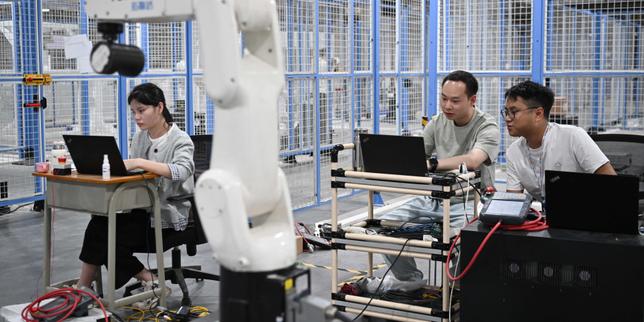
Walk through the industrial corridors of Guangdong province and the noise hits you first. It is not the human chatter of the 2010s. It is the rhythmic, mechanical hiss of pneumatic valves and the hum of automated guided vehicles. In southern China, artificial intelligence is no longer a boardroom talking point. It is actively re-engineering the factory floor to survive a brutal combination of soaring labor costs, a shrinking youth workforce, and fierce international competition.
This shift goes far beyond simple robotics. By embedding machine learning directly into assembly lines, Chinese manufacturers are attempting a high-stakes pivot from low-cost mass production to high-efficiency precision engineering. For another look, see: this related article.
The transformation is born of sheer necessity. Over the past decade, the economic math that built the Pearl River Delta has fallen apart. Young Chinese workers are actively rejecting grueling factory shifts, preferring gig-economy flexibility or service-sector jobs. Concurrently, blue-collar wages have climbed steadily. To prevent multinational brands from moving their supply chains to Southeast Asia or Mexico, Southern China's industrial base had to find a way to produce more goods with a fraction of the human capital.
The Quiet Re-engineering of the Pearl River Delta
The hardware changes are easy to spot. Heavy industrial arms swing with terrifying precision, welding frames and moving heavy components. The true disruption, however, happens invisibly within the local server stacks. Related insight regarding this has been published by TechCrunch.
Traditional automation relied on rigid programming. If a part arrived misaligned by a single millimeter, the entire assembly line ground to a halt. Machine vision systems changed that dynamic entirely. Cheap, high-resolution cameras now monitor components in real time. Feeding these images into localized neural networks allows the system to recognize imperfections, adjust the grip of a robotic arm on the fly, and keep production moving without human intervention.
Consider a factory producing complex electronic circuit boards. A human inspector looking through a microscope can catch obvious soldering defects, but fatigue sets in after a few hours. A computer vision system scans thousands of joints per minute, cross-referencing them against an optimized database of ideal configurations. It catches flaws invisible to the human eye, flags the exact component for rework, and logs the data to adjust the upstream machinery automatically.
This creates a self-correcting loop. The factory floor becomes an evolving ecosystem that optimizes its own output based on live performance data.
The Myth of the Workerless Utopia
International headlines frequently paint these developments as a flawless march toward dark factories where the lights are turned off because robots do not need to see. The reality on the ground is far messier.
Total automation remains an incredibly expensive proposition. While massive conglomerates can afford to sink millions into proprietary software and custom robotic arrays, the thousands of small and medium-sized enterprises (SMEs) that form the backbone of the Chinese supply chain cannot. These smaller players operate on razor-thin margins. For them, upgrading means a piecemeal approach. They might buy a single second-hand robotic arm, hook it up to a basic algorithmic sensor, and leave the rest of the line dependent on human hands.
This creates a jarring operational duality. You can find a facility where a sophisticated algorithm coordinates the logistics of an entire warehouse, yet the final packaging is still done by a row of middle-aged workers taping cardboard boxes by hand.
The Hidden Bottleneck of Customization
Software code is notoriously rigid when applied to the physical world. While an AI model can adapt to slight variations in a single product line, completely retooling a factory for a new product remains a labor-intensive engineering challenge.
- Data Scarcity: Algorithms require vast amounts of specific operational data to learn. A factory switching from producing smartphone cases to medical devices cannot simply flip a switch; it must train new models from scratch.
- Hardware Limitations: Software can update in seconds, but physical machinery requires manual calibration, new custom grippers, and physical floor space adjustments.
- Integration Friction: Getting legacy machinery built in the early 2000s to communicate with modern industrial software platforms requires complex middleware and significant engineering hours.
Geopolitical Pressure and the Race for Local Silicon
Western export controls have complicated this industrial evolution. With access to top-tier international semiconductors restricted, southern Chinese tech hubs like Shenzhen have poured capital into domestic alternatives.
The focus has shifted toward application-specific integrated circuits (ASICs) designed specifically for industrial environments. These chips do not need the massive computational power required to run large language models in cloud data centers. Instead, they are optimized to do one thing exceptionally well: process sensor data at the edge with minimal power consumption. By focusing on these specialized chips, local manufacturers have managed to insulate themselves from some of the harshest impacts of international trade restrictions.
This domestic chip ecosystem has allowed factory owners to keep deployment costs relatively low. A localized vision system running on domestic silicon might not be as advanced as a Western counterpart, but it is often cheap enough to justify the return on investment for a factory owner scraping by on single-digit profit margins.
The Human Cost of Algorithmic Management
For the workers who remain on these modernized factory floors, the nature of employment has shifted dramatically. The physical toll of heavy lifting has decreased, replaced by the psychological pressure of algorithmic oversight.
Every movement is tracked. Software monitors the exact speed at which an operator completes their assigned task, constantly comparing their output against an optimized baseline generated by an algorithm. If a worker slows down due to fatigue, the system notices immediately. This data feeds into performance reviews, determining bonuses and employment status.
The relationship between management and labor has become transactional and data-driven. Workers are no longer managed by human supervisors who understand the nuances of a bad day or physical exhaustion; they are managed by an optimization metric that demands peak efficiency every single minute of an eight-hour shift.
The Scale Problem Outside the Mega-Corporations
Step away from the flagship facilities of global electronics giants and the limits of this technological push become glaringly obvious. The vast majority of Southern China's industrial output comes from fragmented supply chains operating out of multi-story concrete buildings in towns you have never heard of.
For these business owners, the math of upgrading simply does not add up. High interest rates on equipment loans and unpredictable export demand make long-term capital investments incredibly risky. They look at automation not as a grand vision for the future, but through a cold calculation of monthly cash flow. If hiring temporary migrant labor for a peak production season is cheaper than financing a robotic upgrade, they will choose the workers every single time.
This reality splits the manufacturing sector into two distinct tiers. On one side are elite, highly automated facilities capable of meeting the stringent quality standards of global tech brands. On the other are thousands of low-tech workshops reliant on cheap labor and aging machinery, struggling to survive as their cost advantages erode.
The Real Threat to Global Competitors
Western manufacturers who believe China's rising labor costs will naturally level the playing field are miscalculating. The true advantage of Southern China's industrial cluster is not cheap labor, nor is it the sheer intelligence of its software. It is the unparalleled density of the supply chain.
Within a two-hour drive of Shenzhen, a manufacturer can source specialized screws, custom circuit boards, molded plastics, and high-capacity batteries. Integrating automation into this hyper-concentrated ecosystem creates a compounding efficiency advantage. When an algorithm detects a defect or a bottleneck, the fix can be sourced, manufactured, and delivered from a supplier just down the road within the same afternoon.
This level of agility cannot be replicated by simply building a highly automated factory in an isolated industrial park in Europe or North America. The software optimizes the factory floor, but the physical proximity of the supply chain optimizes the entire production cycle.
The race for industrial dominance will not be won by the country with the most advanced theoretical software models. It will be won by the factories that successfully bridge the gap between digital code and physical execution on the shop floor, turning abstract computational power into millions of physical goods shipped on time, every single day.