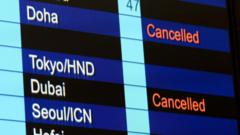
The myth of sport as a sanctuary from geopolitics died this week at 35,000 feet. While fans in Melbourne and London were checking ticket prices, nearly a thousand Formula 1 personnel were scrambling to find any cockpit or cabin that could bypass the closed airspace over the Persian Gulf. This is not just a "reshuffling of flights" or a minor scheduling hiccup. It is a fundamental collapse of the world’s most critical athletic transit hub.
By Monday, the reality had set in: the Middle East, the very region that spent billions to become the "central station" of global competition, has effectively shut its doors. With airspace closures spanning Iran, Israel, Jordan, Iraq, and the UAE, the logistics of modern sport are being stripped to their bones. We are seeing the fallout of a system that placed too much trust in the stability of a single geography.
The Dubai Bottleneck
For twenty years, the sports industry treated Dubai and Doha as the invincible bridges between East and West. If you were a tennis pro heading to Indian Wells or a cricket squad finishing a tour in Asia, you flew through the Gulf. That assumption has vanished.
The closure of Dubai International—the world's busiest airport—has left elite athletes like Daniil Medvedev and PV Sindhu effectively marooned. The ATP is currently paying for hotel rooms and "supporting immediate needs," but they cannot conjure a flight path where missiles are flying. The logistical math is simple and brutal: if you cannot fly over the Gulf, you are looking at a 10-hour detour around the southern tip of Africa or a circuitous crawl through Central Asia. For a professional athlete, a 15-hour flight turning into a 30-hour odyssey isn't just an inconvenience; it is a season-ending physical toll.
Consider the Formula 1 scramble. Travis Auld, chief of the Australian Grand Prix, has been forced into a defensive crouch, assuring the public that the race will go on. Behind the scenes, the "logistical responsibility" he refers to involves chartering private fleets and begging for landing slots in countries that were not on the original flight plan. When 1,000 essential staff members are scattered across half a dozen countries, the risk of a "ghost race"—where cars arrive but the mechanics do not—becomes a terrifyingly real possibility.
The AFC and the Collapse of Competition
While F1 fights to reach Australia, the Asian Football Confederation (AFC) is watching its calendar disintegrate. The decision to postpone Champions League matches involving giants like Al Nassr and Al Hilal isn't just about safety; it’s about the total loss of home-field advantage as a concept.
When the Qatar Football Association suspended all domestic matches indefinitely, it didn't just stop local league play. It threw the March 27 Finalissima between Spain and Argentina into a black hole. Qatar built the Lusail Stadium to be the crown jewel of world football, yet today, it sits empty because no one can guarantee that Lionel Messi or Lamine Yamal can land there safely.
The financial bleed is staggering. In volleyball, the Israeli national teams are stuck abroad, draining their association’s budget just to keep 50 people fed and housed in Europe. This is the hidden tax of war on sport: the slow, agonizing bankruptcy of mid-tier federations that cannot afford to be "nomadic" for months on end.
The Iran World Cup Dilemma
The most significant investigative thread, however, isn't about where teams are sleeping tonight—it’s about whether they will exist on the world stage tomorrow. Mehdi Taj, president of the Iranian Football Federation, has already hinted that Iran’s participation in the 2026 World Cup is "far from expectations."
This is a geopolitical landmine for FIFA. Iran is drawn into Group G, scheduled to play in the United States—the very country currently involved in strikes against them. Even if the conflict de-escalates, the visa hurdles are insurmountable. In late 2025, five out of nine Iranian delegates were already denied entry to the U.S. for the draw. With the current hostilities, the idea of an Iranian national team landing in New Jersey or Los Angeles is a diplomatic fantasy.
If Iran withdraws or is forced out, FIFA faces a legitimacy crisis. Replacing a qualified team weeks before a tournament destroys the integrity of the bracket. Yet, forcing the games to proceed amidst active warfare is a liability nightmare that insurers will not touch.
The Normalization Mirage
We have to talk about the "normalization" efforts that were touted just months ago. In December 2025, EuroLeague basketball triumphantly returned to Tel Aviv. It was supposed to be the "bridge" that everyone loves to talk about. That bridge has been bombed.
By late February 2026, the EuroLeague was forced to backtrack, moving games involving Turkish clubs Fenerbahce and Anadolu Efes to Belgrade and Sofia. The "security guarantees" that politicians used to celebrate have proven worthless against the reality of regional escalation. Sport didn't bring peace; it just provided a high-profile target for the chaos.
The Physical and Financial Cost
When we look at the logistics, we must use precise terms. The detour routes currently being utilized increase fuel consumption by as much as 40%. For a billionaire-backed F1 team, this is an accounting line item. For the Olympic delegations and Paralympic athletes currently trying to reach Italy for the Winter Games, it is a catastrophic drain on limited resources.
- Logistical Deadlock: Airspace closures in 8 countries simultaneously.
- Stranded Personnel: Estimated 1,500+ elite athletes and support staff currently in transit limbo.
- Infrastructure Paralysis: Training centers in Israel and Iran closed, halting the development of the next generation of talent.
The industry is currently operating on "buffer stocks" of patience, but that is running thin. The lesson of 2026 is that the sports world’s pivot to the Middle East was built on a foundation of sand. You can build the most advanced stadiums in the world, but if the sky above them is closed, they are nothing more than very expensive ruins.
The immediate next step for any major sporting body is to stop looking at the Middle East as a reliable hub and begin the painful, expensive process of diversifying their transit routes through Northern Europe and Southeast Asia. The "central station" is closed, and it isn't opening anytime soon.
Would you like me to analyze the specific insurance liability clauses that are now being triggered for the cancelled Finalissima match?