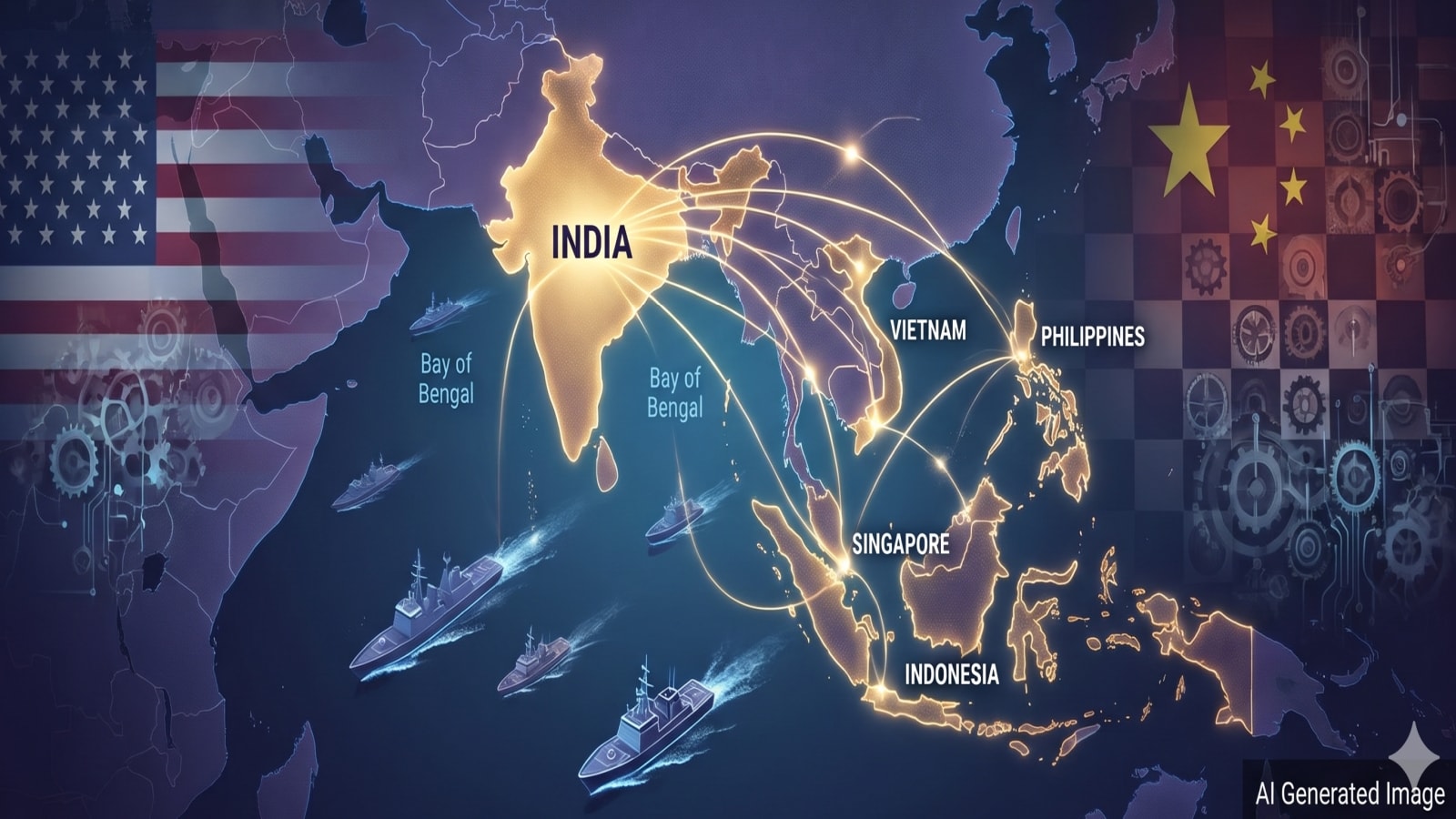
India's Act East policy is no longer a diplomatic luxury or a polite nod to historical neighbors. It is an urgent economic and strategic survival mechanism driven by fractured global supply chains, aggressive maritime expansion in the Indo-Pacific, and New Delhi's desperate need to turn its landlocked Northeast from a security liability into an industrial gateway. If India fails to lock in deep, friction-free trade and defense integration with key ASEAN nations right now, it risks permanent marginalization in the Asian century.
For three decades, foreign policy mandarins in New Delhi talked a big game about looking east. They signed agreements. They attended summits in Jakarta, Bangkok, and Singapore. They toasted to shared Buddhist heritage and ancient maritime spice routes. For a closer look into this area, we recommend: this related article.
Meanwhile, Beijing built ports, laid high-speed rail, and swallowed Southeast Asian supply chains whole.
When Prime Minister Narendra Modi upgraded P.V. Narasimha Rao’s 1991 "Look East" doctrine to "Act East" in 2014, the branding changed, yet the structural bottlenecks remained stubbornly intact. Today, those bottlenecks have become existential threats. Global manufacturers are actively hunting for a "China Plus One" production base, and India wants that capital. Yet you cannot build a modern manufacturing powerhouse on the Bay of Bengal while ignoring the ten-nation bloc sitting right across the water. For additional background on the matter, extensive analysis is available at Forbes.
The Myth of the Automatic Alternative
Walk into any boardroom in Mumbai or Bengaluru, and you will hear the same bullish pitch. Western companies are de-risking from China, and India is the natural heir to the global factory floor.
That pitch falls apart the moment you examine how modern electronics, textiles, and automotive components are actually made.
Manufacturing does not happen in isolation inside a single country's borders anymore. It happens across tightly synchronized regional networks. A smartphone assembled in Tamil Nadu or Vietnam relies on microchips from Malaysia, precision sensors from Singapore, specialty chemicals from Thailand, and raw minerals from Indonesia. When Western firms look to shift assembly lines out of Shenzhen, they do not want to relocate to an isolated island. They want to plug into an existing, hyper-efficient ecosystem.
ASEAN is that ecosystem.
The Association of Southeast Asian Nations commands a combined gross domestic product exceeding $3.6 trillion and a population of roughly 680 million people. More importantly, ASEAN spent the last twenty years aggressively stripping away tariffs and harmonizing customs rules among its members and its East Asian neighbors. India, by contrast, walked away from the Regional Comprehensive Economic Partnership (RCEP) in 2019 out of fear that cheap Chinese and Southeast Asian goods would flood its domestic market and wipe out local farmers and small manufacturers.
That decision left India on the outside looking in.
To capture the supply chain migration happening right now, New Delhi has to solve a brutal paradox. It wants foreign investment to build export-oriented factories, yet its high import tariffs on intermediate components make Indian-made goods too expensive to compete globally. Deepening bilateral ties with industrial heavyweights like Vietnam, Malaysia, and Thailand is the only way out of this trap. Without smooth, low-tariff component flows between Chennai and Ho Chi Minh City, India's "Make in India" ambition hits a hard mathematical ceiling.
The Trade Deficit Nobody Wants to Fix
Ask an Indian trade negotiator about the ASEAN-India Trade in Goods Agreement (AITIGA), signed in 2009, and watch their jaw tighten. Inside the Ministry of Commerce, AITIGA is widely viewed as a lopsided disaster.
The numbers tell a stark story. Since the pact took effect in 2010, India’s trade deficit with ASEAN has ballooned from roughly $5 billion to well over $40 billion annually. Southeast Asian exporters gained easy access to India’s massive consumer market, shipping palm oil, electronics, machinery, and base metals into Indian ports. Indian exporters, meanwhile, ran straight into a wall of non-tariff barriers, opaque regulatory standards, and sluggish customs clearances across Southeast Asia.
Worse still, New Delhi suspects that Chinese manufacturers have been using ASEAN nations as a backdoor. By routing goods through Vietnam or Malaysia with minimal local processing, third-party exporters allegedly take advantage of preferential ASEAN tariffs to dump cheap products into India, bypassing anti-dumping duties meant for Beijing.
This asymmetry has poisoned the well for years. Protectionist lobbies in New Delhi have used the ballooning deficit as ammunition to argue against any further trade liberalization.
They are drawing the wrong conclusion from the right data.
Retreating behind tariff walls will not shrink that deficit; it will simply leave India poorer and less competitive. The ongoing review of AITIGA, which both sides agreed to conclude by 2025, is the real battleground. New Delhi does not need to scrap the deal. It needs to enforce strict Rules of Origin verification, demand mutual recognition of product standards so Indian pharmaceuticals and agricultural goods are not stalled at ASEAN ports, and integrate Indian service sectors—specifically IT, fintech, and engineering—into Southeast Asian digital economies.
Where the Real Leverage Lies
Trade in physical goods is only half the ledger. Southeast Asia is undergoing a massive digital transformation, and its internet economy is projected to cross $300 billion in gross merchandise value within the next few years.
India possesses something none of its regional competitors can match at scale: battle-tested Digital Public Infrastructure (DPI).
Systems like the Unified Payments Interface (UPI) and Aadhaar have fundamentally rewired how money and identity move across a population of 1.4 billion people. Singapore has already linked its PayNow system with India’s UPI, allowing instant, low-cost cross-border remittances. Malaysia, Thailand, and the Philippines are actively moving toward similar integrations.
This is quiet, high-impact statecraft. When an Indian tourist in Bangkok or a Filipino worker sending money home uses payment rails built on Indian architecture, New Delhi gains structural influence that no diplomatic communique can replicate. It creates sticky, everyday interdependence.
The Northeast Corridor Gamble
Look at a map of India, and your eyes immediately catch a glaring geographic vulnerability.
The Siliguri Corridor, known globally as the Chicken's Neck, is a narrow strip of land barely 22 kilometers wide at its tightest point. Sandwiched between Nepal, Bangladesh, and Bhutan, and sitting perilously close to the Chumbi Valley where Chinese troops are heavily entrenched, this slender bottleneck connects mainland India to its eight northeastern states.
For decades, New Delhi treated the Northeast as a remote frontier buffer zone—underfunded, insurgency-plagued, and cut off from the sea. Partition in 1947 severed the region's natural trade arteries through what is now Bangladesh, leaving states like Assam, Manipur, and Mizoram economically stranded.
Act East is an audacious attempt to reverse that geography. Instead of viewing the Northeast as the end of the road, New Delhi is trying to turn it into a bridgehead into mainland Southeast Asia.
The flagship projects are ambitious on paper and agonizingly slow in execution:
- The India-Myanmar-Thailand Trilateral Highway: A 1,360-kilometer overland route designed to connect Moreh in Manipur to Mae Sot in Thailand via Myanmar. Once completed, a truck carrying goods from Guwahati could theoretically drive straight to Bangkok, and eventually connect to the wider ASEAN highway network reaching Vietnam and Cambodia.
- The Kaladan Multi-Modal Transit Transport Project: A complex logistical chain combining sea transport from Kolkata to Sittwe port in Myanmar’s Rakhine state, river transit up the Kaladan River to Paletwa, and a highway link into Mizoram. The goal is simple: bypass the Chicken's Neck entirely and give the landlocked Northeast direct maritime access to the Bay of Bengal.
Here is the brutal reality on the ground. Both projects are bleeding time and money because Myanmar has descended into a savage, multi-front civil war.
Since the military junta seized power in February 2021, central authority across Myanmar has fractured. Resistance militias and ethnic armed organizations now control vast swathes of territory bordering India and Thailand, including key stretches around the Kaladan project and the Sagaing region through which the Trilateral Highway passes. Bridges have been blown up. Construction crews have been evacuated. Security guarantees have evaporated.
New Delhi faces an excruciating diplomatic tightrope in Naypyidaw. If India publicly condemns the junta and aligns with Western sanctions, the generals will push Myanmar entirely into Beijing’s orbit, handing China uncontested access to the Bay of Bengal via the China-Myanmar Economic Corridor. If India cozies up too closely to the junta, it alienates the democratic resistance forces who currently control the very borderlands where Indian infrastructure is supposed to run.
So far, Indian diplomats have opted for cold-eyed pragmatism, maintaining working channels with the military while quietly engaging ethnic armed groups along the border. It is messy, morally compromised, and entirely necessary. Until Myanmar stabilizes, India’s overland dreams will remain stalled in the mud, forcing New Delhi to double down on maritime connectivity across the Bay of Bengal and the Andaman Sea.
Steel, Radar, and the South China Sea
Talk to defense analysts in Singapore, Manila, or Hanoi, and they will tell you that trade statistics are not what keep them awake at night.
Gray-zone maritime coercion is.
Over the past decade, Beijing has constructed militarized artificial islands across the South China Sea, deployed massive coast guard fleets to ram Philippine resupply vessels at Second Thomas Shoal, and harassed Vietnamese and Malaysian energy exploration rigs inside their own Exclusive Economic Zones. Smaller ASEAN states are caught between a superpower neighbor they cannot afford to alienate economically and a terrifying erosion of their maritime sovereignty.
They do not want to be forced to choose between Washington and Beijing. They want a third weight on the scale.
India is stepping into that vacuum, shedding decades of cautious non-alignment in favor of hard security partnerships.
For years, New Delhi avoided taking sharp public stances on South China Sea disputes, wary of provoking Beijing along their contested Himalayan border. That restraint died in the freezing waters of the Galwan Valley in June 2020, when deadly hand-to-hand clashes between Indian and Chinese troops shattered the illusion of a stable border peace.
Since then, India’s defense posture in Southeast Asia has shifted from symbolic port calls to concrete hardware transfers and intelligence sharing:
- The BrahMos Breakthrough: In 2022, India inked a $375 million deal to supply the Philippines with shore-based anti-ship variants of the BrahMos supersonic cruise missile. Co-developed with Russia, the BrahMos flies at nearly Mach 3 and is notoriously difficult to intercept. Delivering those batteries to Manila in 2024 sent an unmistakable signal across the region: India is willing to arm frontline states to raise the cost of maritime aggression. Vietnam and Indonesia are widely reported to be in advanced discussions for similar acquisitions.
- Underwater Domain Awareness: Through its Information Fusion Centre – Indian Ocean Region (IFC-IOR) in Gurugram, India hosts liaison officers from partner nations, including several ASEAN members, pooling real-time satellite and radar data to track dark shipping, illegal fishing, and foreign submarine movements from the Malacca Strait to the Gulf of Aden.
- The Andaman and Nicobar Bastion: Sitting right at the western mouth of the Malacca Strait—the narrow chokepoint through which roughly 80 percent of China’s imported oil and a massive share of global trade must pass—India’s Andaman and Nicobar Islands are an unsinkable aircraft carrier. New Delhi is pouring billions into extending runways, upgrading deep-water jetties, and deploying P-8I maritime surveillance aircraft to the archipelago.
Yet even here, limits exist. India’s naval budget is a fraction of China’s, and its shipyards are stretched thin trying to counter Beijing’s growing footprint in the Indian Ocean itself, where Chinese dual-use research vessels and submarines are making regular appearances in Sri Lanka, the Maldives, and Pakistan. India cannot act as the policeman of the South China Sea. What it can—and must—do is build asymmetric deterrence capacity among key ASEAN partners so they can defend their own coastlines.
The Structural Flaws Holding New Delhi Back
If the strategic logic of Act East is airtight, why does execution still feel like wading through wet cement?
Because India’s domestic bureaucracy and political economy frequently sabotage its foreign policy ambitions.
First, there is a glaring capacity deficit inside the Indian diplomatic and trade establishment. India’s Ministry of External Affairs is notoriously understaffed for a nation of its size and global aspirations, operating with a diplomatic corps roughly comparable in headcount to that of Singapore or New Zealand. Negotiating complex, multi-sector trade agreements, tracking regulatory shifts across ten vastly different ASEAN economies, and managing cross-border infrastructure projects require armies of specialized bureaucrats, lawyers, and technical experts that New Delhi simply does not have on the ground.
Second, Indian corporate culture remains stubbornly risk-averse when it comes to Southeast Asia. While Indian conglomerates aggressively chase deals in London, New York, and Dubai, many still view ASEAN markets as too fragmented or culturally unfamiliar. Meanwhile, Chinese state-backed enterprises flood ASEAN capitals with subsidized financing, turnkey engineering packages, and relentless on-the-ground lobbying. When a Malaysian or Indonesian infrastructure ministry puts a major port or rail contract out to tender, Indian firms rarely show up with competitive financing packages backed by New Delhi.
Third, ASEAN itself is not a monolith, and treating it like one is a fatal analytical error.
The bloc operates strictly by consensus, which means its collective diplomatic voice often defaults to the lowest common denominator. Countries like Cambodia and Laos are deeply reliant on Chinese investment and infrastructure loans, making them reliable proxies for Beijing whenever ASEAN tries to draft a strongly worded statement on maritime security. Indonesia, the bloc’s largest economy and de facto leader, guards its strategic autonomy fiercely and resists any move that looks like an anti-China military alliance. Singapore prioritizes open trade and legal stability above all else, while Vietnam shares India’s deep-seated historical wariness of Chinese territorial ambition.
Trying to move all ten nations at the exact same speed guarantees paralysis.
The Pivot to Minilateralism
Smart strategists in New Delhi have finally realized that waiting for all ten ASEAN flags to align is a fool's errand. The future of Act East lies in targeted, bilateral, and minilateral deals with the maritime nations that actually share India’s immediate security and economic priorities.
That means pouring disproportionate diplomatic capital into four critical anchors:
- Singapore: The financial, logistical, and technological nerve center of the region. Roughly a quarter of all foreign direct investment flowing into India routes through Singapore. Deepening semiconductor ecosystem partnerships, green energy grids, and cross-border digital payment networks with Singapore gives India immediate access to global capital and high-end manufacturing know-how.
- Vietnam: India’s most natural strategic twin in the region. Both nations boast fast-growing, young populations, both are competing fiercely to capture manufacturing shifting out of China, and both face direct territorial pressure from Beijing. Cooperation here spans oil and gas exploration in Vietnam’s waters, defense hardware maintenance, and complementary textile and electronics supply chains.
- Indonesia: Separated from India’s Andaman Islands by less than 100 nautical miles across the Great Channel, Indonesia is a maritime giant controlling the Sunda and Lombok straits. Joint development of the Sabang deep-sea port in Aceh—situated right at the northern tip of Sumatra—gives India and Indonesia shared oversight over the entrance to the Malacca Strait.
- The Philippines: Once an afterthought in Indian foreign policy, Manila has rapidly become a frontline partner. Beyond missile sales, India is expanding coast guard cooperation, maritime domain awareness training, and pharmaceutical exports to a nation actively pushing back against maritime coercion.
By building deep, interlocking hubs with these four maritime powers, India bypasses the consensus trap that paralyzes broader ASEAN summits.
The clock is ticking loudly across the Indo-Pacific. Supply chains are hardening into new configurations right now, and once a multinational corporation sinks billions of dollars into a semiconductor packaging plant in Penang or a battery factory in Java, those investment decisions are locked in for a generation. Maritime boundaries are being redrawn through sheer physical presence, and diplomatic hesitation translates directly into lost territory and lost leverage. New Delhi has spent thirty years talking about the promise of the East; either it tears down its own tariff walls, fixes its broken border infrastructure, and backs its regional partners with hard capital and steel, or it will spend the next thirty years watching someone else write the rules of Asia.