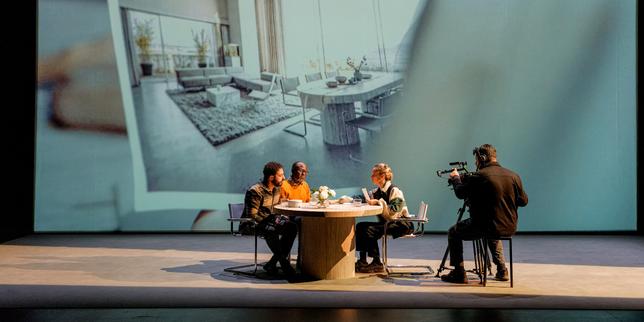
The curtain rises at the Théâtre National Wallonie-Bruxelles, but there is no celebratory air in the room. Anne-Cécile Vandalem and co-writer Joëlle Sambi have brought La Fête to the stage, a grueling, nearly three-hour theatrical examination of privilege, institutional shielding, and the raw tragedy of the Sanda Dia case. For those who have watched Belgium grapple—and frequently fail to grapple—with its colonial ghosts and modern prejudices, this production is not merely a piece of drama. It is a mirror held up to a society that prefers its racism polite, unarticulated, and safely denied.
To understand why La Fête has pierced the cultural armor of Brussels, one must look directly at the real-world wound that inspired it. In 2018, Sanda Dia, a 20-year-old Black engineering student, died during a hazing ritual administered by members of Reuzegom, an exclusive student fraternity largely composed of affluent, white youth in Flanders. The subsequent legal proceedings yielded minimal sentences, community service, and heavy public outrage over a justice system perceived as fiercely protective of its own elite. Vandalem’s play imagines a hypothetical gathering two years after such a catastrophe, bringing grieving families and members of the privileged class into the same suffocating room. The result is an uncompromising dissection of how institutional power preserves itself through silence.
For decades, the cultural establishment in Western Europe has hidden behind a comfortable myth. This narrative insists that racism is an American import or an aberration practiced by fringe extremists, rather than an architectural pillar of European social stratification. Vandalem strips away this defense mechanism with clinical precision. On stage, the physical space is sharply divided, echoing the invisible walls that separate the beneficiaries of imperial history from those who bear its daily costs. The dialogue does not offer easy catharsis. Instead, it weaponizes discomfort, forcing the audience to confront their own passive complicity in structures that reward pedigree and punish outsider status.
Journalists covering the premiere in Brussels and subsequent runs have pointed out the palpable tension in the auditorium. People shift in their seats because the characters on stage are not cartoon villains. They are articulate, well-mannered, and entirely convinced of their own inherent fairness. That is the core pathology La Fête exposes. The most dangerous form of racism in contemporary Europe is not the overt slur shouted in a dark alley; it is the institutional shrug, the quiet networking that commutes penalties, and the insistence that privilege is merely the reward for hard work.
The production utilizes a sophisticated blend of documentary theater techniques, striking sound design by Alex Tambu and Pierre Kissling, and piercing voice-over poetry by Joëlle Sambi. Yet, the technical mastery serves a singular political purpose. It refuses to let the public move on. Societies crave closure after a scandal. They demand trials, editorials, institutional reforms, and then a return to polite quietude. La Fête shatters that timeline, arguing that true reconciliation is impossible while the mechanisms of denial remain fully operational.
Critics of the work have occasionally asked whether art can genuinely shift political realities in a fragmented nation like Belgium, split along linguistic and cultural lines. That question misses the point entirely. Theater does not rewrite penal codes. What it does is worse for the establishment: it makes indifference culturally untenable for two hours and forty-five minutes. When the house lights finally come up on the audience in Brussels, Liège, or Paris, the silence is heavy, laden with the realization that the party is over, and the cleanup has barely begun.