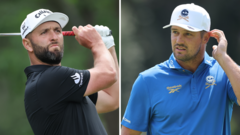
The experiment is over. After four years of market disruption, billion-dollar signing bonuses, and a civil war that tore the foundations of professional golf apart, the Saudi Public Investment Fund (PIF) is pulling the plug. For Jon Rahm and Bryson DeChambeau, the two pillars upon which LIV Golf attempted to build its legitimacy, the news is a cold dose of reality. The "league of the future" has officially become a league with a shelf life, and the biggest names in the sport are now faced with a stark choice: fight for a pathway back to a tour that feels betrayed or go down with the ship by the end of the 2026 season.
LIV Golf’s executive team began informing captains this week that the PIF will cease funding at the conclusion of the current campaign. This is not a strategic pivot or a merger-driven transition. It is an admission of failure. Despite spending nearly $6 billion to secure talent and airtime, the league’s television ratings have flatlined, and its economic model—predicated on team franchises that no one wanted to buy—has collapsed under its own weight.
The $6 Billion Mirage
To understand why the PIF is walking away, you have to look at the numbers that the glossy broadcasts try to hide. In February 2026, the LIV Riyadh event averaged a dismal 23,000 viewers. For context, a rerun of a decade-old sitcom often pulls ten times that audience. While the league saw isolated success in markets like Adelaide, the broad-market penetration required to attract blue-chip sponsors never materialized.
The business plan was always dependent on "team equity." The idea was that corporations would line up to buy franchises like the Crushers or Legion XIII for hundreds of millions of dollars. That never happened. Corporate America looked at the political baggage and the stagnant viewership and stayed away. Without outside capital, the PIF was essentially paying players to play against themselves in a vacuum.
Yasir Al-Rumayyan, the architect of the breakaway, is reportedly stepping down as chairman. His departure signals the end of the "blank check" era. The Saudis are notoriously pragmatic investors; when a project stops serving its purpose as a vehicle for influence or profit, they cut it. Golf was supposed to be a bridge to the West. Instead, it became a high-priced fortress that few fans cared to visit.
Jon Rahm and the Golden Cage
No player embodies the LIV dilemma more than Jon Rahm. The Spaniard was the ultimate "get"—the reigning Masters champion at the time of his signing and a man who once claimed his legacy was more important than money. His defection for a reported $500 million was meant to be the death knell for the PGA Tour.
Instead, it may have been the peak of his relevance. While Rahm has dominated the LIV circuit, winning consecutive individual championships in 2024 and 2025, those victories have occurred behind a digital curtain. In the eyes of the broader sporting public, Rahm has gone from the most feared competitor in the world to a high-paid ghost.
His public stance remains defiant. Earlier this year, Rahm doubled down, stating he had "made his bed" and intended to stay through his contract. But the context has shifted. When Rahm signed, he believed he was joining a permanent fixture of the sporting calendar. Now, he is the captain of a sinking vessel. His contract may be guaranteed, but his access to the history books is not.
The PGA Tour’s newly established "Returning Member Program" offers a path back, but it is paved with glass. Players like Brooks Koepka, who jumped ship back to the US circuit in January 2026, had to pay $5 million in "charitable contributions" and forfeit their rights to the tour’s equity program for five years. For Rahm, the price of return will likely be even higher, both financially and in terms of locker room penance.
Bryson DeChambeau and the Art of the Pivot
If Rahm is the traditionalist trapped by a contract, Bryson DeChambeau is the opportunist who almost made it work. DeChambeau treated LIV not just as a tour, but as a laboratory for his personal brand. He leaned into YouTube, engaged with fans in a way the PGA Tour never allowed, and briefly made the "Crushers GC" logo feel like something approaching a real sports brand.
DeChambeau’s victory at the 2024 U.S. Open provided LIV with its only moment of true competitive validation. For one week, he proved that a player could stay sharp enough to win a Major while playing the LIV schedule. But even Bryson’s "Scientist" persona couldn't solve the math of a dying league.
Despite his individual brilliance, including a dramatic playoff win over Rahm in South Africa this March, DeChambeau is now a man without a country. He is young enough to have a second act on the PGA Tour, but his brand is built on being the disruptor. If he returns to the fold, he does so as a defeated rebel.
The Ranking Point Fallacy
The final blow to LIV’s long-term viability was the "concession" it received from the Official World Golf Ranking (OWGR) earlier this year. While the league finally earned the right to award points, the restrictions were severe. Only the top 10 finishers in the 57-man fields receive points.
This created a mathematical ceiling. A player can finish 11th in every event and see their world ranking plummet to zero. For the "biggest names" who are currently inside the top 50, the clock is ticking. Unless they win regularly, they will lose their exemptions into the Majors—the only four weeks of the year where they actually matter to the casual fan.
The OWGR board essentially called LIV’s bluff. By granting points under a restrictive format, they highlighted the lack of depth in the fields. It’s hard to argue you are an elite league when 80% of your field is ineligible for ranking points because the competition isn't deemed rigorous enough.
The Hunger Games of 2027
As we move toward the end of the 2026 season, the "feeling of panic" reported among the rank-and-file LIV players is palpable. For the stars like Rahm and DeChambeau, the money is in the bank. They are set for life. But for the middle-tier players—the guys who signed for $10 million or $20 million—the end of PIF funding is an existential crisis.
The PGA Tour is not in a forgiving mood. Commissioner Brian Rolapp has been clear: there will be accountability. The "Returning Member Program" is designed to be punitive. It is a filter meant to let the stars back in while leaving the "journeymen" who chased the money out in the cold.
The irony is that the very thing LIV sought to destroy—the PGA Tour’s monopoly—has emerged stronger. The Tour has modernized its product, secured its own private equity through the Strategic Sports Group, and watched its rival burn through $6 billion without making a dent in the Nielsen ratings.
Rahm and DeChambeau will eventually return to the PGA Tour because they have to. They are too good to spend their prime years playing in an unfunded, unsponsored exhibition circuit. But the terms of their return will be dictated by the players who stayed, not the ones who left. The leverage has shifted back to the status quo, and the cost of the "rebellion" is finally being tallied.
The ending won't be a merger. It will be an atmospheric reentry where most of the heat is felt by those who thought they were untouchable.