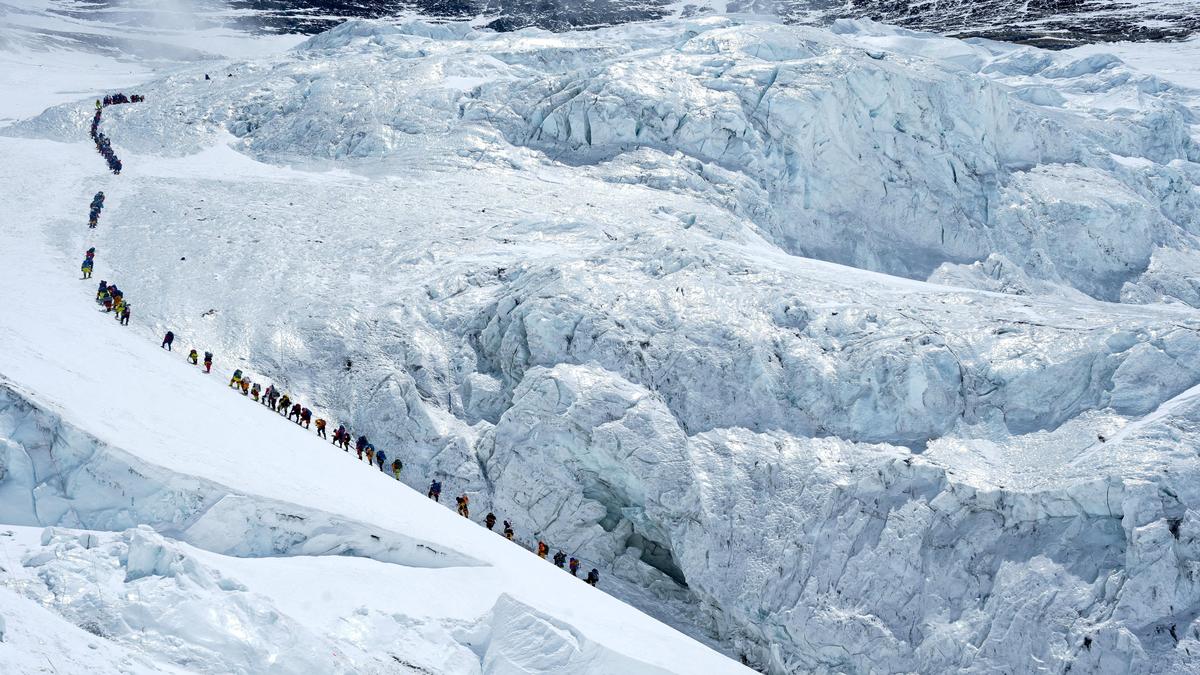
A record-breaking 274 climbers successfully summited Mount Everest from the Nepalese side in a single day on Wednesday, capitalizing on a rare window of clear weather after a heavily delayed spring season. The massive single-day surge surpassed the previous Nepalese record of 223 ascents set in May 2019. Among the international mountaineers making history were three Indian climbers—Tulasi Reddi Palpunoori, Sandeep Are, and Ajay Pal Singh Dhaliwal—who reached the 8,848.86-meter peak alongside 150 Nepalese Sherpas.
While expedition operators celebrate the milestone, veteran mountaineers and safety analysts view the sheer volume of climbers on the south face as a stark reminder of the mounting dangers plaguining the commercialized peak. With China keeping the northern Tibetan route entirely closed this year, the total global demand for the world's highest peak funneled exclusively through Nepal, compressing hundreds of climbers into narrow bottlenecks within the high-altitude death zone.
The High Altitude Bottleneck
The unprecedented rush on Wednesday was triggered by a protracted waiting game. The spring 2026 climbing season started significantly later than usual due to the presence of a massive, unstable serac—a glacial ice cliff—hanging precariously over the standard route through the Khumbu Icefall.
As teams waited out the danger in lower camps, a massive backlog of personnel formed. When weather tracking finally indicated a definitive drop in upper-mountain winds, expedition leaders launched a synchronized push. Climbers who had been waiting for weeks at High Camp were suddenly joined by faster teams moving up from lower stations.
The resulting convergence created long, slow-moving queues along the southeast ridge. In this environment, human physiology becomes the weakest link. At altitudes above 8,000 meters, atmospheric pressure drops significantly, and the human body cannot survive long-term without supplemental oxygen. Moving in a queue at this elevation forces climbers to stand still for extended periods, drastically increasing the risk of frostbite, exhaustion, and depleted oxygen reserves.
The Mechanics of the Single Day Record
The Department of Tourism in Nepal issued 494 climbing permits for the spring season, with each foreign permit priced at $15,000. When factoring in the mandatory one-to-one ratio of local Sherpa guides, nearly 1,000 individuals were positioned to make an attempt on the summit during the narrow May weather windows.
| Metric | 2026 Record Push | Previous Record (2019) |
|---|---|---|
| Successful Summits (Single Day) | 274 | 223 (Nepal side) |
| Permits Issued | 494 | 381 |
| Standard Base Permit Fee | $15,000 | $11,000 |
Virtually all 274 climbers who reached the top on Wednesday relied on bottled oxygen and Sherpa support. The lone exception was Ecuadorian climber Marcelo Segovia, who completed the ascent completely unassisted and without oxygen, highlighting the vast gap between elite alpine mountaineering and the heavily assisted logistics of commercial expeditions.
The Infrastructure of the Ascent
The logistical feat of putting nearly 300 people on top of the world in less than 24 hours relies entirely on the labor of indigenous high-altitude workers. This season witnessed further historic milestones from veteran Nepalese guides who continue to rewrite mountaineering history.
Kami Rita Sherpa extended his own world record by scaling Mount Everest for the 32nd time. His closest peer, Pasang Dawa Sherpa, recorded his 30th successful ascent earlier in the week. Simultaneously, Lhakpa Sherpa reached the summit for the 11th time, breaking her own record for the most successful Everest climbs by a female mountaineer.
These individual records obscure a more complex systemic reality. Sherpa guides do not just accompany clients; they fix kilometers of synthetic rope, carry heavy payloads of oxygen canisters, set up high-altitude tents, and cook meals. When a client moves slowly in a bottleneck, the accompanying Sherpa remains exposed to the elements for the exact same duration, carrying a far greater physical burden.
Commercial Realities vs Risk Mitigation
The economic incentive for Nepal to maximize permit sales remains clear. Mountaineering tourism provides millions of dollars in direct revenue to one of Asia’s poorest nations, supporting thousands of families via guiding, portering, lodge operations, and domestic aviation.
However, international safety experts warn that the current model is unsustainable. While the government has proposed tighter controls and higher fees in recent years, the sheer volume of permits issued continues to hover near maximum levels. When unforeseen environmental factors—like this year’s threatening serac—shorten the available climbing window, large-scale traffic jams become statistically inevitable.
A critical complicating factor this year was the absolute closure of the Tibetan side by Chinese authorities. In normal seasons, approximately 100 climbers choose the northern route, splitting the total crowd across two separate faces of the mountain. With the north face unavailable, Nepal’s south face bore the entirety of the global commercial climbing apparatus.
The successful descent of the 274 climbers on Wednesday prevented a mass casualty event, but the margins for safety on Everest remain razor-thin. A sudden shift in jet stream winds or an unexpected avalanche during a high-density summit push would quickly overwhelm the rescue capabilities of base camp medical teams and helicopter evacuation services.
Officials from the Department of Tourism are currently gathering photographic evidence and satellite tracking data from returning teams to formally certify each individual ascent. As the final teams wrap up their expeditions before the monsoon rains arrive at the end of May, the discussion within the global alpine community will undoubtedly shift from celebrating records to addressing the systemic vulnerability of hundreds of people standing in a single line at the edge of the atmosphere.