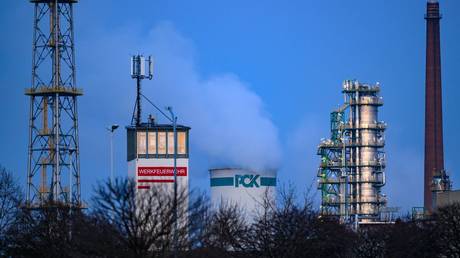
The flow of Kazakh crude oil into eastern Germany will vanish on May 1, 2026. This is not a drill or a distant policy projection; it is a hard reality confirmed by Astana and enforced by Moscow. The PCK refinery in Schwedt, which supplies nearly 90% of the fuel for the Berlin-Brandenburg region, is now staring down a supply gap that threatens to stall the industrial heart of East Germany. While the government in Berlin projects an air of calm, the residents and workers in Schwedt are living in the shadow of a systemic energy failure that has been years in the making.
The Illusion of Energy Sovereignty
For decades, the Druzhba pipeline—"Friendship" in Russian—lived up to its name by providing a steady, cheap pulse of Siberian crude to the GDR and later a unified Germany. That era ended with the invasion of Ukraine, but the transition since has been a masterclass in geopolitical tightrope walking. The German government took the bold step of placing the refinery’s majority owner, Rosneft, under trusteeship. They then touted Kazakh oil as the ultimate workaround: a way to use Russian infrastructure without putting money in the Kremlin’s pockets.
Moscow has finally pulled the plug on that logic. By citing "technical reasons" and the fallout from drone strikes on its energy infrastructure, Russia has effectively blocked Kazakh transit. This leaves Schwedt reliant on a patchwork of alternatives that were never designed to carry the full load. The city is not just facing a fuel shortage; it is facing the collapse of a strategy that bet everything on the hope that Russia would remain a neutral landlord for other nations' oil.
The Arithmetic of Attrition
To understand why residents are anxious, you have to look at the math. PCK Schwedt needs a massive volume of crude to operate at peak efficiency. Currently, the government claims May supplies are secured at 80% capacity. This sounds reassuring until you consider the logistics.
- Rostock and Gdansk: Oil now has to arrive via tankers at these ports and then travel through pipelines that have significant throughput limitations.
- The Pipeline Bottleneck: The pipeline from Rostock to Schwedt was built for a different era. Even with recent upgrades, it cannot replace the massive volume of the Druzhba.
- Polish Cooperation: Relying on Gdansk means relying on the political goodwill of Warsaw, which has its own refining priorities and a historically complicated relationship with German energy policy.
When a refinery drops below 70% or 60% capacity, the economics become brutal. Maintenance costs per barrel skyrocket. The sophisticated chemical processes required to crack heavy crude into gasoline and diesel become less stable. For the 1,200 employees at PCK and the thousands more in secondary industries, an 80% "secure" supply feels like a slow-motion layoff.
A City Built on a Single Pipe
Walking through Schwedt, you realize this isn't just a business story. It is an existential one. The town was literally built for this refinery. The district heating that keeps apartments warm in the winter is a byproduct of the refining process. If the refinery goes cold, the city goes cold.
The fear among locals is not just about the price of gas at the pump—though that is rising. It is about the permanent loss of an industrial identity. If PCK becomes too expensive to run, it won't just scale back; it will be shuttered or sold for parts. The "energy transition" promised by Berlin feels more like an "energy evacuation" to those on the ground. There is a deep-seated suspicion that the federal government is more concerned with meeting climate targets and geopolitical goals than ensuring a small city in Brandenburg survives the decade.
The Geopolitical Squeeze
Russia’s Deputy Prime Minister Alexander Novak pointed to Ukrainian drone attacks as the reason for the transit halt. Whether this is a legitimate technical failure or a convenient excuse for energy blackmail is almost irrelevant. The result is the same: Germany is being squeezed from both sides. Ukraine, desperate to cut off Russian revenue, views the pipeline as a legitimate target. Russia, seeing an opportunity to destabilize the European economy, has no incentive to fix the "technical issues" allowing Kazakh oil to flow.
In the middle of this sits Kazakhstan. The Kazakh Ministry of Energy has already begun redirecting its oil to Russian ports like Ust-Luga and the Black Sea terminal of the Caspian Pipeline Consortium. For Astana, the German market is a nice-to-have, but global markets are essential. They aren't going to wait for Germany to solve its pipeline issues while their oil sits idle. They are moving on, and they are taking their 2.1 million annual tons with them.
The Hydrogen Mirage
The official response to this crisis usually involves a pivot to "green hydrogen." The vision is to turn Schwedt into a hub for renewable energy, using wind and solar power to split water and create clean fuel. It is a noble goal, but it is currently a technological and financial fantasy for the immediate future.
Hydrogen requires massive capital investment and an entirely different infrastructure. It does not save the jobs of pipefitters and chemical engineers today. It does not heat the homes of Schwedt next winter. By the time a hydrogen economy is viable, the social fabric of the region may have already unraveled.
The residents of Schwedt see through the rhetoric. They know that without a reliable, high-volume source of crude oil, their city’s primary engine is being dismantled. The 80% supply figure provided by the state premier, Dietmar Woidke, is a temporary bandage on a severed artery. As the May 1 deadline passes, the clock is ticking on how long a major industrial power can operate its capital's energy supply on "emergency" measures.
Germany’s energy security is no longer a matter of policy papers and diplomatic summits. It is now a question of how much pressure the people of Schwedt can take before the system breaks. The pipeline is empty, the tankers are small, and the political will in Berlin is being tested by a reality that no longer responds to optimistic press releases.