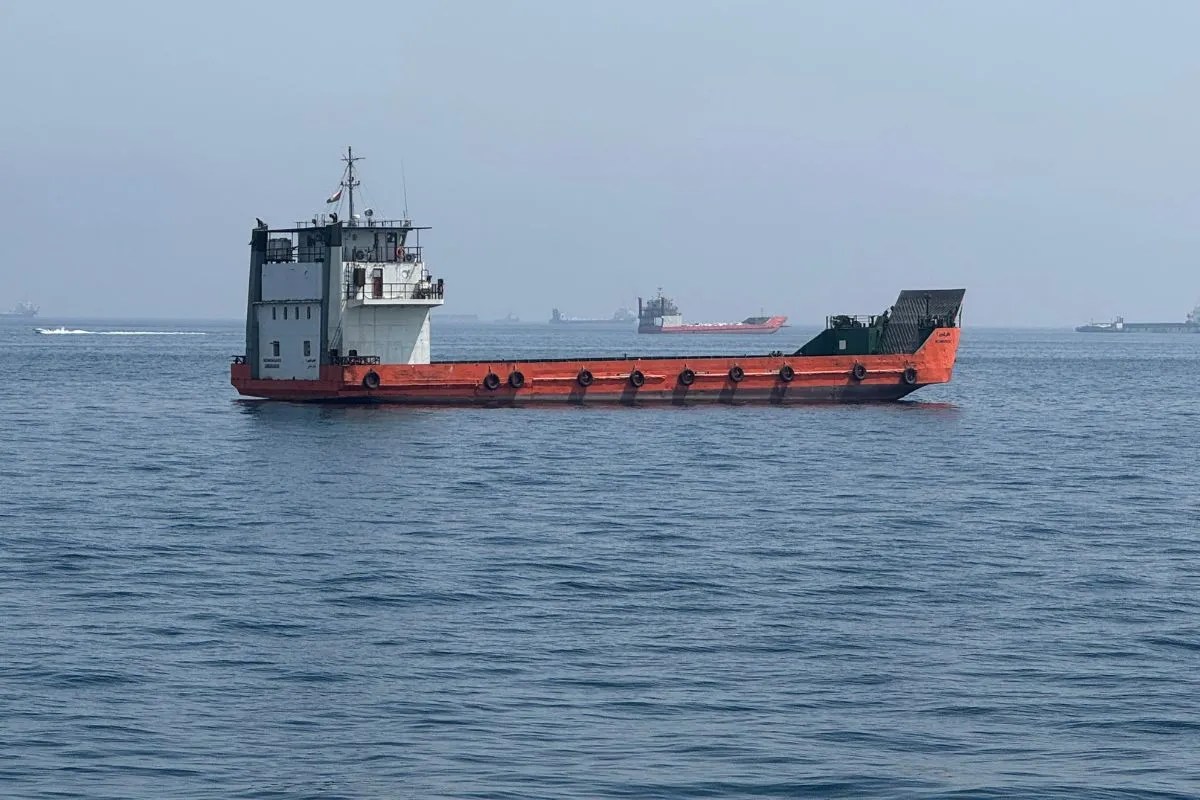
A dangerous escalation in the Strait of Hormuz has pushed the Middle East to the brink of a wider conflict following a sequence of kinetic strikes between US forces and Iranian-backed groups. The primary trigger was an American military strike targeting specific regional assets, which was swiftly met by Iranian claims of retaliatory strikes on US bases in the Gulf region. This rapid tit-for-tat cycle fundamentally threatens the world's most critical maritime chokepoint, through which roughly a fifth of global oil consumption passes daily. While standard news feeds focus entirely on the immediate military exchanges, the real crisis lies in a calculated, long-term breakdown of structural deterrence that both sides have spent years assembling.
The Strategy of Asymmetric Choking
The Strait of Hormuz is a geographic anomaly that grants immense leverage to a nation willing to exploit it. At its narrowest point, the shipping lanes are only two miles wide in either direction, bounded by Iranian territorial waters on one side and Omani waters on the other. This confinement means that any military friction instantly morphs into an international economic crisis. For a closer look into this area, we recommend: this related article.
Iran does not need a blue-water navy to control this space. Decades of Western sanctions forced Tehran to abandon conventional military procurement and instead master asymmetric warfare. They built an intricate network of anti-ship cruise missiles, fast-attack craft, and sea-mining capabilities hidden along the jagged coastline of the Zagros Mountains.
When the US conducts a targeted strike, the response from Tehran is rarely a mirror image. The reported attacks on American installations in the Gulf serve a dual purpose. They satisfy the domestic and proxy demand for a visible counter-strike while signaling that every Western asset in the region sits inside a pre-registered kill zone. For additional information on this development, comprehensive reporting can be read on NPR.
The Deterrence Trap
For decades, the presence of the US Fifth Fleet in Bahrain maintained an uneasy equilibrium. That equilibrium has shattered. Deterrence requires two components: capability and credibility. While the US possesses unmatched capability, its credibility has shifted in the eyes of Iranian strategists who perceive a Western reluctance to enter another prolonged regional war.
This perception alters the risk calculus. Every time an incident occurs without a decisive, structural shift in the balance of power, the baseline of what is considered acceptable conflict moves. What used to be a red line is now standard operating procedure.
The danger of this shift is structural. Miscalculation is no longer a remote possibility; it becomes an mathematical certainty over a long enough timeline. A single drone strike hitting a barracks instead of an empty patch of desert, or an anti-ship missile locking onto a commercial supertanker by mistake, can trigger a chain reaction that neither Washington nor Tehran can easily halt without losing face.
The Global Economic Shrapnel
When explosions echo near the Strait, the financial impact registers instantly in London, New York, and Tokyo. The immediate reaction is seen in war-risk insurance premiums. Underwriters at Lloyd's of London adjust their algorithms within minutes of a confirmed strike, raising the cost of transit to prohibitive levels.
These costs are not absorbed by the shipping conglomerates. They are passed directly down the supply chain, manifesting as higher fuel prices at regional pumps and inflated manufacturing costs across Europe and Asia.
Furthermore, modern supply chains operate on a just-in-time inventory model. Buffers are minimal. A major disruption in Hormuz forces tankers to take the long route around the Cape of Good Hope, adding weeks to transit times and straining global shipping capacity to a degree that makes the supply shocks of previous decades look mild.
Beyond the Proxy Network
To view this conflict purely through the lens of a bilateral dispute between Washington and Tehran is a profound analytical failure. The geopolitical landscape has shifted beneath the surface. Iran has deepened its strategic partnerships with major global powers that view Middle Eastern instability as a useful mechanism to divert Western resources and attention away from other theaters.
This diplomatic shield changes how Iran responds to American pressure. Tehran no longer operates in isolation. The economic lifeline provided by covert energy sales to Asian markets ensures that conventional sanctions have hit a ceiling of effectiveness.
Consequently, military action remains one of the few levers the US can pull to enforce its red lines. Yet, each strike risks validated accusations of overreach from neutral nations, complicating the diplomatic coalition-building that is essential for a long-term solution to maritime insecurity.
The Failure of Current Western Policy
The current Western approach to securing the Gulf relies heavily on reactive positioning. Ships are deployed to escort tankers after a crisis begins, rather than addressing the industrial and command infrastructure that enables the attacks in the first place. This reactive stance gives the initiative entirely to the asymmetric actor.
A defensive posture in a two-mile-wide channel is inherently flawed. Swarm tactics using low-cost loitering munitions can overwhelm sophisticated air-defense systems through sheer volume. The economics of this style of warfare favor the instigator; a drone costing twenty thousand dollars can force the deployment of a defensive missile worth two million dollars.
This economic imbalance cannot be sustained indefinitely. It drains naval readiness and forces high-value assets to remain stationary in highly vulnerable waters, turning them into targets rather than instruments of stability.
Realigning Regional Realities
Any attempt to resolve this crisis through purely military means ignores the underlying political drivers. The regional architecture is fractured, and temporary ceasefires offer nothing more than a chance for both sides to rearm and recalibrate their targeting data for the next confrontation.
The path away from catastrophic conflict requires a fundamental reassessment of regional security dynamics. Security cannot be imported via an external naval presence alone; it must be anchored in enforceable maritime agreements that include all littoral states. Until a framework exists where regional actors bear the direct economic cost of disruption, the temptation to use the Strait of Hormuz as a geopolitical chessboard will remain irresistible. The current escalation is a warning that the window for establishing such a framework is rapidly closing.