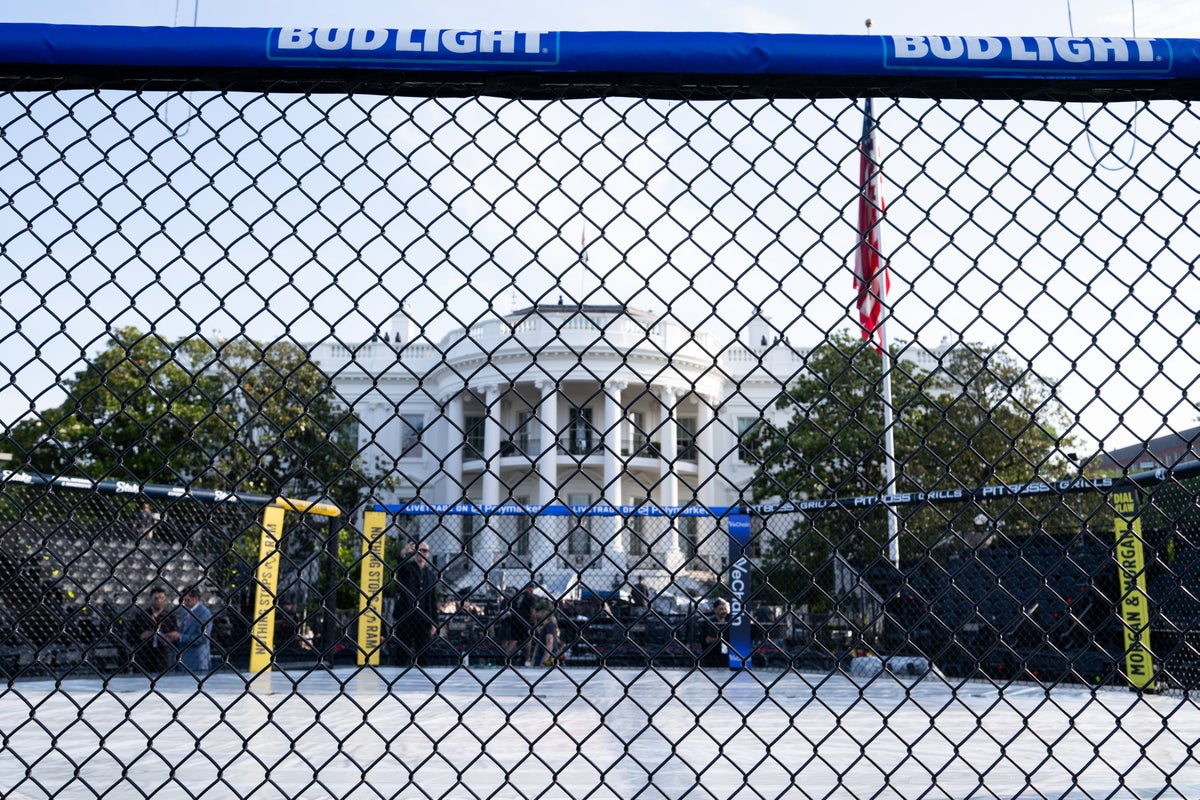
The Ultimate Fighting Championship staged a fight card on the south lawn of the White House. This sentence reads like political satire, but it represents the logical conclusion of a decade-long merger between sports entertainment and populist political theater. While early media coverage treated the event as a bizarre novelty or a temporary scheduling quirk, the reality runs far deeper. The decision to host mixed martial arts inside the perimeter of American executive power is a deliberate, highly calculated branding play that benefits both a modern political machine hungry for young male eyeballs and a sports franchise seeking ultimate cultural legitimacy.
This was never about a simple photo opportunity. By examining the logistical infrastructure, the financial underpinnings, and the shifting demographics of sports viewership, we can see exactly how the octagon became the new center stage for political communication. Meanwhile, you can read similar developments here: The Bubble Wrap Fallacy Why the Dodgers Panic Over Ohtani and Wrobleski Proves MLB Teams Don't Understand Risk.
The Engineering of a Spectacle
Staging a professional athletic event on federal property requires overcoming massive regulatory and logistical hurdles. The National Park Service, the Secret Service, and District of Columbia zoning boards usually take years to approve even minor modifications to the Ellipse or the surrounding grounds. Yet, the structures for this event appeared almost overnight.
The physical setup of a combat sports event is inherently destructive to turf. A standard UFC cage weighs several tons when fully loaded with the steel fence, canvas padding, under-structures, and lighting rigs. To explore the bigger picture, we recommend the detailed article by FOX Sports.
- The Substructure: Engineers laid down specialized high-density composite matting to distribute the weight across the lawn, preventing the historic turf from compacting and dying.
- The Lighting Grid: Instead of driving heavy cranes onto the grass, technicians utilized modular aluminum truss systems that could be assembled by hand and hoisted using compact winches.
- The Security Perimeter: The Secret Service established a dual-layered checkpoint system, treating the fighter warm-up tents as an extension of the West Wing.
The sheer speed of the installation proved that the executive branch cleared every piece of traditional red tape. It demonstrates a level of administrative cooperation usually reserved for state dinners or incoming foreign dignitaries. The message sent to the corporate world was unmistakable: the machinery of state is open for business if the audience is large enough.
The Demographic Gold Rush
To understand why this happened, look at the numbers. Traditional political broadcasts are dying. The average age of a cable news viewer now hovers well over sixty. Political strategists are desperate to reach young men between the ages of 18 and 34, a demographic that increasingly ignores legacy media, skips the voting booth, and consumes content exclusively through streaming platforms and short-form video.
The UFC owns that demographic.
By bringing the octagon to 1600 Pennsylvania Avenue, political actors are bypassing the traditional press corps entirely. They are embedding themselves directly into the lifestyle content of millions of young men. It is a highly effective capture of attention. The fighters become influencers for the venue, posting behind-the-scenes content that frames the seat of American government not as a starchy bureaucratic institution, but as an aggressive, high-stakes arena.
This cross-pollination benefits the sports franchise just as much. For years, mixed martial arts fought against the stigma of being a blood sport, famously labeled "human cockfighting" by politicians in the 1990s. Fighting on the White House lawn is the ultimate corporate sanitization. It provides a stamp of institutional approval that Madison Avenue cannot ignore. It tells major blue-chip advertisers that the brand is safe for consumption at the highest levels of society.
Follow the Money and the Influence
A spectacle of this scale does not happen without a complex web of financial and political capital changing hands. While federal regulations prohibit the direct commercialization of the White House grounds for private profit, smart lawyers found the necessary loopholes. The event was designated as a non-profit exhibition supporting military veterans, allowing corporate sponsors to write off their involvement as charitable donations while enjoying unprecedented brand placement.
The relationship between combat sports executives and top-tier political figures has been decades in the making. Early UFC events found a home in Atlantic City casinos when mainstream venues banned them. That early lifeline created a loyalty that survived the sport's transition into a multi-billion-dollar global powerhouse.
The Cost of Access
While the public sees a sporting event, industry insiders recognize a masterclass in lobbying. The corporate entities behind modern sports entertainment are constantly facing regulatory scrutiny. This ranges from antitrust investigations regarding fighter pay to questions about independent contractor classification. Hosting a high-profile event at the seat of power creates a powerful shield against regulatory overreach. It is much harder for a congressional committee to investigate a business entity that was just celebrated on the South Lawn.
The Global Broadcast Footprint
The international implications are equally significant. The broadcast was beamed to over 170 countries, showcasing American political landmarks wrapped in corporate branding. For foreign audiences, the imagery blurs the line between state power and commercial entertainment. It presents a hyper-masculine, aggressive image of American culture that contrasts sharply with traditional diplomatic optics.
The Long-Term Cost to the Institution
The immediate success of the broadcast will likely inspire copycats. We will soon see calls for corporate-sponsored tennis matches on the lawn or extreme sports exhibitions down the steps of the Lincoln Memorial. The barrier has been broken.
Every time a historic public space is leased out for a commercial television product, the intrinsic dignity of that space degrades slightly. The White House belongs to the public, serving as a symbol of constitutional governance. Transforming it into a backdrop for pay-per-view violence reduces a monument of collective history to mere set dressing for a media conglomerate.
The critics who complain about the violence of the sport are missing the point entirely. The issue is not what happens inside the cage, but where the cage is placed. When the state adopts the tactics of sports entertainment to maintain relevance, it admits that traditional authority is no longer enough to command public attention. It accepts the rules of the attention economy, where shock value and raw spectacle matter more than policy or precedent.
The octagon on the lawn is not a temporary aberration. It is the new blueprint for institutional survival in an age that demands constant entertainment. The fighters will leave, the grass will be reseeded, and the tire tracks from the broadcast trucks will fade, but the precedent remains fixed in stone. Executive power has discovered the utility of the colosseum, and there is no going back to the podium.