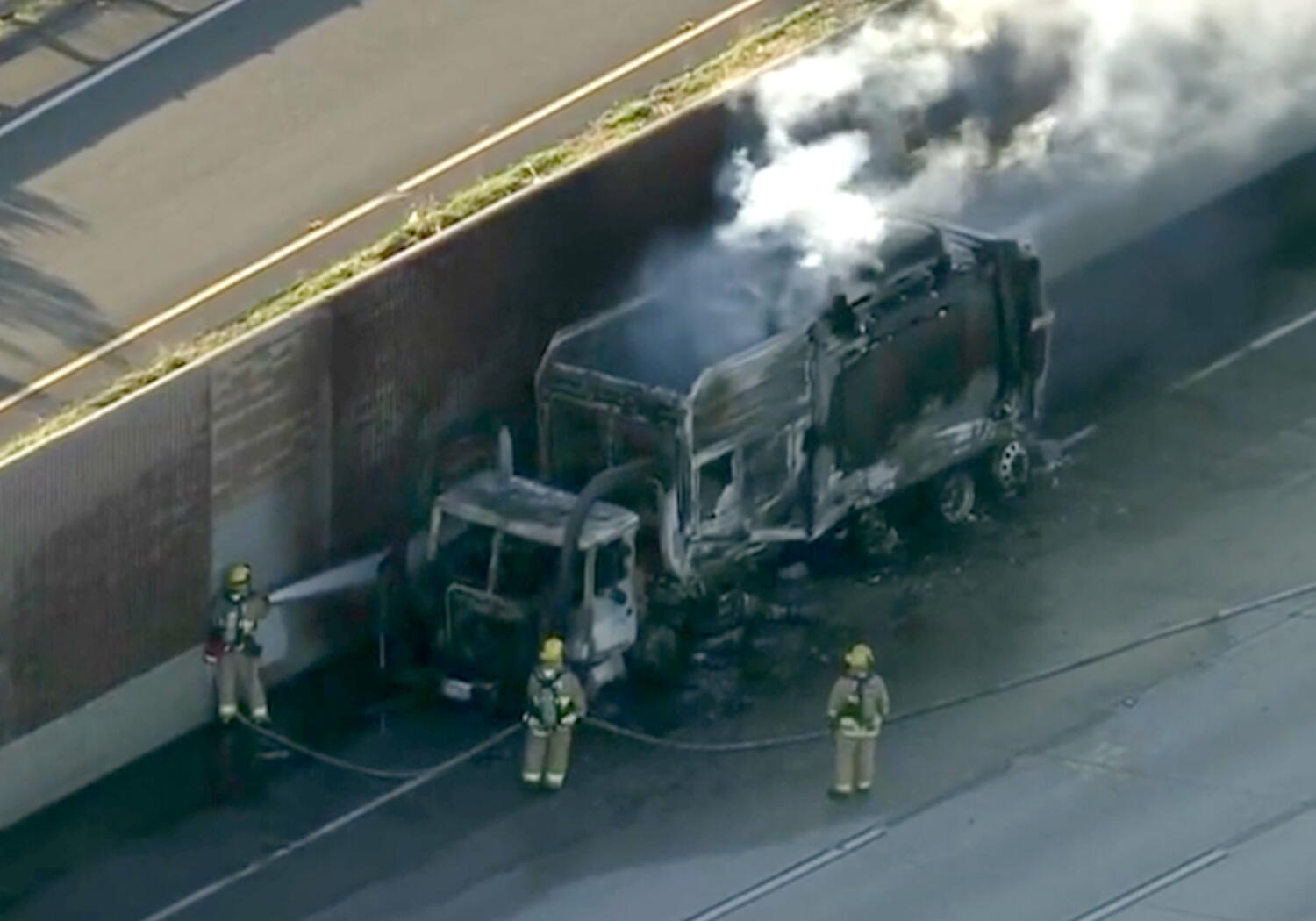
A burning trash truck on the 5 Freeway stops traffic for hours not merely because flames block the pavement, but because refuse haulers carry volatile, pressurized, and smoldering waste through high-density freight corridors where a single vehicle fire forces full lane closures, hazardous material checks, and heavy-tow recoveries. When a refuse truck catches fire along Interstate 5, commuters see a chaotic backup and a plume of dark smoke. Industry veterans see a predictable collision between municipal waste economics, modern battery chemistry, and the unforgiving geometry of a major arterial highway.
The competitor headline frames the event as a sudden traffic nightmare caused by a fire and lane closures. That framing treats the gridlock like an unexpected weather event. It is not. Anyone who has spent decades tracking freight logistics, municipal contracts, and highway incidents knows that refuse fires happen with troubling regularity, and that their disruption scales violently when they occur on a spine corridor like the 5 Freeway. Building on this idea, you can also read: Anatomy of Los Angeles Community College District Board Elections.
What Actually Ignites Inside a Refuse Truck
People assume a burning garbage truck caught fire because of an engine malfunction or a brake failure. Sometimes that happens. Often, the fire starts inside the hopper or the compaction body, hours after the load was collected from a curb or a commercial bin.
Refuse is a chemical soup. Households and businesses toss lithium-ion batteries from power tools, vapes, toys, and scooters straight into standard bins. Aerosol cans, pool chemicals, propane cylinders, hot ashes, and oily rags ride along in the same load. Once the truck's hydraulic compactor crushes those items together, friction, short circuits, and trapped heat turn a quiet bin into an oven. Observers at BBC News have provided expertise on this matter.
Lithium-ion cells pose a distinct headache for haulers and firefighters alike. Unlike a simple paper or cardboard fire that water knocks down quickly, a damaged lithium-ion battery can enter thermal runaway, generating its own heat and reigniting long after the visible flames look extinguished. Drivers frequently spot smoke in their side mirrors or smell acrid plastic while cruising at highway speed. Pulling over on a narrow shoulder or stopping in an active lane is a split-second judgment call made under immense pressure.
A refuse fire rarely behaves like a standard car fire. You are not just fighting flames on the outside; you are trying to cool thousands of pounds of compressed, smoldering fuel buried inside a steel box.
Once air reaches the compacted load—either when the driver dumps the burning contents onto the asphalt to save the cab and chassis, or when crews pry open access panels—the fire can flare dramatically. Dumping the load on the 5 Freeway saves expensive rolling stock. It also turns several lanes of interstate into an active burn pile.
Why Interstate 5 Turns a Local Incident into Gridlock
Interstate 5 is not a neighborhood boulevard where drivers can easily peel off at the next corner and find a parallel route with spare capacity. Across much of its length, it carries heavy commuter streams alongside long-haul freight, regional distribution runs, and intercity travel. When a multi-axle commercial vehicle stalls or burns across multiple lanes, the upstream queue builds backward at alarming speed.
Traffic shockwaves travel backward faster than most drivers realize. Even when a fire is confined to two right-hand lanes, rubbernecking slows the left lanes to a crawl. When emergency apparatus arrives—fire engines, water tenders, battalion chiefs, highway patrol cruisers, and eventually heavy-duty wreckers—the footprint expands again.
The Cascading Math of Lane Closures
Highway capacity does not drop linearly when lanes close. Closing half the lanes on a busy stretch of freeway can cut throughput by far more than half because merging vehicles create friction, braking waves, and hesitation points. Add smoke across the roadway, and visibility drops. Low visibility forces slower speeds, wider gaps, and abrupt lane changes that trigger secondary fender-benders miles behind the original scene.
Consider a hypothetical example to see how quickly a single truck fire compounds. Imagine a morning rush hour along a four-lane section of the 5 Freeway where two right lanes are blocked by a smoking refuse truck that has dumped part of its load. Even if drivers in the two left lanes try to keep moving, vehicles merging from the blocked lanes disrupt flow, emergency vehicles need buffer space, and downstream bottlenecks form where surface streets cannot absorb thousands of diverted cars at once. Within forty-five minutes, a localized incident becomes a multi-mile regional stall.
Surface streets around major highway corridors rarely have the signal timing, turn-pocket length, or lane continuity to swallow sudden highway overflow. Local arterials clog up with confused commuters and delivery vans, locking up intersections and delaying emergency access from other directions.
The Hidden Bottlenecks After the Flames Die Down
Ask any seasoned tow operator or traffic management engineer what takes the longest during a burning trash truck event, and they will point past the firefighting phase. Putting out visible fire is only act one. Clearing the wreckage and certifying the road is safe for high-speed traffic often takes the lion's share of the clock.
First comes scene safety and hazardous materials assessment. Responders have to make sure no pressurized cylinders remain unruptured in the debris, no chemical runoff is pouring into storm drains, and no deep-seated hotspots are waiting to flare up inside a tow truck's bed. If a haul company dumped burning refuse onto the pavement, crews have to cool, shovel, and reload smoldering waste—often using front loaders or specialized roll-off containers—before sweepers can even touch the asphalt.
Heavy Recovery and Pavement Wear
A loaded refuse truck is heavy, tall, and awkward to move when its axles, tires, or hydraulic lines are damaged. Standard light-duty tow trucks cannot handle it. Crews need heavy-duty rotators or wreckers, staging room on the freeway, and careful rigging so the chassis does not buckle or spill more debris during recovery.
Heat also takes a toll on the road surface itself. Intense, prolonged fire can scorch or soften asphalt and spall concrete, leaving ruts, oil stains, or damaged pavement that crews must inspect or patch before reopening lanes safely. Reopening a lane too early creates a hazard for motorcycles and passenger cars; waiting until the surface is clear and stable frustrates thousands of drivers sitting idle in their cars.
| Phase of a Refuse Truck Fire | Primary Operational Focus | Why It Slows Reopening |
|---|---|---|
| Initial Detection and Pull-Off | Driver safety and traffic protection | Smoke, traffic speed, and lack of wide refuge space |
| Fire Suppression and Load Dump | Knocking down flames and cooling waste | Compacted fuel, lithium batteries, and flare-ups |
| Hazmat and Debris Removal | Neutralizing risks and clearing trash | Smoldering hotspots, heavy loads, and loader work |
| Heavy Tow and Road Check | Removing the truck and inspecting pavement | Specialized equipment, rigging time, and surface safety |
Accountability Across Haulers, Regulators, and Commuters
When a trash truck burns on a major highway, finger-pointing starts almost immediately. Commuters blame road crews or slow emergency response. Haulers point to careless residents tossing hazardous items into curbside carts. Regulators look at fleet maintenance logs, routing rules, and waste-handling standards.
Each side has a point, and none of them gets off completely easy. Waste haulers sit at the center of the operational chain. Fleet operators know which routes generate frequent hot loads, which collection districts have higher rates of improper disposal, and how well their drivers are trained to spot early smoke and execute safe pull-offs. Investing in thermal sensors, fire-suppression systems in hoppers, and strict driver protocols costs money upfront, yet a single major highway fire carries massive liability, equipment loss, and reputational damage.
The Limits of Curbside Rules and Enforcement
Municipal rules already prohibit putting hazardous waste, batteries, and hot ashes in regular trash carts. Telling residents to follow the rules is easy; enforcing it across millions of household bins every week is nearly impossible. Most people are not trying to start a freeway fire—they toss a dead vape pen or an old power-tool battery into the nearest bin out of convenience or ignorance.
Drop-off programs for household hazardous waste help, provided they are convenient, well-publicized, and open at hours working people can actually use. Still, no public-awareness campaign will catch every battery or chemical container before it hits the compactor. That reality forces a harder look at pre-collection sorting, transfer station screening, and vehicle design.
There are real trade-offs here. Rerouting refuse trucks off major highways entirely sounds appealing to frustrated commuters, yet trucks still have to reach landfills, transfer stations, and processing facilities along regional corridors. Banning certain materials without practical alternatives pushes people toward illegal dumping, which creates different environmental and safety hazards. Even advanced fire-suppression nozzles inside a compaction body cannot guarantee instant extinguishment when dozens of crushed cells are feeding heat from the inside out.
What Drivers Can Do When Smoke Appears Ahead
Most people reading about a burning trash truck on the 5 Freeway are not running a municipal fleet or writing state transport policy. They are trying to get to work, pick up kids, make a flight, or keep a delivery schedule without losing two hours on an overpass.
When you spot dark smoke rising ahead on a major highway, assume a lane or two will close soon and check alternate routes before you get trapped past the last convenient exit. Once traffic slows to a stop, stay inside your vehicle with windows closed if smoke is thick, keep an eye on your mirrors for distracted drivers approaching from behind, and leave room in front of you so emergency rigs and tow trucks can thread through if lanes shift.
Check your local traffic agency feed before you merge onto the corridor, pick your exit early rather than gambling on the final mile, and keep a realistic buffer in your schedule whenever you travel major freight routes during peak hours.