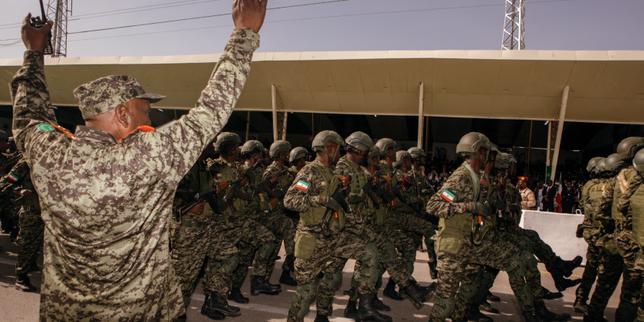
Transnational military augmentation operates under strict economic and operational laws that politicians frequently obscure behind aggregate headcount figures. When state actors announce the integration of foreign units into an active theater of operations, the immediate analytical error is treating personnel as interchangeable widgets. A reinforcement protocol involving ten thousand additional auxiliary troops does not translate into a linear upward shift in combat power. Instead, it introduces a complex web of logistical drag, command friction, and interoperability costs that must be balanced against raw numerical gains.
The Logistical Pipeline and Infrastructure Bottlenecks
Moving thousands of combatants across international borders requires a massive institutional footprint. The transit phase is only the initial hurdle. Once personnel arrive within the staging zones of the recipient state, the structural requirements multiply exponentially. Every incoming soldier demands baseline sustainment: caloric intake, potable water, medical triage capacity, clothing, protective gear, and individual weaponry.
When the supplying state utilizes distinct military standards, calibers, and logistic doctrines, supply chain fragmentation intensifies. Ammunition compatibility becomes a primary vulnerability. Standardizing logistics across heterogeneous forces creates administrative strain on central supply nodes that are already operating under high-intensity stress. If the incoming personnel utilize small arms ammunition or heavy weapons systems that do not match the host nation's inventory pipelines, separate logistical channels must be established. This duplication of effort draws transport capacity away from primary frontline units, creating localized shortages at critical points of contact.
Furthermore, transportation networks within contested zones face constant interdiction via long-range precision strikes and reconnaissance drone surveillance. Concentrating staging areas to process incoming reinforcements exposes those assets to targeted bombardment before tactical deployment can occur. The administrative overhead required to receive, equip, and transport auxiliary units often neutralizes their short-term utility, forcing planners to absorb a net operational deficit during the initial integration window.
Interoperability and Doctrine Frictions
Combat effectiveness in modern peer-to-peer conflict relies on shared tactical awareness, rapid communication loops, and integrated fire support. Auxiliary forces trained under isolated military doctrines experience severe friction when inserted into an active operational theater characterized by electronic warfare saturation and drone-adjusted artillery.
Language barriers compound this friction. Even with embedded interpreters and liaison officers, real-time coordination during active combat maneuvers breaks down under high-stress conditions. Artillery requests, medical evacuation protocols, and infantry-armor synchronization require millisecond precision. When commands must pass through multiple layers of translation and cultural adjustment, the velocity of tactical decision-making drops significantly.
The training mismatch is another critical variable. Military forces structured around static defensive doctrines or traditional infantry tactics face an acute adaptation curve when confronted with modern aerial surveillance regimes. Without extensive retraining in decentralized dispersion, electronic signature management, and combined-arms maneuver under constant observation, incoming units suffer high attrition rates immediately upon frontline contact. The utility of mass diminishes rapidly when units lack the specific survival skills mandated by contemporary technological parity.
The Attrition Calculus and Diminishing Returns
In a war of attrition, leadership frequently falls back on quantitative metrics to justify strategic momentum. The addition of manpower is viewed through a purely additive lens. However, the operational value of personnel follows a curve of diminishing marginal returns.
In modern industrial warfare, casualties are heavily driven by indirect fire, loitering munitions, and mechanized assaults rather than close-quarters infantry engagements. Adding infantry headcounts without a proportional increase in armored protection, counter-battery radar, and electronic jamming systems simply expands the target surface area. If the recipient state cannot provide adequate mechanized transport and heavy fire support to shield these units, the auxiliary force functions primarily as a sponge for high-explosive ordnance, accelerating casualty accumulation without altering structural territorial control.
The opportunity cost must also be factored into the equation. The financial, administrative, and diplomatic capital expended to secure, transport, and maintain foreign auxiliary units could alternatively be allocated toward domestic mobilization, industrial base enhancement, or the acquisition of advanced force multipliers such as precision-guided munitions and air defense assets. Strategy requires choosing the most efficient vector of resource allocation; personnel quantity without qualitative parity often represents a suboptimal deployment of scarce national capabilities.
Command Hierarchies and Political Control
Integrating foreign contingents into a host nation's military structure introduces acute principal-agent problems. Command authority is rarely absolute. Supplying states typically maintain parallel chains of command to protect their national interests, monitor casualty rates, and ensure that auxiliary units are not deployed in missions that exceed agreed-upon political thresholds.
This dual-key command structure generates operational paralysis. When tactical commanders on the ground must defer to external political directives or navigate bureaucratic clearance procedures across different national capitals, the responsiveness of defensive or offensive operations deteriorates. Field commanders lose the autonomy required to exploit fleeting tactical opportunities, while higher headquarters find themselves managing diplomatic disputes disguised as tactical disagreements.
The presence of foreign personnel also alters internal morale dynamics within the host military. Disparities in compensation, leave policies, and frontline rotation schedules between domestic conscripts or volunteers and foreign auxiliaries can breed resentment and institutional friction. Cohesion relies on shared sacrifice and equitable treatment; introducing distinct tiers of personnel based on national origin disrupts this psychological baseline.
Strategic Escalation and Resource Transfers
The exchange of manpower for material or financial compensation represents a profound transactional shift in bilateral relations. For the supplying state, committing troops to a foreign conflict provides invaluable operational data on modern warfare, testing hardware and personnel performance under real combat conditions while securing economic or strategic concessions from the recipient.
However, this transaction transfers long-term risk. The reputational exposure of participating in a high-intensity interstate conflict binds the supplying state more tightly to the fortunes of the recipient. Any battlefield catastrophes involving auxiliary units carry domestic political consequences that the regime must manage. Furthermore, the recipient state incurs long-term obligations, often requiring reciprocal military guarantees, technological transfers, or economic concessions that constrain its future strategic autonomy.
To shift the strategic equilibrium, military augmentation must solve a specific tactical deficit—such as securing extended frontlines or freeing up elite mobile reserves. When used merely as a political signaling mechanism or a blunt numerical fix for structural manpower shortages, auxiliary deployments consume disproportionate resources while yielding marginal operational advantage.
Shift operational planning toward the immediate decentralization of logistics nodes and the establishment of dedicated bilingual integration hubs to mitigate command friction before any future tactical deployment reaches the forward edge of the battle area.