Every time a municipality declares a water emergency and grants an exemption to a ski hill, the outrage machine fires up on schedule.
Predictable. Loud. Completely illiterate in basic watershed mechanics. For an alternative look, check out: this related article.
The standard take on Calgary handing Canada Olympic Park (COP) an exemption to blow snow during municipal water restrictions goes something like this: Regular citizens are told to take shorter showers and let their lawns turn to dust, while a corporate recreation facility gets a free pass to spray millions of liters of treated water into the cold air for entertainment.
It sounds like a slam-dunk indictment of municipal favoritism. It makes for great rage-bait headlines. And it misses the physics of water, municipal infrastructure, and seasonal hydrology by a mile. Related insight regarding this has been shared by Al Jazeera.
If you want to understand why City Hall signed off on WinSport’s snow guns while keeping tight reins on residential irrigation, you have to stop treating every liter of water as if it behaves the same way once it leaves the pipe. Water isn't destroyed when you freeze it. It is borrowed.
The Consumptive Fallacy
Most public debates over municipal water restrictions collapse because critics treat water usage as a binary: you either save it, or you waste it. Hydrologists and municipal engineers look at two entirely different metrics—withdrawal and consumptive loss.
When a homeowner waters a Kentucky bluegrass lawn in July, that water hits warm soil, evaporates into the atmosphere, and leaves the local watershed entirely. You don't get it back in the storm drains. It is a high-loss, consumptive use happening at the exact moment river flows are dropping and evaporation rates are peaking.
Snow-making at a facility like Canada Olympic Park operates on the opposite end of the thermodynamic spectrum.
- Zero-evaporation window: Snow guns only run efficiently when wet-bulb temperatures drop well below freezing. At -10°C or -15°C, atmospheric moisture capacity is near zero. Almost none of that water vanishes into thin air.
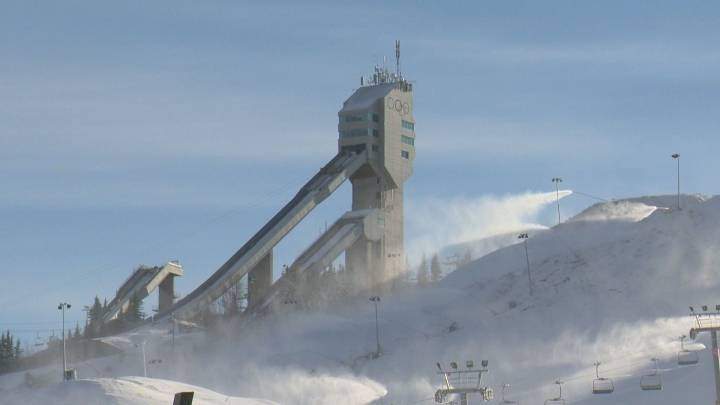
- Closed-loop watershed return: COP sits on the Paskapoo slopes directly above the Bow River valley. Every single crystal of machine-made snow blown onto those runs in November and December stays locked in a frozen state until the spring freshet in April and May. When it melts, it runs directly back into the Bow River basin—the exact river system Calgary draws from.
- Sublimation is negligible compared to summer runoff: Critics love to bring up sublimation—the direct transition from ice to vapor without melting. Does sublimation happen on dry Chinook days in Calgary? Yes. Does it compare to the evapotranspiration loss of 400,000 residential sprinklers running in August? Not even close.
The lazy consensus sees a snow gun spraying mist and assumes the water is gone forever. In reality, a ski hill is just a massive, open-air frozen reservoir sitting uphill from the intake pipes.
Infrastructure Stress Is Not a Volumetric Problem
When Calgary’s water system hits crisis mode—whether driven by catastrophic feeder main ruptures like the Bearspaw South failure or low winter snowpack in the Rockies—the constraint isn't always the volume of water sitting in the Glenmore Reservoir or flowing down the Bow. Often, the bottleneck is treatment capacity, pipe pressure, and seasonal demand spikes.
I’ve sat in municipal utility briefings where engineers pull their hair out trying to explain peak-load hydraulics to politicians. A city's water grid isn't a bucket; it's a pressurized arterial network.
Summer residential demand creates violent pressure swings. Millions of gallons are pulled simultaneously between 6:00 AM and 9:00 AM for showers, lawn irrigation, and commercial cooling. That spikes turbidity, taxes treatment plants, and stresses aging prestressed concrete cylinder pipes.
WinSport doesn't draw water during peak residential surges. Snow-making crews operate overnight, between midnight and 6:00 AM, when ambient temperatures bottom out and municipal grid demand is flatlined. Furthermore, high-capacity snow-making systems draw from dedicated intake lines and holding ponds filled during off-peak hours, acting as a buffer rather than a sudden shock to neighborhood water mains.
Treating an overnight industrial-scale freeze operation the same as daytime residential lawn watering is like comparing an off-peak freight train to rush-hour gridlock. They share the same tracks, but they don't cause the same problems.
The Economic Math Nobody Wants to Admit
Let’s address the elephant on the chairlift: money and jobs.
Critics frame Canada Olympic Park as a luxury playground for weekend skiers. That framing ignores what WinSport actually is. It is a high-performance Olympic training center, a year-round youth athletic hub, and an anchor employer in northwest Calgary.
Imagine a scenario where the city denies the exemption to score political points on optics. What happens next?
- Total season wipeout: Without a base layer of machine-made snow in November and early December, Calgary’s warm, dry Chinook winds strip natural snowfall down to bare dirt within 48 hours. Natural snow cannot sustain a ski hill on the edge of the foothills. Period.
- Collapse of national training pipelines: Hundreds of Olympic and Paralympic development athletes—from freestyle skiers to bobsledders relying on integrated facility operations—lose their primary Canadian training ground.
- Immediate layoffs: Hundreds of seasonal and full-time staff, ski patrollers, lift mechanics, instructors, and hospitality workers lose their winter income overnight.
City councils don't issue exemptions because they love corporations. They issue exemptions because shutting down a major municipal economic engine to save water that will melt back into the Bow River four months later is fiscal self-harm.
What People Get Wrong About Urban Water Restrictions
Whenever water restrictions hit the news, search engines flood with the same predictable questions. Almost every single one is built on a flawed premise.
"Why am I fined for washing my driveway while a ski resort gets millions of liters?"
Because washing a driveway is a 100% discretionary, unmonitored, non-metered flush of treated potable water straight into the storm sewer system, carrying oil, brake dust, and road salt directly into the river without treatment. WinSport’s water draw is strictly metered, scheduled during off-peak grid hours, capped under a legal municipal license, and tracked to the liter. One is an unregulated leak in the system; the other is a controlled industrial loan.
"Doesn't snow-making waste treated drinking water?"
In many jurisdictions, yes—and that is a legitimate flaw in legacy infrastructure. Using fully chlorinated, fluoridated, potable municipal water to make snow is an engineering inefficiency. Modern alpine resorts increasingly pull raw, untreated water directly from retention ponds or river intakes. Where COP relies on city-supplied lines, the criticism shouldn't be that they are allowed to make snow; the criticism should be that the city and WinSport haven't fast-tracked a dedicated raw-water bypass line so treated potable water isn't wasted on ski runs.
"If we are in a drought, shouldn't every non-essential use stop?"
"Non-essential" is a political buzzword, not a hydrological category. If you shut down every non-essential water user—car washes, breweries, hockey rinks, swimming pools, ski hills—you don't solve a structural supply deficit. You just trigger a localized recession while leaving the actual culprits untouched. In Alberta, agricultural irrigation accounts for roughly 60% to 70% of all surface water allocations in the South Saskatchewan River Basin. Municipal residential and commercial use combined is a fraction of that total. Fighting over a ski hill’s winter water draw while ignoring watershed-wide allocation math is majoring in the minors.
The Real Flaw in the Exemption (And How to Fix It)
Defending the hydrology of snow-making doesn't mean giving WinSport or the City of Calgary a blank check. There are real, glaring weaknesses in how municipalities handle industrial and recreational exemptions—and pretending they don't exist destroys public trust.
First, transparency at City Hall is atrocious. When officials announce an exemption via a quiet administrative bulletin without publishing the exact volume caps, off-peak draw windows, and return-flow calculations, residents naturally assume backroom cronyism. If WinSport is approved for, say, 150,000 cubic meters over six weeks, put that meter reading on a public dashboard every morning. Show the taxpayers the exact numbers.
Second, potable water dependency is outdated. Spraying fully treated municipal drinking water out of a fan gun is lazy engineering. The true cost of water isn't the H2O molecule; it’s the electricity, alum, chlorine, and filtration capacity required to make it safe for human consumption. If a facility wants a guaranteed drought exemption going forward, the condition should be mandatory capital investment in raw-water retention ponds and rainwater/snowmelt recapture cisterns at the base of the hill.
Third, Chinook sublimation losses need honest accounting. Calgary isn't Banff or Lake Louise. Situated at 1,100 meters elevation in the rain shadow of the Rockies, COP gets hammered by warm, dry westerly winds that can spike temperatures from -15°C to +10°C in hours. During severe Chinooks, a measurable percentage of the snowpack sublimates directly into the atmosphere rather than melting into the soil. Pretending 100% of machine-made snow returns to the Bow River is dishonest. Independent hydrologists—like those at the University of Saskatchewan’s Global Institute for Water Security, led by researchers such as John Pomeroy—have spent decades measuring snowpack sublimation across the eastern slopes of the Rockies. In open, wind-exposed terrain, sublimation can claim 15% to 30% of snow water equivalent over a winter. That loss is real, and it should be factored into WinSport's water pricing tier.
Stop Policing the Wrong End of the Pipe
Public outrage over the Canada Olympic Park exemption is a classic case of visible bias. People see massive snow cannons blasting white plumes into the sky next to the Trans-Canada Highway and feel cheated because they can't water their petunias.
Visibility is not volume. Optics are not hydrology.
If Calgary wants real water security in an era of volatile mountain snowpacks and aging underground pipes, residents and policymakers need to grow past knee-jerk scapegoating. Stop demanding that winter sports facilities shut down over water that stays inside the watershed. Start demanding metered transparency, raw-water infrastructure, tiered industrial pricing that accounts for Chinook sublimation, and aggressive leak detection across the city’s crumbling main lines.
Until then, yelling at a snow gun is just screaming into the wind.