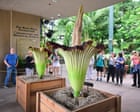
You stand in a line that wraps around the manicured lawns of San Marino, baking in the July heat. You've been waiting for three hours. Your reward? A brief, intense whiff of what smells like a hot dumpster full of rotting animal carcasses and sweaty socks.
It sounds like a terrible way to spend a afternoon. Yet, thousands of people just did exactly that.
The sudden, simultaneous blooming of two massive titan arum plants—affectionately dubbed "Odora" and "Odorysseus"—at The Huntington Library, Art Museum, and Botanical Gardens sent shockwaves through Southern California. This wasn't just a regular botanical event. It was a rare double bloom, a biological phenomenon that turned a quiet research institution into a chaotic, sold-out spectacle overnight.
If you think people are crazy for standing in line to smell death, you're missing the bigger picture. This plant is a masterpiece of evolutionary deception. It's a botanical heavyweight that plays a high-stakes game of survival, and the science behind its rare tantrums is far more fascinating than the smell itself.
The Double Bloom That Broke Southern California
Normally, a single corpse flower bloom is a major news event. The titan arum (Amorphophallus titanum) is notoriously unpredictable. It can take seven to ten years for a single plant to produce its very first bloom. After that, it might only flower once every few years, if you're lucky.
So when both Odora and Odorysseus decided to open their velvet-maroon skirts at the exact same time, botanical circles went wild.
The Huntington has been cultivating these monsters for more than 25 years, but a simultaneous double bloom is virtually unheard of in cultivated collections. It triggered an immediate gold rush for tickets. Monday morning crowds packed the parking lots, and the gift shop ran completely out of custom corpse flower shirts.
Why the madness? Because you only have a 24-to-48-hour window before the entire structure collapses into a sad, mushy heap. If you miss it, the plant goes back into hiding underground, sometimes for half a decade.
Meet Odora and Odorysseus
The two stars of the show have very different histories. Odora is a seasoned veteran, having last put on a show in 2024. Odorysseus, on the other hand, was making its grand public debut.
To the untrained eye, they look like something straight out of Avatar. They aren't actually single flowers. Instead, they are what botanists call an inflorescence—a massive structure holding hundreds of tiny, separate male and female flowers hidden deep at the base of the central spike.
When they open, the giant, ruffled spathe (which looks like a petal but is actually a modified leaf) unfurls to reveal a deep, velvety burgundy interior. Emerging from the center is the towering spadix, a yellow-green horn that can grow up to six inches a day during its peak growth phase. It is a physical marvel, easily reaching heights of over eight feet.
Why Does the Corpse Flower Smell So Bad?
The odor isn't some random evolutionary accident. It is a highly targeted chemical weapon designed to scream "free food" to very specific insects.
In its native home in the equatorial rainforests of Sumatra, Indonesia, the titan arum competes with dense canopy foliage. It can't rely on pretty colors or sweet perfumes to attract bees or butterflies. Bees aren't interested in what this plant is selling. Instead, the corpse flower targets carrion beetles and flesh flies—creatures that lay their eggs in decaying meat.
To pull off this trick, the plant cooks up a volatile cocktail of chemical compounds:
- Dimethyl disulfide: Smells like rotting cabbage.
- Dimethyl trisulfide: The distinct odor of rotting onions and garbage.
- Trimethylamine: Think rotting fish.
- Isovaleric acid: The cheesy, vinegar-like smell of sweaty feet.
To make sure this horrific perfume travels as far as possible through the humid jungle air, the plant does something incredible. It heats itself up.
Through a process called thermogenesis, the central spadix can reach temperatures of up to 98 degrees Fahrenheit. It matches human body temperature. This heat volatilizes the oily, stinky compounds, causing the odor to rise and drift over the forest canopy like smoke from a chimney. To a flesh fly miles away, it looks and smells like a fresh carcass ready for colonization.
Once the insects crawl down into the base of the spadix looking for a place to lay eggs, they get trapped in the male and female floral chambers, dusting themselves in pollen before escaping to cross-pollinate the next stinky neighbor.
The Intense Science of Hand-Pollinating an Endangered Giant
This isn't just about giving the public a weird weekend activity. The real work happens behind the scenes, where botanists like Brandon Tam, curator of the Huntington’s orchid collection, are fighting to keep an endangered species alive.
The International Union for Conservation of Nature (IUCN) lists the titan arum as endangered. Logging, agricultural expansion, and oil palm plantations have decimated its native Sumatran habitat. There are believed to be fewer than 1,000 individual plants left in the wild.
This is where botanical gardens step up. They act as genetic lifeboats.
The Huntington boasts one of the largest titan arum collections in North America, with over 43 mature specimens. Most of these plants are actually descendants of a single legendary specimen that was successfully hand-pollinated back in 2002.
Because the female flowers open and mature before the male flowers release their pollen (an evolutionary trick to prevent self-pollination), pollinating a corpse flower in a greenhouse is a logistical nightmare.
Botanists have to harvest pollen from a blooming plant, freeze it, and then paint it onto the female flowers of a different blooming plant using fine artist brushes. When successful, the plant produces bright red, cherry-sized fruits filled with seeds.
By sharing these seeds and seedlings with other botanical gardens across the globe, institutions build a diverse, protected genetic backup population, taking the pressure off the fragile, dwindling wild populations.
The Hidden Underground Life of the Corpse Flower
Most people only care about the corpse flower when it's screaming for attention, but its off-season life is just as weird.
When the brief 48-hour bloom ends, the giant structure quickly collapses. It looks like a melted candle. The energy required to grow six inches a day and heat itself to nearly 100 degrees absolutely exhausts the plant.
The plant retreats underground into its corm. The corm is a massive, potato-like tuber that acts as an energy storage bank. In mature specimens, this underground tuber can easily weigh over 100 pounds.
For the next several years, the plant will not produce flowers. Instead, it sends up a single, massive leaf.
Calling it a "leaf" doesn't do it justice. It looks like a spotted, green palm tree standing 12 to 15 feet tall. This leaf spends up to a year soaking up sunlight, photosynthesizing, and pumping energy back down into the underground corm. Eventually, the leaf dies back, the plant goes dormant for a few months, and then the cycle repeats.
Only when the corm has stored up an immense, critical mass of energy will it decide to gamble everything on another giant, stinky bloom.
How to Catch the Next Bloom Without Waiting in a Three-Hour Line
Let's be real: standing in a three-hour line in the Southern California heat isn't everyone's idea of a good time. If you want to experience the magic of the titan arum without the sweat and the crowds, you have options.
Use the Livestreams
Most major botanical gardens, including the Huntington and the U.S. Botanic Garden, set up 24-hour high-definition livestreams the second a corpse flower begins to show signs of blooming. You can watch the spathe slowly peel back and track the daily growth without leaving your air-conditioned living room.
Visit the Off-Season Collections
If you visit the Rose Hills Foundation Conservatory at the Huntington during the winter or spring, you can see the plants in their vegetative state. Seeing the massive, tree-like single leaves is a trippy experience in its own right, and you'll have the conservatory almost entirely to yourself.
Time Your Visit Mid-Week
The heaviest crowds always hit on weekends and the immediate day after the bloom announcement. If the plant is still holding on by a Tuesday or Wednesday, you can often walk right in with minimal wait times.
The corpse flower is a reminder of how weird, aggressive, and magnificent nature can be when left to its own devices. It doesn't care about our aesthetic standards. It doesn't want to smell like roses. It has a job to do, and it does it with absolute, unapologetic theatricality.


