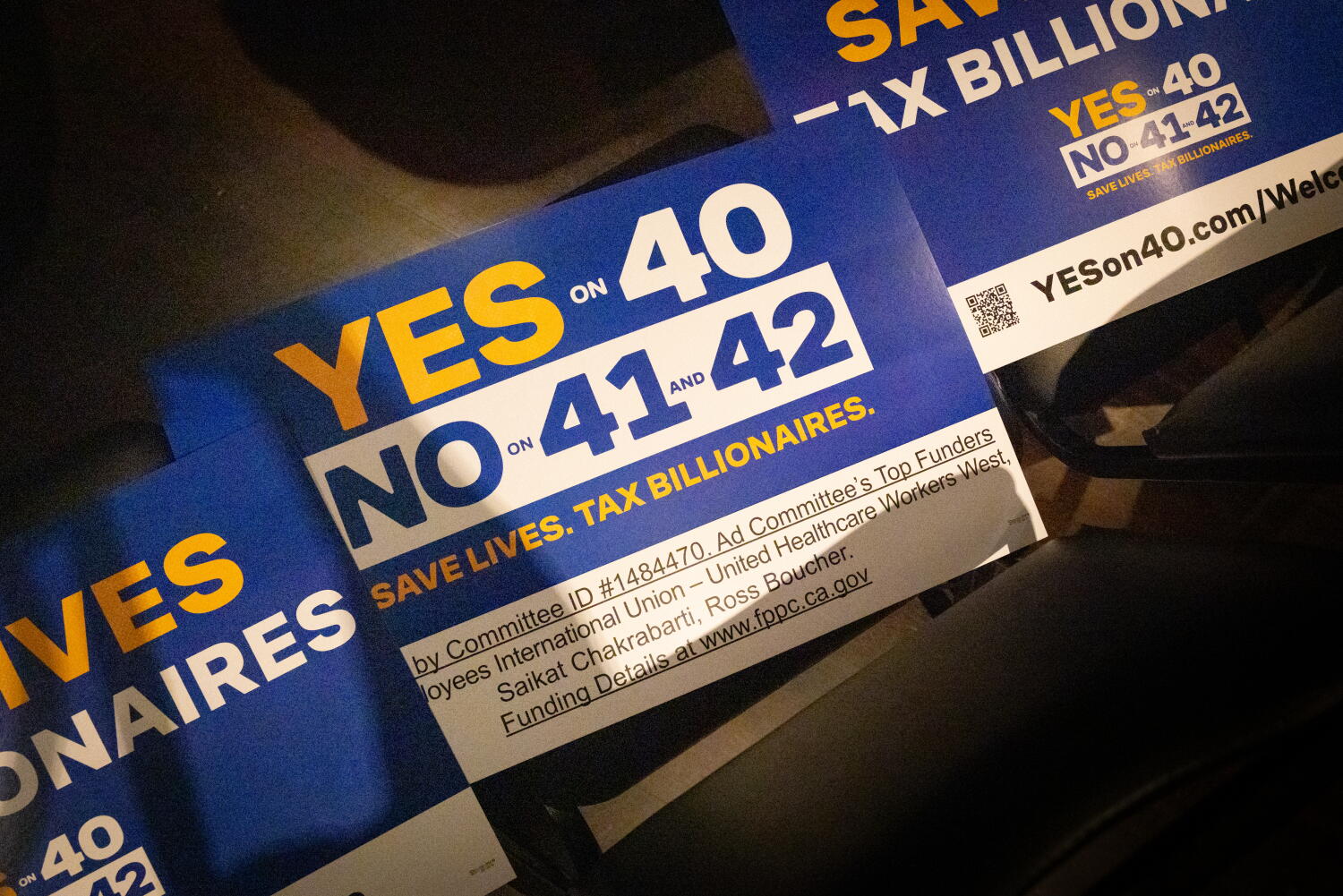
Mainstream political analysts are currently having a collective stroke trying to explain how California voters rejected both a billionaire wealth tax and a strict voter ID mandate on the exact same ballot.
To the pundit class, this looks like ideological schizophrenia. Left-wing strategists are weeping because they assumed "tax the rich" was a guaranteed layup in a deep-blue state. Right-wing commentators are fuming because they thought "show an ID to vote" was a common-sense slam dunk that crosses party lines. Both sides are reading the tea leaves upside down because they view the electorate through the lens of partisan tribalism rather than operational risk management.
The reality is brutally simple. California voters did not suffer a sudden bout of confusion at the ballot box. They executed a cold, calculated double-veto against state overreach.
When you strip away the cable news shouting matches, rejecting a wealth tax and rejecting voter ID come from the exact same psychological root. It is a profound, earned distrust of Sacramento’s administrative competence. Voters looked at two massive expansions of state bureaucracy—one targeting the capital base of the state's primary revenue engine, the other targeting the friction of ballot access—and said no to both.
The Lazy Consensus on the California Electorate
If you read the standard post-mortem coverage from legacy outlets, you get the same tired narrative. The conventional wisdom claims that progressive fatigue finally caught up with fiscal policy, while progressive loyalty held the line on election administration.
That analysis is lazy. It treats voters like mindless automatons pulling levers based on party affiliation, ignoring the actual mechanics of how policies function in the real world.
I have spent two decades advising institutional funds, municipal bond desks, and policy groups on how ballot initiatives translate into actual balance-sheet realities. I have seen campaigns burn tens of millions of dollars polling superficial slogans while completely missing the underlying economic anxieties of the people actually signing the checks. Voters in California are not ideologues; they are bruised consumers of terrible government services. They pay the highest marginal income tax rate in the nation—13.3 percent, plus a 1.1 percent payroll tax surcharge on high earners—and in return, they get rolling blackouts, crumbling infrastructure, and a multi-billion-dollar budget deficit that materializes every time the Nasdaq sneezes.
When you ask an electorate in that condition to hand Sacramento a brand-new, untested tax mechanism or a brand-new bureaucratic hurdle at the polling place, they do not ask whether the idea sounds nice in theory. They ask how badly the state is going to botch the execution.
Why the Billionaire Tax Was Dead on Arrival
To understand why the billionaire tax trailed and died, you have to understand the structural flaw of taxing unrealized capital gains and net worth.
Proponents sold the measure as a painless way to extract billions from a tiny handful of tech moguls to fund public services. On paper, a 1.5 percent or 2 percent annual levy on net worth above a certain threshold sounds like free money. In practice, it is fiscal suicide for a state that already relies on capital gains for roughly half of its general fund revenue.
Let’s look at the mechanics. Income is a flow; wealth is a stock. When you tax income, you take a slice of cash that actually changed hands. When you tax wealth, you are forcing an asset holder to liquidate equity or take on debt every single year just to pay the tax collector, regardless of whether the underlying asset generated a dime of cash flow.
Imagine a scenario where a founder holds shares in a private late-stage tech company valued at $2 billion on paper during a frothy venture round. Under a wealth tax, that founder owes $30 million to $40 million in cash to the Franchise Tax Board every April. The stock is illiquid. They cannot sell it on the open market. To pay the tax, they either have to borrow against volatile shares at punitive interest rates or force a secondary sale that tanks the company's valuation.
Even worse, billionaires are the single most mobile demographic on earth. They do not own brick-and-mortar factories tied to the Port of Los Angeles. Their wealth lives on servers, in brokerage accounts, and inside Delaware LLCs.
Tax economists like Emmanuel Saez and Gabriel Zucman—the intellectual architects behind modern wealth tax proposals—have argued that exit taxes and strict residency audits can trap capital inside a jurisdiction. That theory falls apart the moment it collides with the United States Constitution. Unlike a sovereign nation, California cannot build a financial wall around its borders. The Commerce Clause and the constitutional right to interstate travel severely limit a state's ability to tax someone after they establish domicile in Nevada, Texas, or Florida.
California voters might not recite constitutional tax law over breakfast, but they know how math works. They watched high-profile founders pack their bags for Austin and Miami over the last five years. They saw what happened to the state budget when tech IPOs dried up and the top 1 percent of earners—who already pay nearly 50 percent of California's personal income tax—pulled back. Voters realized that chasing the golden goose out of the state does not get you more eggs; it leaves the middle class holding the bag when the inevitable revenue shortfall hits.
The Unspoken Truth About the Voter ID Rejection
Now flip the coin. If voters are so skeptical of Sacramento's competence and fiscal discipline, why did they reject a voter ID mandate? According to right-wing media, voter ID polls at 70 to 80 percent nationally. How does a policy with overwhelming theoretical popularity crash and burn in California?
Because in California, voter ID is a solution in search of a problem that comes with a massive administrative price tag.
Let’s define the actual baseline of California’s election architecture. California operates primarily on universal vote-by-mail. Every active registered voter is automatically sent a ballot weeks before Election Day. To register in the first place, applicants must provide a California driver’s license number, a state ID number, or the last four digits of their Social Security number, which the Secretary of State cross-checks against the Department of Motor Vehicles and the Social Security Administration. When a mail ballot returns, election workers verify the signature on the envelope against the signature on file.
Proponents of the voter ID measure wanted to mandate government-issued photo identification for in-person voting and require partial ID numbers on mail-in ballot envelopes.
Here is where the practical reality killed the ballot measure. First, fewer than 15 percent of Californians actually vote in person at a physical precinct anymore. Mandating photo ID at polling places affects a shrinking fraction of the electorate while creating immediate friction for the elderly, students, and low-income residents who rely on public transit and do not maintain active DMV credentials.
Second, and far more importantly, voters took one look at the state agency responsible for issuing those IDs: the California DMV.
Ask any Californian about their last interaction with the DMV. Mention the rollout of REAL ID, which turned into a multi-year bureaucratic nightmare of six-hour lines, rejected birth certificates, and lost paperwork. Now tell those same voters that their constitutional right to cast a ballot will depend on the DMV seamlessly issuing, updating, and verifying identification records across 58 counties without a hitch.
Voters did not reject voter ID because they want illegal voting. They rejected it because they do not trust the state government to run an ID verification database without disenfranchising legitimate citizens through clerical incompetence. Furthermore, legal scholars and legislative analysts pointed out that the measure would trigger immediate, endless litigation under the California Constitution, costing taxpayers tens of millions of dollars in legal fees to defend a law that solves a statistically non-existent problem.
Dismantling the "People Also Ask" Fallacies
Whenever an election produces a split decision like this, search engines light up with frantic questions from people trying to make sense of the outcome. Almost every single one of those questions is built on a flawed premise.
Is California turning conservative on taxes?
No. California is not turning into Texas. Voters are not suddenly falling in love with supply-side economics or libertarian deregulation. What you are seeing is basic self-preservation. Voters will happily pass bond measures for local schools or water infrastructure when they can see where the money goes. They revolt when Sacramento asks for a blank check to fund opaque, poorly audited state programs—especially after watching billions of dollars disappear into homelessness initiatives with zero measurable reduction in street encampments.
Does rejecting voter ID mean California elections are insecure?
This is a fundamental misunderstanding of how mail-in ballot security actually works. Security in a vote-by-mail system happens at the front end (registration verification) and the back end (ballot tracking, barcoded envelopes, and signature auditing), not at a folding table in a high school gymnasium. Adding a driver's license number to a mail-in ballot envelope does not stop fraud; it simply creates a massive new vector for ballot rejection due to handwriting mismatches, transposed digits, or outdated DMV records. Research from institutions like the Caltech/MIT Voting Technology Project has repeatedly shown that strict documentary ID laws reduce turnout marginally among specific demographics without uncovering systemic impersonation fraud.
Why don't voters trust ballot measures anymore?
Because the California initiative process has been hijacked by special interest groups, billionaire vanity projects, and legislative cowardice. Instead of doing their jobs and passing coherent laws, lawmakers punt controversial decisions to the ballot box, forcing ordinary citizens to act as unpaid tax attorneys and constitutional scholars every November. When voters are confused, tired, or suspicious of hidden fine print, their default setting is "No."
The Hidden Vulnerability of the Centrist Veto
There is a massive downside to this voter behavior that nobody in the celebratory camp wants to admit. While killing bad ideas at the ballot box protects California from acute self-inflicted wounds, governing by perpetual veto leaves the state trapped in structural stagnation.
By rejecting the wealth tax, voters prevented capital flight, yet they left the state's dangerously volatile tax code completely untouched. California still relies overwhelmingly on the top 1 percent of income earners. When the stock market booms,