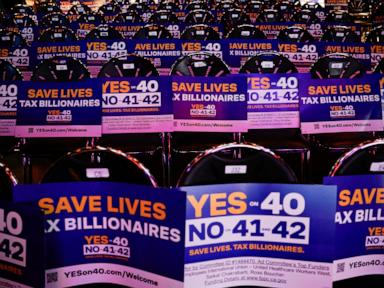
California voters have officially rejected Proposition 40, the high-profile ballot measure commonly referred to as the billionaires tax, according to projections from the Associated Press. While the proposal was pitched as an aggressive effort to fund public services and housing initiatives by levying a direct wealth tax on the state's ultra-rich, a broad coalition of voters ultimately sided with critics who warned of severe economic fallout and capital flight.
The defeat of Proposition 40 represents a significant moment in American fiscal policy. For decades, California has served as a testing ground for progressive taxation, already boasting the highest top marginal income tax rate in the nation. Yet when asked to cross the threshold from taxing annual income to taxing accumulated net worth, the electorate drew a hard line. Understanding why this measure failed requires looking beyond campaign slogans and examining the structural realities of state-level wealth taxes, the volatility of California's budget, and the shifting political calculus of middle-class voters.
The Mechanics Behind the Measure
Unlike traditional income taxes, which apply to wages, salaries, and realized capital gains within a given calendar year, Proposition 40 sought to establish an annual tax on total net worth above a specific threshold. Proponents argued that the ultra-wealthy frequently accumulate vast fortunes through unrealized gains—such as rising stock valuations and private equity stakes—that remain untouched by standard income tax codes unless the assets are sold.
The logic seemed straightforward on paper. By capturing a small percentage of that massive, untaxed wealth each year, the state could generate billions in dedicated revenue for critical infrastructure, homelessness programs, and public education. Supporters framed the measure as a basic question of tax fairness, pointing out that working-class Californians pay taxes on every paycheck while billionaires can borrow against their appreciating assets to fund their lifestyles without triggering a taxable event.
However, translating that theory into enforceable state law proved deeply contentious. Assessing net worth is fundamentally different from verifying a W-2 form. While publicly traded stocks have clear daily market values, a substantial portion of billionaire wealth is tied up in illiquid assets. Private companies, intellectual property, real estate holdings, fine art, and complex trust structures require invasive, expensive, and subjective valuations every single year.
Opponents, including prominent economists, business associations, and tax attorneys, highlighted the administrative nightmare this would create for the California Franchise Tax Board. Auditing the global balance sheets of the state's wealthiest residents would require an unprecedented expansion of state bureaucracy, inevitably leading to years of costly litigation over how private assets are priced.
The Capital Flight Dilemma
The most potent argument against Proposition 40 was not administrative complexity, but mobility. Unlike the federal government, which taxes citizens regardless of where they live in the world, a single state cannot easily prevent its tax base from moving across state lines.
California already relies heavily on a remarkably small fraction of its population to fund basic government operations. According to data from the California Legislative Analyst's Office, the top one percent of earners regularly account for nearly half of all personal income tax revenue collected by the state. This extreme concentration creates a structural vulnerability. When the stock market surges, Sacramento enjoys massive budget surpluses; when tech valuations dip, the state faces multi-billion-dollar deficits.
Critics argued that Proposition 40 would push that vulnerability past the breaking point. If a handful of ultra-wealthy founders and investors decided to relocate to states with zero income or wealth taxes—such as Texas, Florida, or Nevada—the resulting loss in regular income tax revenue could actually exceed whatever new money the wealth tax raised.
Consider a hypothetical example to illustrate the math behind this concern. Suppose a tech founder with a net worth of $5 billion pays $40 million annually in standard California state income taxes from stock sales and dividends. Under a new wealth tax, that founder might face an additional $50 million annual bill simply for holding their company shares. If that individual responds by establishing legal residency in Austin or Miami, California does not just fail to collect the new $50 million wealth tax; it also loses the $40 million in reliable income tax it was already receiving. Multiply that scenario across even a dozen high-net-worth households, and the net fiscal impact turns sharply negative.
To counter this risk, the authors of Proposition 40 included exit-tax provisions designed to continue taxing wealthy individuals for several years after they left the state. Legal scholars immediately questioned the constitutionality of such measures, warning that attempts to tax former residents on out-of-state assets would violate the Dormant Commerce Clause and Due Process protections of the U.S. Constitution. Rather than reassuring voters, the inclusion of aggressive exit penalties reinforced the perception that the measure was legally fragile and economically desperate.
The Shift in Voter Sentiment
Perhaps the most telling aspect of the Proposition 40 defeat was who voted against it. A ballot measure targeting a tiny fraction of the population cannot fail unless hundreds of thousands of ordinary, middle- and working-class voters actively choose to reject it.
Throughout the campaign, opposition groups spent heavily to frame Proposition 40 not as an isolated tax on the ultra-rich, but as a threat to the broader California economy. Television and digital advertisements focused relentlessly on the downstream effects of business relocation. When a billionaire founder moves a headquarters or family office out of Silicon Valley or Los Angeles, they do not leave alone. They take executive teams, legal counsel, philanthropic foundations, and local investment capital with them.
Voters living in regions already grappling with high housing costs, elevated gas prices, and lingering inflation proved skeptical of promises that new tax revenue would efficiently solve chronic social problems. Over the past decade, California voters have approved several major tax increases and bond measures aimed at addressing homelessness and infrastructure. Yet visible conditions on the streets of major cities have often failed to improve at the pace voters expected.
That skepticism created a powerful headwind. For many undecided voters, the central question was no longer whether billionaires could afford to pay more, but whether Sacramento could be trusted to manage the windfall effectively without damaging the state's job engine. Political analysts noted that even in traditionally progressive coastal counties, support for the measure lagged well behind historical baselines for tax initiatives.
The Startup Ecosystem and Unrealized Gains
Beyond the immediate budget numbers, venture capitalists and startup founders mounted an aggressive campaign warning that Proposition 40 would cripple California's status as the global hub for technological innovation.
In Silicon Valley, paper wealth is frequently disconnected from actual cash flow. A founder of a high-growth artificial intelligence or biotech startup might hold equity valued at over a billion dollars following a private funding round, even while the company is losing money and the founder is drawing a modest salary. Because those shares cannot be easily sold on a public exchange, a tax on unrealized net worth would force founders to liquidate portions of their ownership early just to pay the state tax bill.
Industry leaders argued that forcing premature stock sales would dilute founder control, depress valuations, and incentivize entrepreneurs to incorporate and build their companies elsewhere from day one. While defenders of Proposition 40 pointed out that the measure included deferral mechanisms for illiquid assets, critics countered that those provisions came with strict conditions and interest charges that still penalized domestic innovation compared to rival tech hubs in New York, Seattle, or Austin.
What the Defeat Means for National Tax Policy
The rejection of Proposition 40 sends a clear signal far beyond California's borders. In recent years, progressive lawmakers in several states—including Washington, Illinois, New York, and Massachusetts—have introduced legislation to tax extreme wealth or unrealized capital gains. California was widely viewed as the ultimate bellwether for whether such policies could survive a direct democratic vote.
If a wealth tax cannot pass in the nation's most populous blue state, its prospects in more politically divided jurisdictions appear dim. The outcome reinforces a fundamental constraint of American federalism: subnational governments operate in an open competitive market for residents and capital. While voters frequently express frustration over rising wealth inequality, they remain pragmatic about the limits of state-level taxation when borders are open and relocation is frictionless.
For state lawmakers in Sacramento, the defeat of Proposition 40 closes off one potential avenue for closing future budget gaps and forces a reckoning with existing fiscal structures. Rather than relying on novel taxes aimed at an increasingly mobile elite, California policymakers will have to confront the harder questions of spending efficiency, regulatory reform, and stabilizing an income tax system that rises and falls with the fortunes of Wall Street and Silicon Valley.