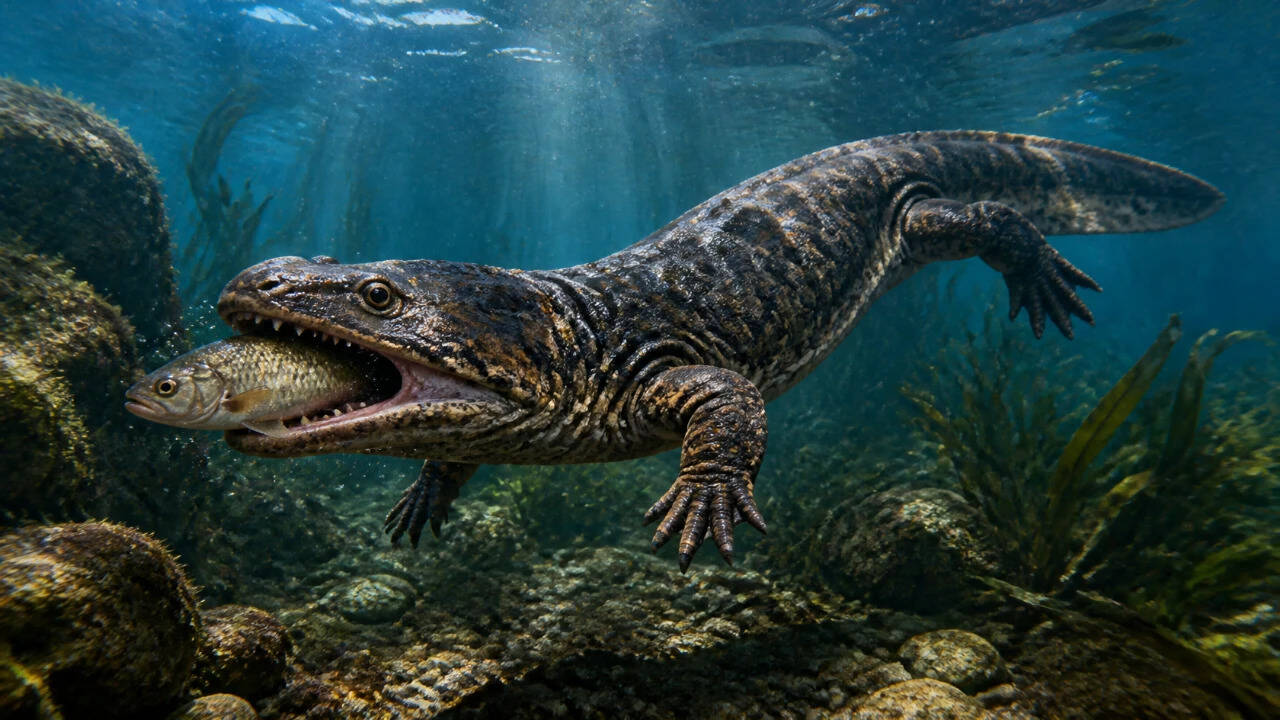
Every few years, paleontology headlines pull the same trick. A rock splits in a Triassic quarry, a weird little skeleton pops out, and within twelve hours the internet is shouting that amphibians conquered the open ocean.
Slow down. Put the champagne back in the fridge. You might also find this connected story interesting: The Quiet Boat Across Cold Water.
When a story claims an armoured, roughly 2.4-foot fossil from China dated to about 237 million years ago might represent the first amphibian to live entirely at sea, the lazy consensus writes itself. It frames evolution as a heroic checklist. Land first. Then sky. Then back to the waves, right on the heels of the marine reptiles. It treats "amphibian" as a tidy badge of identity and "marine" as a dramatic plot twist.
That framing is lazy. Worse, it asks the wrong questions. As highlighted in recent coverage by USA Today, the implications are notable.
The Taxonomy Trap That Trips Up Headlines
Let's start where lazy science journalism always stumbles: words.
In everyday English, an amphibian is a slimy little thing that sits on a lily pad, croaks at dusk, and dries out if you leave it on a sunny sidewalk for twenty minutes. Modern amphibians—lissamphibians, meaning frogs, toads, salamanders, and caecilians—have permeable skin, eggs without hard shells, and a heavy dependence on fresh water or damp habitats. Saltwater is brutal on them. Osmosis pulls water right out of their bodies in hypertonic seawater unless they have specialized physiological tricks to fight it.
Now contrast that with ancient temnospondyls or early tetrapodomorph relatives from the Triassic. When a headline says a 237-million-year-old fossil from the Middle Triassic is the "first amphibian known to have lived entirely at sea," two traps spring shut at once.
First, living entirely at sea is a monstrously high bar to prove from stone. A skeleton found in marine sediment tells you where the animal died—or where currents washed its carcass after death. It does not automatically prove the animal never waded into a lagoon, never bred in brackish estuaries, or never touched a shoreline. Taphonomy—the study of how organisms decay and become fossilized—is messy. Dead bodies float. Rivers dump carcasses onto continental shelves. Storms rearrange bones. Proving exclusively marine life requires tight anatomical, ecological, and geochemical evidence, not just a splashy press release.
Second, lumping every non-amniote, non-fish four-limbed vertebrate into the casual bucket of "amphibian" flattens hundreds of millions of years of deep history. Paleontologists argue constantly over exact stem-group and crown-group placements, and for good reason. Calling an ancient armoured tetrapod an "amphibian" makes it sound like a giant salamander wearing chainmail. That mental picture is fun. It is also a shortcut that obscures what actually happened in Triassic waters.
I have spent years watching smart people—both in science communication and in commercial research—fall in love with neat origin stories before checking the plumbing underneath. I have watched teams pour time and budget into chasing "first-ever" milestones that turn out to be sampling artifacts or semantic sleight-of-hand. The pattern is always the same: people reward novelty over precision. A "first" gets clicks. A careful qualification gets ignored.
Why the Middle Triassic Was Anything But Quiet
To understand why a 237-million-year-old marine creature matters—and why the "shocking rewrite of amphibian evolution" angle misses the deeper story—you have to look at the calendar.
237 million years ago sits right in the Middle Triassic (around the Ladinian–Carnian boundary). By then, life on Earth had been climbing out of the Permian-Triassic extinction—the "Great Dying" roughly 252 million years ago—for about fifteen million years.
Think about what an empty ecological stage looks like after a catastrophe. Predators vanish. Niches blow wide open. Survivors scramble into every available corner of land, river, coast, and sea.
In the oceans during the Triassic, marine reptiles were already experimenting wildly. Ichthyosaurs, sauropterygians, placodonts, and early archosauromorphs were testing different body plans, diets, and swimming styles. Coastal shelves and shallow epicontinental seas in East Asia and across Tethys were packed with shifting food webs, warm waters, and plenty of room for weirdos.
An armoured body—dermal bone plates or osteoderms—makes total sense in a rough neighborhood. Armour does two main jobs in water:
- Defense: It turns a soft, tasty body into a bad day for predators with crushing jaws or sharp teeth.
- Ballast: Heavy bone acts like a weight belt. For an aquatic or semi-aquatic animal trying to stay submerged without burning huge amounts of energy paddling constantly, extra bone mass helps control buoyancy and trim.
Notice that ballast works whether an animal is a dedicated open-ocean cruiser or a bottom-grubbing coastal hunter. Armour is a mechanical solution to physics and predation. It is not a magical "I live in the deep blue sea forever" stamp.
Asking the Right Questions Instead of Chasing "Firsts"
When readers see a headline about an ancient sea-dwelling amphibian, their natural curiosity spawns a predictable set of questions. Most of those questions are built on shaky premises. Let's tear them down and replace them with sharper ones.
"Did amphibians evolve in the ocean first, or on land?"
That question reverses the sequence and muddies the terms. Vertebrates with limbs and digits—tetrapods—emerged from lobe-finned fish in Devonian aquatic or marginal environments, moving onto land where they diversified hugely. Modern amphibians are one branch of that story, while amniotes (reptiles, birds, and mammals) are another.
Several lineages later returned to water. Whales, seals, sea turtles, sea snakes, mosasaurs, and ichthyosaurs all went back into the drink. Calling an ancient tetrapod "the first amphibian at sea" treats the sea like an alien world that amphibians finally conquered, when in reality water is where vertebrate skeletons and swimming mechanics started in the first place.
A better question: How did specific ancient tetrapod lineages solve osmoregulation, locomotion, and reproduction in salty or brackish environments that usually exclude modern amphibians?
"How do scientists know it lived entirely at sea?"
Usually, they don't—not with 100% certainty. Even when fossils are found in marine limestone or shale alongside marine ammonites, conodonts, or fish, honest researchers treat "obligate marine lifestyle" as a hypothesis supported by clues, not a closed case.
Clues might include:
- Sedimentary context: Fine-grained marine deposits formed offshore, away from obvious river deltas.
- Associated fauna: Marine invertebrates and open-water fish rather than terrestrial plants or freshwater bugs.
- Functional morphology: Limb proportions, tail structure, skull shape, and bone density suited for swimming rather than walking on dry ground.
- Geochemistry: Trace elements or isotopes in teeth and bone that reflect marine water chemistry rather than freshwater.
Even with all four, a sharp skeptic asks: Could it have migrated into coastal waters seasonally? Could juveniles have used estuaries while adults roamed farther out? Real biology is rarely a binary switch.
"Does this overturn everything we know about amphibian evolution?"
Almost never. Real science usually shifts edges and adds branches rather than lighting the entire textbook on fire.
Heavyweights like Jennifer Clack (who reshaped our understanding of early tetrapod origins and the water-to-land transition) and Michael Benton (who has written extensively on Triassic ecosystems and recovery after mass extinctions) have spent careers showing how complex and experimental early vertebrate history really was. When a new fossil shows up in a previously under-sampled region or time slice, it usually reminds us how much of the fossil record is missing—especially in places like parts of Asia where intensive fieldwork and new localities keep turning up surprises.
A fossil challenging what scientists know often just challenges what casual readers assumed. There is a massive difference between the two.
A Thought Experiment in Fossil Bias
Imagine a scenario where a team of paleontologists excavates two neighboring rock layers from the same Triassic period. Layer A is a well-studied coastal basin in Western Europe that has been quarried and cataloged for two centuries. Layer B is a less-explored marine formation in South China where new roads and quarries have recently exposed fresh rock.
In Layer A, you already know most of the usual suspects. In Layer B, a strange 2.4-foot armoured skeleton shows up.
Does that mean the animal only existed in South China? No. Does it mean it was the very first of its kind on Earth? Maybe—or maybe its relatives elsewhere simply haven't been found, recognized, or published yet.
Sampling bias is the quiet villain of paleontology. You can only find fossils where rocks of the right age exist, sit near the surface, aren't crushed or baked beyond recognition, and happen to be dug up by people looking in the right spot. Treating the first fossil found as the first organism that ever lived is a classic rookie mistake.
The Downside of Being a Contrarian Skeptic
Let's be honest about the cost of taking this stance.
If you strip away the "first sea amphibian rewrites history" drama and talk about taphonomy, bone ballast, Triassic recovery, and sampling bias, you lose some of the thrill. You sound less like a movie trailer and more like a careful detective reading lab notes. Readers who want a neat, punchy moral will sometimes get annoyed when you refuse to hand them one.
There is also a real risk of over-correcting. Skepticism should never become knee-jerk cynicism. A genuinely unusual marine tetrapod from the Middle Triassic is cool. Finding strange animals in unexpected places expands our map of past ecosystems, even if it doesn't rewrite the laws of biology. Good contrarianism respects the evidence while refusing to swallow the hype whole.
How to Read Science Headlines Like an Insider
Next time a fossil story—or any splashy research claim—hits your feed, run it through a quick four-step filter before sharing it as gospel:
- Separate the fossil from the label: Check what the actual bones show versus what modern word ("amphibian," "shark," "ape," "superfood") the headline uses to make it familiar.
- Check the superlatives: Whenever you see "first," "only," "entirely," or "rewrites everything," ask what evidence could possibly prove something that absolute—and what might still be sitting underground.
- Look for the habitat clue: Ask whether the animal was found in marine rock or proven to live there its whole life.
- Watch the clock: Anchor the organism in its actual geological time and ecological neighborhood, not just a big scary number of millions of years.
Stop falling for tidy origin myths. Pay attention to the mechanics, the rock record, and the messy reality of ancient life.