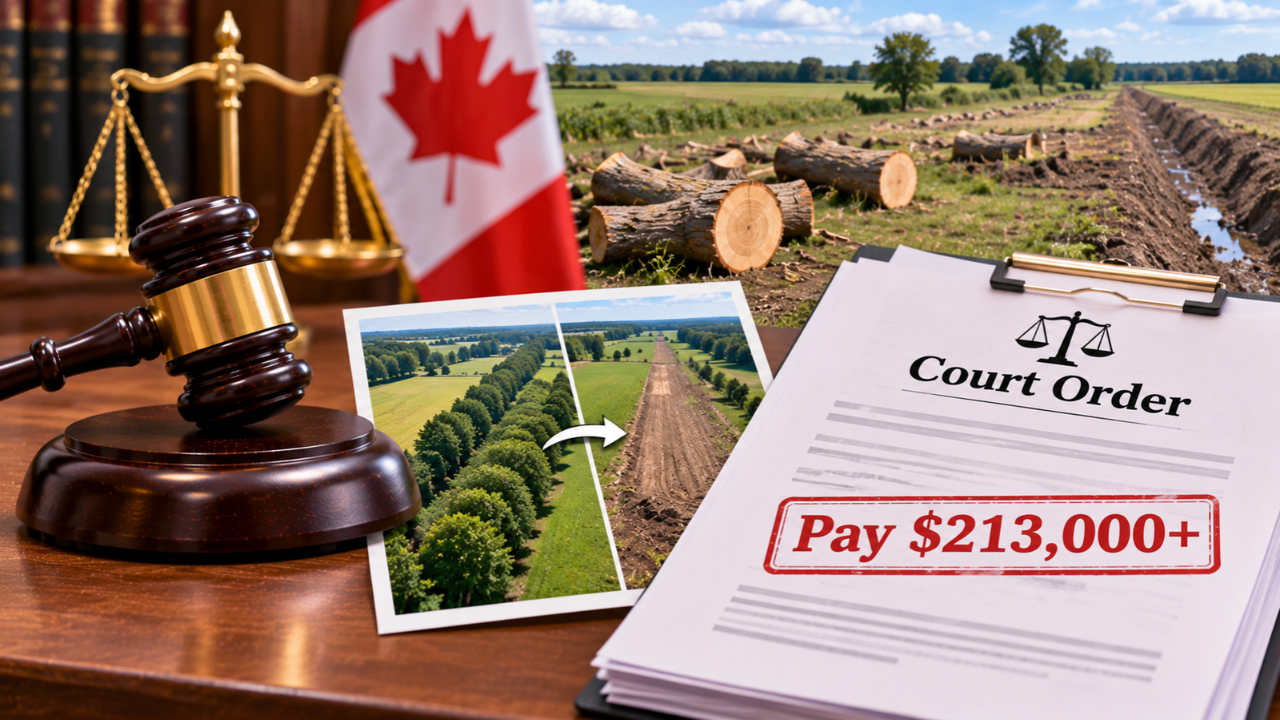
Property lines aren't suggestions. Yet every year, rural landowners treat boundary markers like rough estimates, assuming an excavator and a chainsaw can solve any drainage headache or overgrown fencerow in an afternoon.
That assumption just cost a Canadian farmer $213,000.
When a farmer in Canada cleared trees on a neighbour's property and filled in a drainage ditch without permission, the resulting legal battle didn't end with a polite handshake or a slap on the wrist. Courts ordered the farmer to pay $213,000 in damages and penalties—a massive financial hit that proves rural property law has sharp teeth. If you own acreage, manage farmland, or live next to agricultural operations, this case isn't just local news. It's a warning.
What Actually Happened With the $213,000 Tree and Ditch Dispute
Let's strip away the rumour mill and look at why the penalty climbed past two hundred thousand dollars.
In rural disputes, people often think the worst-case scenario for cutting down someone else's trees is paying for the raw lumber value. That's dead wrong. Under Canadian common law and provincial timber trespass statutes, courts don't just calculate what a log sells for at the mill. They calculate restoration costs, loss of amenities, ecological damage, and punitive damages when the act is deliberate.
Filling in a ditch makes things ten times worse.
Drainage ditches aren't just random trenches dug into the dirt. Across Canadian provinces—whether you're dealing with Ontario's Drainage Act, municipal drains, or natural watercourses—altering water flow affects neighbouring fields, roadbeds, and soil erosion. When you dump fill into a ditch, you don't just change your own grade. You force water onto someone else's land, or you starve downstream users of runoff they rely on.
Combine unauthorized timber clearing with illegal grade alteration, and you hand a judge two separate reasons to throw the book at you. That's how a single afternoon with heavy machinery snowballs into a $213,000 judgment.
Why Courts Punish Tree Clearing So Heavily in Canada
If you've ever dealt with rural boundary disputes, you know how quickly emotions flare. One neighbour sees a row of mature trees as an eyesore that shades out their cash crops and drops branches onto their equipment. The other neighbour sees a windbreak, wildlife habitat, and decades of growth you can't replace at a garden centre.
Canadian courts overwhelmingly side with the property owner who lost the trees.
Here is why the dollar figures get massive so fast:
- Replacement valuation isn't based on firewood. Arborists use established appraisal methods—like the Council of Tree and Landscape Appraisers (CTLA) trunk formula method—to value mature trees. A single 40-year-old hardwood can easily appraise for $5,000 to $15,000 depending on species, health, and location. Multiply that across a fencerow of twenty or thirty trees, and you're already staring at six figures before lawyers even enter the room.
- Remediation costs dwarf the original work. When a court orders you to restore damaged land, you aren't hiring your buddy with a backhoe for a weekend. You're paying for certified land surveys, soil remediation, stump grinding, mature nursery stock, and multi-year watering guarantees.
- Punitive damages target "ask forgiveness later" behaviour. Judges hate self-help remedies. If a landowner bypasses a survey, ignores a neighbour's objections, or clears land while knowing the boundary is disputed, courts add punitive damages specifically to deter other farmers from doing the same math and deciding a fine is cheaper than doing things legally.
Honestly, the old rural mindset of "just push the fencerow back a few feet and nobody will notice" doesn't survive modern satellite imagery and drone mapping. High-resolution aerial photos from municipal GIS portals and historical Google Earth layers give lawyers exact before-and-after proof down to the individual canopy.
The Hidden Legal Trap of Filling a Rural Ditch
Trees get the emotional headlines, but water law is where farmers really get burned.
Water doesn't respect property pins. Because of that, every Canadian province regulates drainage and surface water far more strictly than most landowners realize. Even if a ditch sits right on the edge of your field, you rarely have unilateral authority to fill it in.
Natural Watercourses vs. Constructed Drains
In Canadian property law, there's a massive difference between surface water runoff and a defined watercourse. If water flows through a natural channel with a bed and banks, riparian rights apply. You cannot block, divert, or fill that channel if doing so harms an upstream or downstream neighbour.
If the ditch is a municipal drain or a mutual agreement drain, filling it without formal engineering approval is a direct statutory offence. Municipalities have the legal power to enter your land, dig the ditch back out at your expense, and tack the entire bill straight onto your property taxes.
Environmental and Conservation Authority Penalties
Depending on where the ditch leads, filling it in can trigger provincial environmental legislation or local Conservation Authority rules. If that ditch drains into a wetland, creek, or fish-bearing stream, dumping dirt into it can violate provincial water resources acts—or even the federal Fisheries Act if sediment washes downstream into fish habitat. Those fines don't go to your neighbour; they go straight to the Crown, and they come with strict compliance orders.
Common Mistakes Landowners Make on Rural Boundaries
I've seen dozens of property line blowups over the years, and they almost always start with the exact same three mistakes.
1. Trusting an old wire fence as the legal boundary
Fences drift. Over fifty years, someone repairs a broken post, shifts the line around a boulder, or puts up temporary electric wire three metres off the true lot line. Under Canadian land titles systems (especially in provinces using the Torrens system), adverse possession or "squatter's rights" is heavily restricted or completely abolished. A fence that's stood in the wrong spot for thirty years doesn't automatically transfer ownership of the trees behind it.
2. Assuming verbal agreements carry over to new owners
Maybe your dad and the old neighbour agreed in 1994 that you could farm right up to the ditch and clear the brush. That handshake deal dies the second either farm sells. New buyers rely on registered deeds and legal surveys, not oral history.
3. Guessing the line using a phone GPS
Consumer GPS on your smartphone is accurate to within three to five metres on a good day—and way worse under tree canopy. Using a hunting app or a municipal GIS overlay on your phone to decide where to run a chainsaw is asking for a lawsuit. GIS parcel lines are illustrative maps, not legal surveys.
How to Protect Yourself Before Clearing Land or Altering Drainage
If you own rural land and need to clear brush, remove hazard trees, or fix a wet spot in a field, a few upfront steps will save you from a six-figure disaster.
- Hire an Ontario Land Surveyor (OLS) or provincial equivalent first. Yes, a boundary retracement survey costs anywhere from $2,500 to $8,000+ depending on acreage and terrain. Compare that to a $213,000 court judgment plus your own $50,000 legal bill. Have the surveyor plant iron bars and flag the line clearly before any equipment rolls onto the site.
- Check municipal drainage maps. Call your township or county drainage superintendent before touching any trench, culvert, or swale. Ask if the ditch is a registered municipal drain or subject to a recorded drainage agreement on title.
- Get written permission—not a text message—for boundary trees. Under Canadian forestry laws (like Ontario's Forestry Act), any tree whose trunk grows across a boundary line is common property. Cutting or injuring it without the explicit written consent of both owners is a strict liability offence. Write down what is being removed, who is paying for cleanup, and have both parties sign and date it.
- Document the site before work starts. Take timestamped photos and video showing the flagged survey stakes, the existing ditch depth, and the specific trees slated for removal. If a dispute ever comes up later, proof that you stayed strictly on your side of the iron bars ends the argument before it reaches a courtroom.
Never put a blade in the dirt or a saw to a trunk until you know with legal certainty where your property ends.