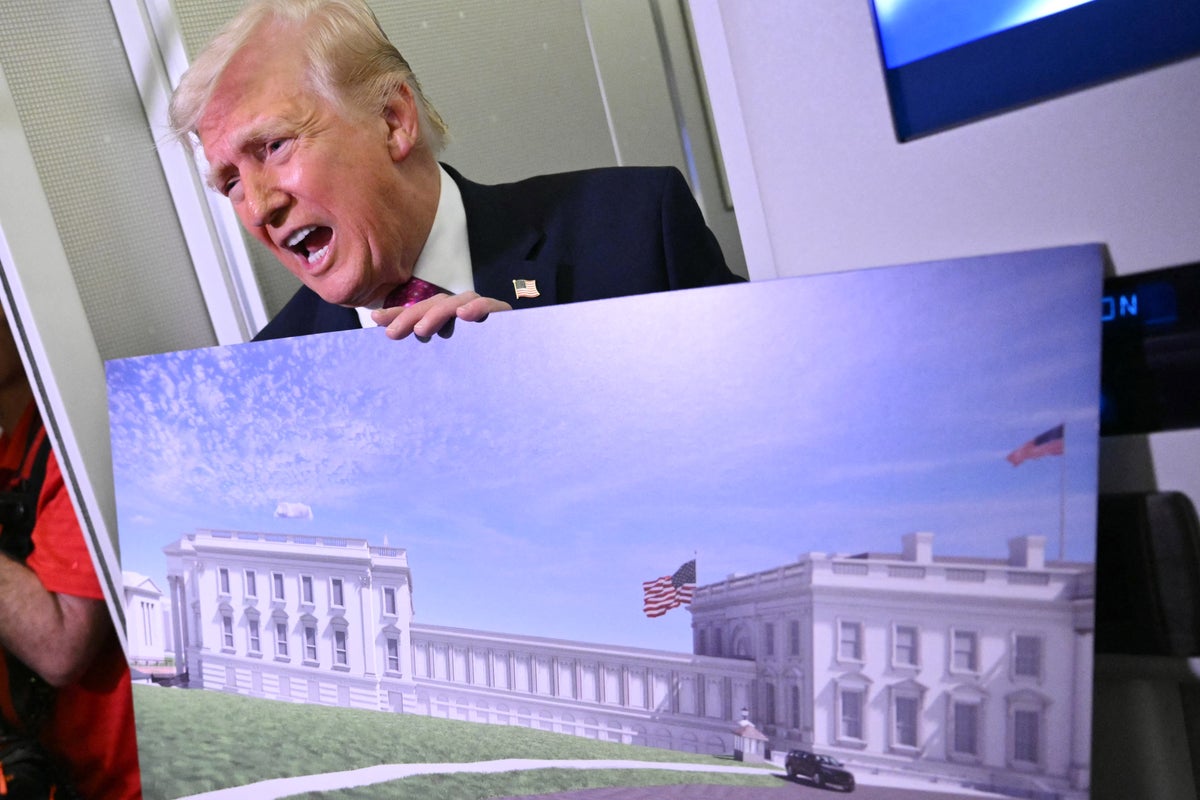
The proposed $10 billion allocation for the revitalization and beautification of Washington, D.C., represents a fundamental shift from maintenance-based budgeting to a strategic capital injection aimed at increasing the District's utility as a global administrative hub. This initiative functions as a massive urban CAPEX (Capital Expenditure) project intended to address long-standing structural inefficiencies, aesthetic degradation, and the logistical bottlenecks that currently constrain the federal district’s operational capacity. By viewing the capital not just as a seat of government but as a high-value asset, the administration seeks to trigger an "urban multiplier effect," where targeted aesthetic and functional improvements drive broader economic stability and increased property valuations within the metropolitan core.
The Tripartite Framework of Federal Urban Investment
To understand the mechanics of a $10 billion infusion, the project must be categorized into three distinct operational pillars. Each pillar carries a different risk-adjusted return on investment (ROI) and addresses a specific failure in the current urban model.
1. Functional Utility and Hard Infrastructure
This pillar focuses on the "plumbing" of the city. While the public discourse centers on "beautification," the majority of a $10 billion budget must logically address the degradation of transit systems, utility grids, and bridge integrity. In engineering terms, this is the mitigation of Entropy Debt. Washington’s infrastructure has suffered from decades of deferred maintenance. The cost of rectifying these issues increases non-linearly over time; waiting ten years to fix a bridge can cost five times as much as proactive reinforcement.
2. Aesthetic Standardization and Symbolic Capital
This is the "beautification" aspect mentioned in the proposal. From an analytical perspective, this is not a vanity project but an exercise in Signaling Theory. A capital city’s physical state communicates the competence and stability of the state to international observers, investors, and diplomatic corps. High-quality public spaces and neoclassical architectural consistency serve as a form of "soft power" branding. The economic mechanism here is the "Broken Windows" theory in reverse: high-investment environments discourage civil disorder and attract higher-tier commercial tenants.
3. Security-Integrated Urbanism
The post-2021 security posture of D.C. has relied on temporary, unsightly measures—concrete barriers, chain-link fences, and Restricted Access Zones. These interventions create significant "Friction Costs" for residents and tourists. A $10 billion plan allows for the transition to Invisible Security Architecture. This involves integrating hardening measures (e.g., reinforced bollards, strategically graded landscapes, and blast-resistant street furniture) into the urban design itself, thereby restoring flow and aesthetic value without compromising the defensive perimeter.
The Cost Function of Urban Transformation
A $10 billion figure is significant but requires context within the scale of modern urban redevelopment. When broken down by the standard costs of Tier-1 city construction, the budget's reach becomes clearer.
- Subterranean and Utility Relocation: High-density urban areas like D.C. have complex, layered utility maps. Relocating a single mile of high-voltage transmission or water main can cost between $50 million and $150 million depending on soil conditions and historical preservation requirements.
- Materials and Labor Premiums: Federal projects often require compliance with "Buy American" provisions and prevailing wage laws, which typically adds a 20% to 30% premium over private-sector commercial construction.
- The Regulatory Tax: The National Environmental Policy Act (NEPA) and Section 106 of the National Historic Preservation Act (NHPA) introduce significant temporal costs. In large-scale D.C. projects, the "soft costs" (legal, environmental assessments, and public hearings) can consume 15% of the total budget before a single brick is laid.
Addressing the Displacement Paradox
A primary criticism of large-scale beautification is the potential for displacement and the "Gentrification Feedback Loop." When the federal government invests $10 billion into a specific geographic radius, the surrounding land value experiences a sharp upward trajectory.
The mechanism is simple: Amenity Value Influx. As parks are improved, transit becomes more reliable, and streets become safer, the "willingness to pay" for local residential and commercial space increases. For the federal government, this is a net positive for the tax base of the District, but it creates a socioeconomic bottleneck. The strategy must account for the Supply-Side Constraint. If the $10 billion is spent purely on demand-side attractors (beautification) without simultaneous deregulation of housing density, the result is a price spike that may push the very service-sector workers necessary to maintain the "beautified" city out of the region.
The Logic of Federal Oversight vs. Home Rule
The $10 billion proposal is inextricably linked to the debate over the District’s autonomy. From a management perspective, the administration’s desire for direct federal control over the funds stems from a perceived Agency Problem.
Under the current "Home Rule" structure, the D.C. local government manages most urban planning. However, the federal government—as the primary landowner and "anchor tenant"—bears the reputational and security risks of the city’s performance. The $10 billion investment serves as a "levered buyout" of urban policy. By providing the capital, the federal government asserts the right to dictate the design language and operational priorities of the city, bypassing local bureaucratic hurdles that might otherwise stall high-impact projects.
This creates a Governance Friction Zone. Strategic success depends on whether the federal "top-down" approach can integrate with the "bottom-up" needs of a functioning city. If the projects are designed solely for tourists and federal employees, they risk creating a "Potemkin Village"—a beautiful facade that lacks the organic density required for long-term economic resilience.
Identifying the Bottlenecks: Why Projects Fail
Even with $10 billion, three specific factors could lead to a "Value Leakage" where the investment fails to produce the intended urban transformation.
- The Procurement Trap: Federal procurement is notoriously slow. By the time funds are allocated and contracts are awarded, inflation in the construction sector (which often outpaces the CPI) may have eroded the purchasing power of the $10 billion by 10% to 15%.
- Aesthetic Incoherence: Without a unified "Master Plan," the $10 billion could be fragmented across hundreds of disconnected projects. This leads to Diminishing Marginal Utility, where the sum of the parts is less than the whole. A master-planned approach—similar to the McMillan Plan of 1902—is required to ensure the investments are synergistic.
- Maintenance Tail Risk: Capital projects require ongoing operational expenditure (OPEX). If the $10 billion is spent on high-maintenance features (elaborate fountains, exotic landscaping, or complex smart-city tech) without an earmarked endowment for upkeep, the "beautification" will revert to decay within a decade.
Strategic Recommendation: The Integrated Corridor Approach
To maximize the impact of the $10 billion, the administration should abandon a "scattergun" approach in favor of Corridor-Based Development. Rather than small improvements across the entire District, the focus should be on high-traffic, high-visibility "Spines" that connect the federal core to neglected neighborhoods.
- Priority 1: The Pennsylvania Avenue Axis. Transforming this corridor into a pedestrian-first, high-security, high-aesthetic boulevard would maximize the "Signaling Value" to global audiences.
- Priority 2: The Anacostia River Waterfront. This represents the largest opportunity for "Value Capture." By cleaning the waterway and building high-utility parklands, the government can unlock billions in private-sector development on currently undervalued land.
- Priority 3: The Transit Hub Reinforcement. Union Station and its surrounding environs act as the "Front Door" to the capital. Applying a significant portion of the $10 billion to modernize this hub—integrating retail, high-speed rail, and security—creates a functional multiplier that benefits the entire Northeast Corridor.
The move toward a $10 billion revitalization is a recognition that physical environments dictate economic and political outcomes. The success of this mandate will not be measured by the "beauty" of the result, but by the reduction in friction, the increase in asset value, and the long-term sustainability of the District's infrastructure. The administration must treat the city as a high-performance system rather than a static monument. Execution requires a ruthless prioritization of hard infrastructure and security integration, disguised within a neoclassical aesthetic framework to ensure both functional and symbolic dominance.