A modern smartphone is a graveyard of ancient elements. If you cracked open the device in your pocket right now, you wouldn't just see silicon and glass. You would find traces of the earth’s most stubborn secrets: neodymium, praseodymium, terbium. These are the rare earths. They are the silent conductors of our digital lives, buried deep within the vibrating motors and high-fidelity speakers that we take for granted every single day.
For decades, the journey of these minerals followed a predictable, albeit lopsided, map. They were pulled from the ground, often in places like Inner Mongolia, and refined through a grueling, chemical-heavy process that China mastered while the rest of the world looked away. But the map is being redrawn. The ink is still wet, and the person holding the pen is Norio Nakajima.
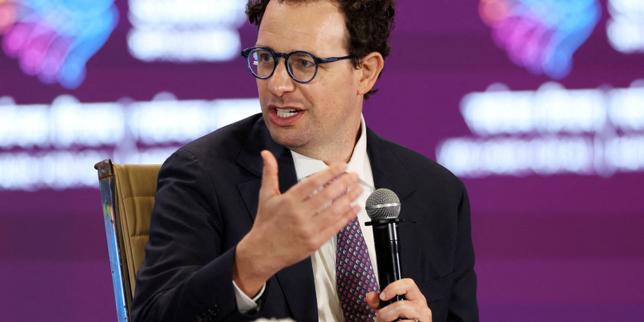
Nakajima is the president of Murata Manufacturing. You might not know the name Murata, but they know you. They produce the tiny ceramic capacitors that regulate electricity in almost every electronic device on the planet. If Apple is the architect of the digital age, Murata is the master mason providing the bricks. And recently, Nakajima made a decision that signals a tectonic shift in how your next phone will be built.
Murata is moving to decouple. They are stripping Chinese rare earths out of their supply chain for the first time in a generation.
The Weight of a Single Magnet
To understand why a Japanese component giant is spending billions to avoid Chinese minerals, you have to look at the fragility of a "just-in-time" world. Imagine a factory floor in Vietnam or Thailand. The air is hums with the sound of precision machinery. Thousands of multilayer ceramic capacitors (MLCCs) are being baked in kilns at temperatures exceeding 1,000 degrees Celsius.
Historically, the high-performance magnets used in the motors that produce these components relied entirely on Chinese processing. It was cheap. It was efficient. It was also a trap.
Geopolitics used to be something that happened in summit rooms and embassy backchannels. Now, it happens on the assembly line. When trade tensions flare, the flow of rare earths doesn't just slow down; it can be used as a valve. Turn the handle, and the global tech industry gasps for air. Murata realized that being the world’s leading supplier of electronic "bricks" meant nothing if the mortar was controlled by a single, increasingly assertive neighbor.
Nakajima’s strategy isn't born of a political crusade. It is born of cold, hard survival. He saw the vulnerability. He felt the invisible tug of a supply chain that could be snapped at any moment by a policy shift in Beijing or a new round of export controls. So, Murata began the grueling work of finding a different way.
Mining the New Map
The shift started in the shadows of the Indo-Pacific. Murata began sourcing its rare earth magnets from partners who bypassed the Chinese refining monopoly. This wasn't as simple as switching vendors. Rare earth elements are notoriously difficult to separate. They are chemically "clannish," clinging to each other in the ore. Refining them involves hundreds of stages of solvent extraction.
Think of it like trying to separate a thousand different shades of blue sand that have been mixed together. For years, the world let China do this because it was dirty, difficult work. But the "invisible stakes" have changed. The cost of environmental impact and technical difficulty is now lower than the cost of a halted production line.
By sourcing from Australian miners and processing facilities in Southeast Asia, Murata is creating a "Non-China" circuit. It is an expensive, redundant, and technically demanding feat. It defies the old logic of globalization, which dictated that you always go where the labor and materials are cheapest. Murata is proving that in 2026, "certainty" is more valuable than "cheap."
The iPhone Connection
Every time you swipe a screen, a capacitor discharges. A high-end smartphone contains over 1,000 of these tiny components. Murata owns about 40% of the global market for them. This means that when Murata moves, the entire ecosystem moves with them.
Apple has been quietly pushing its suppliers to diversify for years. The "China Plus One" strategy—keeping production in China for the local market but building a secondary, independent chain for the rest of the world—is no longer a suggestion. It is a mandate.
Murata’s decoupling is the physical manifestation of this mandate. It is a message to the market: the era of the unified global supply chain is over. We are entering the age of the "Hemispheric Supply Chain." One for the East, one for the West, and a massive, expensive wall of ceramic and logic built in between.
Consider the engineer at a Murata plant in the Shiga Prefecture. Ten years ago, their job was purely about heat, pressure, and material science. Today, their job is part of a grander, more stressful puzzle. They have to ensure that a capacitor made with Australian-sourced neodymium performs exactly like one made with Chinese ore. The physics don't care about borders, but the customers do.
The Quiet Cost of Sovereignty
This shift isn't free. Building a parallel supply chain requires massive capital expenditure. It requires new factories, new shipping routes, and new diplomatic arrangements. Ultimately, this cost trickles down. It sits inside the price tag of your next tablet, your next electric vehicle, your next laptop.
We are paying a "security premium." We are choosing to pay more for the assurance that a diplomatic spat over a rocky island or a trade tariff won't turn our devices into expensive paperweights.
There is a certain irony in it. The very elements we call "rare" aren't actually that rare in the Earth’s crust. They are everywhere. What is rare is the political will to dig them up and the technical patience to clean them. China had that patience for thirty years. Murata is betting that the rest of the world is finally waking up to catch up.
The transition is messy. It is imperfect. There are still sub-components and raw chemicals that inevitably pass through Chinese ports. You cannot untangle forty years of integration overnight. But the "Ceramic Wall" is being built, brick by tiny, microscopic brick.
As Nakajima oversees the expansion of plants in Vietnam and the hardening of logistics in Japan, the human element remains at the center. It is a story of thousands of technicians, logistics managers, and miners working to ensure that when you reach for your phone to call a loved one, the hidden magnets and the silent capacitors do their job without asking for permission from a distant government.
The graveyard of elements inside your phone is being replenished from new soil. The tremors of this change are subtle—a cent added to a component price here, a new shipping lane opened there—but the result is a world where the power of the "brick" no longer depends on who holds the mortar.
The Kilns are burning. The chemistry is changing. The invisible tug of war has a new protagonist, and he is holding a tiny piece of ceramic that the world cannot live without.
Would you like me to look into the specific mining projects in Australia and Vietnam that are fueling this new independent supply chain?