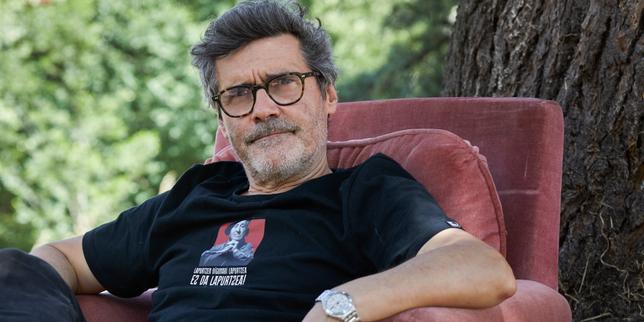
You probably know the Chao name because of Mano Negra or Manu Chao's massive global anthems. But there's a different kind of frequency running through this family. It's a frequency forged in the ruins of the Spanish Civil War, carried through decades of pirate radio, and dropped right into our messy modern reality.
When Antoine Chao stepped onto the stage for his performance Au départ, il y a Guernica, he wasn't just putting on a show. He was cooking a red-and-black paella while mixing raw noise and archival audio. It sounds wild, maybe even a bit chaotic, but it captures something crucial that mainstream history textbooks always seem to leave out. Resistance isn't just a subject for academic journals. It's something you live, breathe, and transmit.
The Day the Bombs Fell on Market Day
The story doesn't start in a recording studio. It starts on April 26, 1937, on a hill overlooking Bilbao. A five-year-old girl named Felisa—Antoine’s mother—stood on a balcony in Artxanda. She watched Nazi and Italian fascist warplanes streak across the sky. They were headed for Guernica.
What happened next changed global warfare forever. Over 60 tons of explosives wiped out a defenseless town on market day. It was the first time a military force used carpet bombing explicitly to terrorize civilians.
While Felisa watched the planes, her father, Tomas, was serving as a communications commander for the Republican army. Here is the twist: he refused to carry a gun. He fought entirely with wires, signals, and waves. Fascist Radio Sevilla condemned him to death in absentia, but he kept transmitting until the bitter end. On March 29, 1939, he escaped on the Lézardrieux, the very last boat to flee the fallen port of Valencia.
When you understand that background, Antoine Chao's entire career shifts into focus. He didn't just stumble into radio journalism or punk rock. He inherited a legacy of tactical communication.
From Punk Squats to the House of Radio
Growing up in Sèvres during the 1980s, Antoine and his brother Manu didn't exactly fit into quiet suburban life. They took over an old rubber factory, turned it into a punk squat, and started blasting music. That raw energy eventually birthed Mano Negra, where Antoine played trumpet, touring the world and rewriting the rules of alternative rock.
But the airwaves kept calling. Antoine eventually spent over two decades at France Inter, working on iconic shows like Daniel Mermet’s Là-bas si j'y suis and his own program, C'est bientôt demain.
Then, in 2024, France Inter canceled his show. It wasn't just an administrative tweak; it marked a visible decline in deep, boots-on-the-ground investigative radio reporting on public airwaves.
Instead of retiring quietly, Chao did what any proper son of an anti-fascist operator would do. He went back to the margins. He likes to say he doesn't just want to "make" radio—he wants to "unmake" it. He brought the pirate spirit back to life, using sound as a weapon against historical amnesia.
Why Sound is the Ultimate Act of Resistance
There's a massive difference between reading a tweet about authoritarianism and hearing the actual, physical crackle of a banned broadcast. Chao’s work relies on the idea that sound bypasses our intellectual defenses. It hits us somewhere deeper.
In Au départ, il y a Guernica, the performance relies on a stark juxtaposition. While Cécile Jarsaillon cranks out harsh noise music and Khia Hemici lays down the historical documentation, Chao cooks food for the audience. It’s a deliberate choice. Fascism thrives on isolation, fear, and the destruction of community. Sharing a meal while listening to the dark echoes of the 1930s is a direct antidote to that isolation.
We often think of history as something static, trapped in museums or black-and-white newsreels. But the tactics used in Spain—terrorizing civilian populations, controlling the flow of information, suppressing independent voices—aren't historical artifacts. They're all over the news right now.
Moving Beyond Passive Consumption
If you think keeping history alive is just about remembering dates, you're missing the point entirely. The Chao family history proves that transmission is an active, everyday choice. If you want to keep these stories from fading into the background, you have to find your own ways to amplify them.
Start supporting independent audio collectives, community stations, and podcasts that operate outside the commercial media bubble. Dig into archives like ARTE Radio or local historical audio projects to understand how ordinary people resisted oppression in their own neighborhoods. Don't just sit back and consume information passively. Talk to your older relatives, document your own family stories, and find creative ways to share them with the people around you. History survives only when we keep talking about it.