Western space analysts spent years assuming China would simply clone Elon Musk's homework line for line. When you watch a Falcon 9 booster touch down on a drone ship, you see four telescopic landing legs snap open at the final second. It is clean, it makes sense, and it works hundreds of times a year.
But China just tossed that playbook out the window.
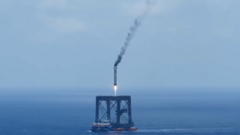
During the maiden flight of the Long March 10B rocket from Hainan Island, the state-owned China Academy of Launch Vehicle Technology (CALT) achieved the country's first-ever successful recovery of an orbital-class booster. Instead of copying the famous Falcon 9 landing legs, the Chinese booster dropped out of the sky and got snagged by a massive net suspended over an ocean platform.
It looked less like Cape Canaveral and more like an aircraft carrier recovery crew trying to catch a falling skyscraper with a giant fishing net. This choice alters how the global space race might shake out over the next decade.
The Mechanical Leap Over Landing Legs
To understand why this bizarre net-capture mechanism matters, you have to look at the brutal math of rocket design. Every ounce of hardware you bolt onto a rocket booster eats away at the weight of the actual satellite you can push into orbit.
Landing legs are heavy. They require massive internal hydraulic systems, structural reinforcements at the base of the rocket, and complex deployment mechanisms that can fail in a dozen different ways. When SpaceX flies a reusable Falcon 9, they sacrifice roughly 30% of their potential maximum payload capacity just to carry the fuel and heavy gear needed to bring that first stage back home safely.
China's new approach sidesteps that weight tax entirely.
By utilizing four lightweight structural hooks on the side of the Long March 10B booster, engineers shifted the heavy lifting of the landing process from the flying vehicle to the sea platform. The giant net system on the barge absorbs the kinetic energy of the descending 63-meter-tall rocket. According to CALT expert Chen Muye, this net-based recovery simplifies the onboard architecture of the vehicle, cuts down dead weight, and expands the actual target window for landing when high winds kick up at sea.
Basically, if the rocket is off by a few feet, a smart, coordinated net system can adjust to catch it. A rigid landing pad cannot do that.
Breaking Down the Long March 10B Specs
The Long March 10B is not some suborbital test toy. This is a massive, two-stage commercial heavy-lifter designed to do serious work. Let's look at the raw numbers from the maiden flight.
The rocket stands roughly 207 feet tall and tips the scales with a liftoff mass of around 760 metric tons, churning out 890 tons of thrust. The first stage burns a classic mixture of kerosene and liquid oxygen, while the upper stage steps things up with a liquid methane and liquid oxygen setup.
In this specific reusable setup, the rocket successfully delivered its satellite payload into a preset low-Earth orbit before the booster split off. Six minutes after separation, the first stage performed its vertical retro-burns, guided itself back through the atmosphere, and dropped straight into the sea-based net.
Right now, its reusable payload capacity is rated at roughly 16 metric tons to low-Earth orbit. For context, a fully loaded Falcon 9 maxes out around 22.8 metric tons when it isn't saving fuel to land. But if China refines this hook-and-net system to shed more dry weight, that performance gap could shrink fast.
The Real Strategy Behind the Lunar Push
Do not view this test as an isolated commercial tech demo. The Long March 10B is a direct variant of the broader Long March 10 family, which serves as the foundation for China's ambitious timeline to put astronauts on the moon before 2030.
Building a sustainable lunar program requires an absurd amount of launch frequency. If you rely on expendable rockets, you end up throwing away hundreds of millions of dollars of hardware with every single launch, which quickly bankrupts your political will. By proving they can reliably catch an orbital booster at sea, Chinese state engineers are validating the guidance software, thermal protection tiles, and variable-thrust engines required to make their moon shots financially viable.
This success also triggered an immediate financial wave back home. Right after state broadcaster CCTV aired the footage of the booster resting safely in its giant net, shares of domestic aerospace companies like China Spacesat and China Satellite Communications rocketed straight to their daily trading limits on the stock exchange. Private Chinese companies like LandSpace, CAS Space, and Deep Blue Aerospace are already building their own reusable vehicles.
What This Means for Your Launch Costs
If you are a commercial satellite operator or a tech firm relying on orbital data, this development should change how you plan your capital expenditures over the next five years. Up until now, SpaceX held a functional monopoly on cheap, rapid launch access. They could dictate pricing because nobody else could match their reuse cadence.
That era is ending. China plans to clean, inspect, and re-fly this exact Long March 10B booster before the end of the year.
Once this net-capture method scales to a regular operational cadence, the global market will see a massive influx of cheap launch capacity. Your immediate next step should be auditing your long-term satellite deployment contracts. Do not lock yourself into rigid, multi-year launch agreements with Western providers without leveraging the reality that launch costs are about to plunge globally as state and private Chinese operators begin competing aggressively for commercial payloads. Keep your hardware configurations adaptable to multiple fairing sizes, because the options for getting your tech into space are about to get a lot more crowded, and a lot weirder.