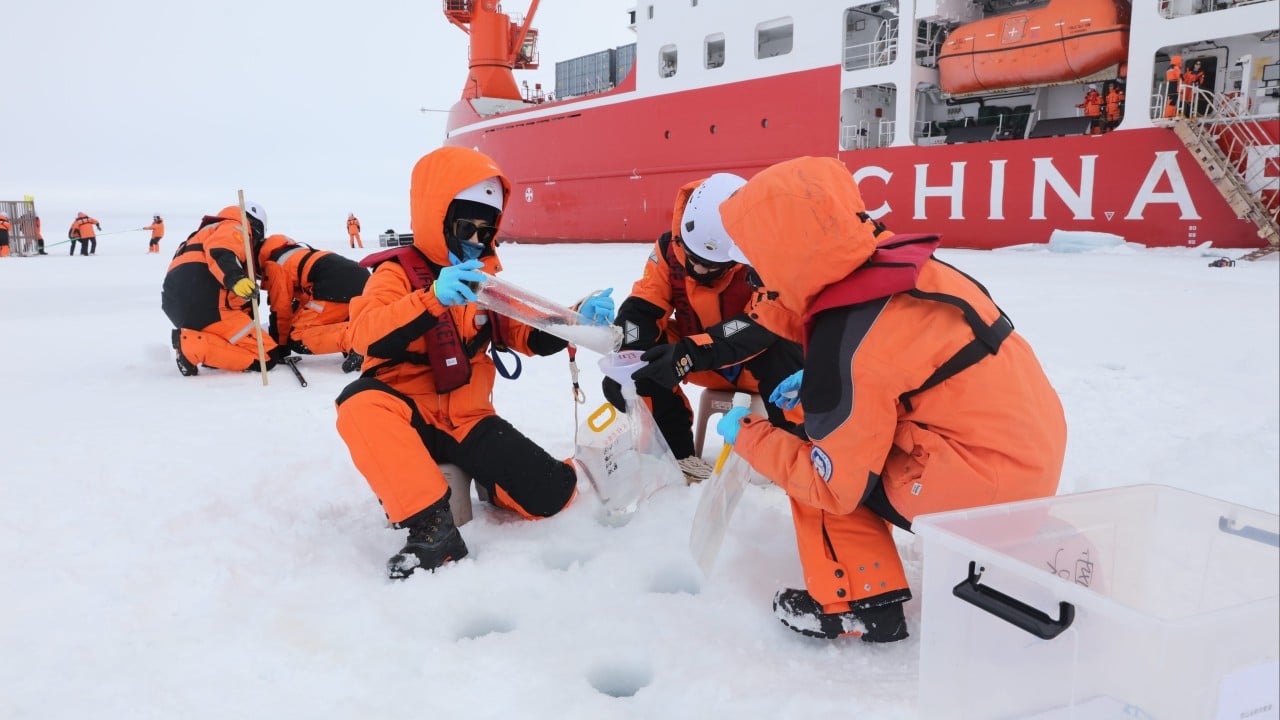
Every time Beijing and Moscow drop an icebreaker into the polar north, Washington loses its collective mind. The headlines write themselves. China and Russia launch joint sea ice surveys aboard the Xuelong 2, Arctic tensions swell, and defense analysts start hyperventilating about a new Cold War frozen in the high latitudes. It is lazy, predictable theater. And it completely misses the economic and physical reality of what is actually happening at the top of the world.
I have spent the better part of a decade talking to maritime logistics operators, naval architects, and Arctic policy wonks who actually look at bathymetric charts instead of cable news chyrons. What they tell me off the record matches what the physical data has been screaming for years.
The lazy consensus says that joint Sino-Russian polar missions represent an unstoppable strategic axis ready to dominate the future Northern Sea Route. The reality? They are scrambling to map a shifting, chaotic hazard that refuses to cooperate with their geopolitical ambitions.
Let us dismantle the panic.
The Geography of Friction
Here is the fundamental error underlying every panic-stricken defense memo about Arctic sea ice surveys: the assumption that ice is a highway once you break it.
It is not. It is an unmanaged, highly dynamic tectonic mess.
When the Xuelong 2 steams into the high Arctic to measure ice thickness, drift patterns, and salinity profiles, it is not planting a flag of absolute control. It is doing damage control for a route that remains commercially unviable for regular, unescorted transit. Icebreakers do not open lanes; they carve temporary ditches in a moving slurry that freezes back over before the wake even settles.
I watched a major shipping conglomerate blow millions trying to run unescorted bulk carriers through the Siberian shelf during peak melt season a few years back. They bought into the hype that climate change had turned the Arctic into a turn-key shortcut between Europe and Asia. Two weeks later, a sudden pressure ridge trapped their lead vessel, insurance rates spiked by 400 percent, and the cargo had to be airlifted out by helicopter.
That is the hidden tax of the Arctic. Nature does not care about bilateral agreements between authoritarian states.
The Data Mirage
Why are Beijing and Moscow launching these joint surveys now? Follow the money and the draft requirements.
The Xuelong 2 is a triumph of modern shipbuilding—a dual-direction polar research vessel equipped with Azipod propulsion capable of cutting through ice going both forward and astern. But a single brilliant ship does not equal a commercial corridor.
The data these surveys collect—multibeam sonar mapping of the seabed, oceanographic profiling, and ice mechanics—is essential because current navigational charts of the Siberian shelf are notoriously unreliable. Much of the hydrographic data in these waters dates back to Soviet-era lead-line soundings. If you want to move mega-tonnage liquefied natural gas from Yamal or Arctic LNG 2 to Asian markets without running a fifty-thousand-ton tanker aground on an uncharted shallow, you need modern bathymetry. Desperately.
This is not a display of maritime hegemony. It is remedial cartography. They are surveying because they are flying blind in a harsh environment that punishes hubris.
To understand why this matters, we have to look past the political posturing and examine the physical limits of ice navigation.
The Mechanics of Polar Failure
Let us define our terms. When military commentators talk about Arctic militarization, they throw around terms like "freedom of navigation" and "strategic choke points." These terms belong in the Strait of Malacca or the Persian Gulf. They break down completely north of the Arctic Circle.
In the Arctic, the primary adversary is not an opposing navy. It is multi-year ice.
Multi-year ice is not the soft, salty first-year ice that forms and melts seasonally. It is dense, freshwater-leached, rock-hard glacial residue that can withstand pressures exceeding twenty megapascals. When an icebreaker collides with a multi-year pressure ridge, the kinetic energy transferred to the hull can crack engine mounts and sheer propeller blades.
Imagine a scenario where a joint task force attempts to escort a fleet of commercial container ships through the Vilkitsky Strait during a severe compaction event. The wind shifts by fifteen degrees, driving pack ice against the coast. The icebreaker stalls. The commercial vessels lose maneuverability, get pinned against the shelf, and their hulls buckle under lateral pressure.
No amount of joint communiqués from Beijing and Moscow alters the compressive strength of ice. Physics remains undefeated.
The Cost Benefit Delusion
The narrative pushed by think tanks in Washington and London is that China and Russia are splitting the Arctic spoils down the middle—Moscow providing the geography and security umbrella, Beijing providing the capital and scientific muscle.
It sounds tidy. It falls apart under basic cost-accounting.
Operating in the high Arctic requires staggering capital expenditure. Fuel consumption for ice-class vessels operating in heavy pack ice triples compared to open-water transits. Maintenance cycles are twice as frequent because abrasive ice scours anti-corrosive hull coatings down to bare steel within a single season.
When you factor in the high cost of specialized crew training, satellite ice-forecasting subscriptions, and marine insurance syndicates that view polar routes as radioactive liabilities, the economics of the Northern Sea Route stop making sense for anything other than high-margin commodities like hydrocarbons.
Containerized shipping between Rotterdam and Shanghai via the Arctic remains an internet fantasy. You cannot run a just-in-time global supply chain through a route that is seasonally impassable, legally ambiguous, and subject to sudden, unpredictable closures caused by moving ice packs.
If Beijing wants to burn billions of dollars subsidizing polar research and icebreaker construction for domestic political consumption, let them. It is a massive misallocation of capital that yields diminishing returns compared to investing in domestic rail corridors, Southeast Asian trade agreements, or deep-water ports in friendlier latitudes.
The Real Threat Is Invisible
While Western defense analysts obsess over the optical display of red flags on icebreakers, they ignore the actual strategic vulnerability unfolding in the north.
It has nothing to do with surface warships or joint scientific surveys. It has to do with underwater infrastructure and subsea domain awareness.
While the Xuelong 2 gathers surface ice data, the real game is happening below the photic zone. Fiber-optic communication cables, seismic monitoring arrays, and subsea energy pipelines are spreading across the Arctic floor. These assets are notoriously difficult to protect and even harder to repair in sub-zero conditions.
Yet, media outlets keep flashing pictures of icebreakers breaking through thin surface ice, feeding an outdated paradigm of polar warfare. We are preparing to fight the last war of the surface fleet in a region where the decisive battles will be fought in the silent, dark depths of the continental shelf.
Stop Asking the Wrong Questions
If you search for answers about Arctic geopolitics, you find endless variations of the same flawed queries: Will China and Russia control the Arctic? Can NATO match their icebreaker fleet? Is the Suez Canal obsolete?
Every single one of these questions is poisoned by false premises.
The right questions look different. How long can Russia sustain the massive maintenance subsidies required to keep northern ports ice-free without collapsing its regional economy? How will China absorb the reputational and financial losses when its state-owned enterprises realize that polar shipping lanes offer lower reliability than traditional southern routes?
The answers reveal a truth that neither Washington nor Beijing wants to admit. The high Arctic is not a lucrative prize waiting to be claimed by the boldest geopolitical actors. It is an unforgiving, high-overhead desert that punishes economic inefficiency and exposes the limits of state planning.
Let the surveyors map their ice. Let the headlines sound the alarm. The physical barriers of the polar north are more stubborn than any bilateral treaty or state-backed fleet. Nature is still running the show, and she does not negotiate.


