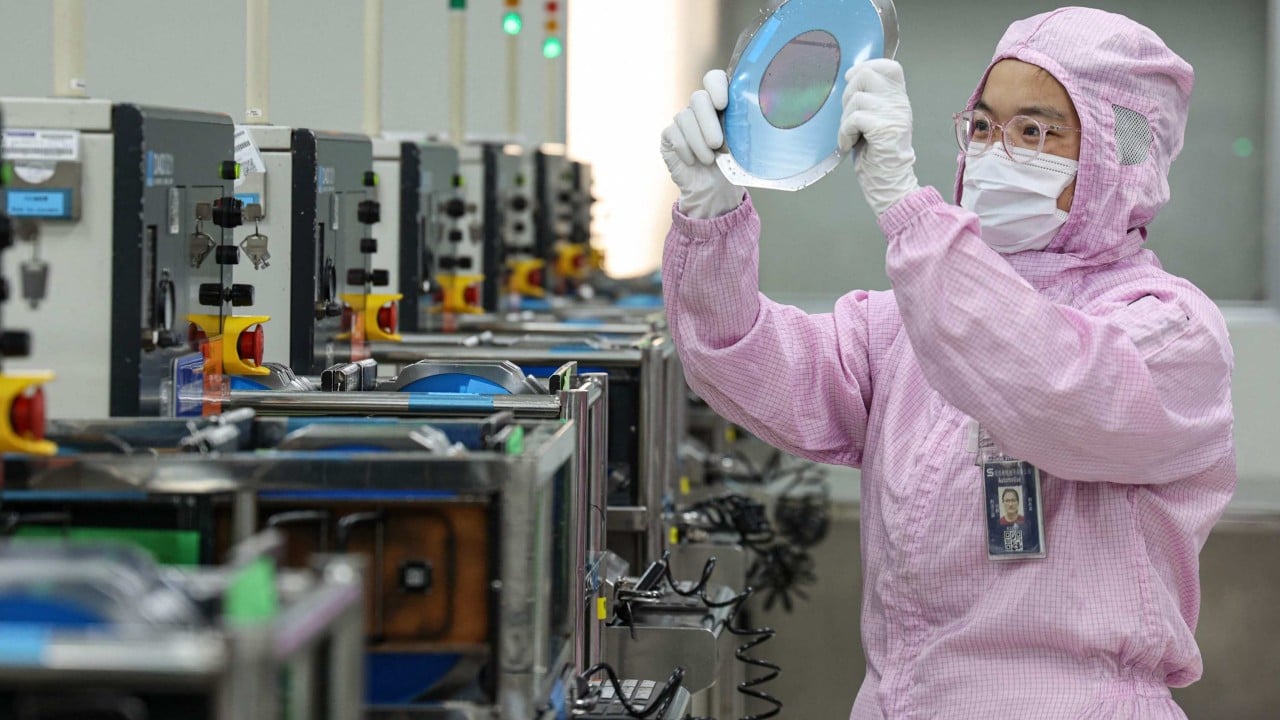
China’s semiconductor players are tired of playing defense. For years, the narrative has been about surviving U.S. sanctions and finding workarounds for lithography machines. But that’s shifting. Now, the biggest names in Chinese tech are demanding a massive surge in state support to move from "catching up" to "taking over" the AI hardware space. It’s not just about money anymore. It’s about a fundamental restructuring of how the country builds the brains of the future.
If you think this is just another government handout, you're missing the bigger picture. The leaders of companies like SMIC and various state-backed chip designers aren't just asking for checks. they're asking for a coordinated national strategy that mirrors a wartime mobilization. They know that without a breakthrough in high-end AI chips, China’s massive investments in large language models will hit a physical wall.
The Brutal Reality of the Hardware Gap
Let’s be real. Despite the headlines about "breakthroughs," China still faces a massive hurdle in high-end logic chips. Most domestic AI firms are still scrambling to find enough Nvidia H100s through the gray market or relying on older, slower domestic alternatives. This isn't sustainable.
The domestic industry is currently fragmented. You’ve got hundreds of small startups trying to design "Nvidia killers," but they lack the manufacturing consistency of TSMC. Industry insiders are now pushing the government to stop sprinkling subsidies on every small player and instead focus fire on a few national champions. They want "Big Fund" level investment, but with better oversight and more aggressive targets.
We’ve seen what happens when the money is spread too thin. You get "zombie" companies that live off grants without ever producing a viable wafer. The new demand is for a "concentrated force" approach. Basically, pick the winners and give them everything they need to fail or fly.
Why AI Dominance Requires More Than Just Silicon
It’s easy to focus on the chips themselves, but the industry is screaming for help with the entire ecosystem. You can't just bake a chip and call it a day. You need the software stack—the equivalent of Nvidia’s CUDA—to make that hardware actually useful for developers.
Right now, Chinese developers often find it easier to write code for restricted Western chips than for wide-open domestic ones. The software is just clunkier. This is where the state support comes in. Industry leaders are calling for government-mandated adoption of domestic AI architectures in state-owned enterprises and universities. If the government forces the market to use the tools, the tools will eventually get better.
- Unified Standards: There’s a push to stop the "walled garden" approach where every Chinese chip maker has its own proprietary software.
- Data Center Subsidies: The government is being asked to foot the bill for massive "computing power clusters" that exclusively use homegrown silicon.
- Talent Poaching: While it's getting harder to hire from Silicon Valley, the industry wants more state-backed incentives to lure overseas Chinese engineers back home with "no-questions-asked" research budgets.
The Sanction Paradox
The irony isn't lost on anyone in Beijing. Every time Washington tightens a screw, it actually helps the domestic lobby argue for more money. Sanctions have become the best marketing tool for China’s chip industry. They’ve removed the option of buying "easy" and forced a "buy local" mandate that didn't exist five years ago.
But there's a catch. Without access to the most advanced ASML machines, Chinese fabs are forced to use multi-patterning techniques that kill yield rates and skyrocket costs. The state isn't just being asked to fund the R&D; it’s being asked to subsidize the loss on every single chip produced. They’re basically asking the government to pay the "inefficiency tax" until the tech matures.
Breaking the Lithography Bottleneck
Everyone talks about the 7nm and 5nm "walls." The truth is, China is getting surprisingly good at squeezing life out of older DUV (Deep Ultraviolet) equipment. But "good enough" won't win the AI race. AI models are getting exponentially larger. They need more memory bandwidth and faster interconnects.
The industry is now looking at "chiplets" as a workaround. Instead of trying to make one giant, perfect chip—which is nearly impossible without the latest EUV machines—they’re stitching together smaller, easier-to-make chips. It’s like building a supercar out of three smaller engines. It’s clever, but it requires a level of packaging expertise that China is still perfecting. State support is now pivoting heavily toward this "advanced packaging" sector. It’s a pragmatic shortcut to high performance.
The Strategy for the Next 24 Months
If you're watching this space, don't look at the stock prices. Look at the procurement contracts of major Chinese cloud providers. That’s where the real story lives. The industry is betting that within two years, the performance gap between a top-tier domestic AI chip and a mid-tier Nvidia export-compliant chip will vanish.
The next steps for the industry are clear. They'll continue to push for a "National AI Computing Network." Think of it like a power grid, but for processing power. If the state builds the grid, the chip makers just provide the fuel.
Investors and tech watchers should focus on companies involved in HBM (High Bandwidth Memory) and advanced packaging. These are the current "choke points" where state money is flowing fastest. The goal isn't just to survive anymore; it's to create a parallel tech universe where the West's rules don't apply. It’s a massive gamble, but in the eyes of China’s chip titans, it’s the only hand they’ve got left to play.
Check the latest export control updates from the Bureau of Industry and Security (BIS). Every time a new restriction drops, expect a corresponding billion-yuan "investment" announcement from Beijing within weeks. That's the new rhythm of the global tech war.