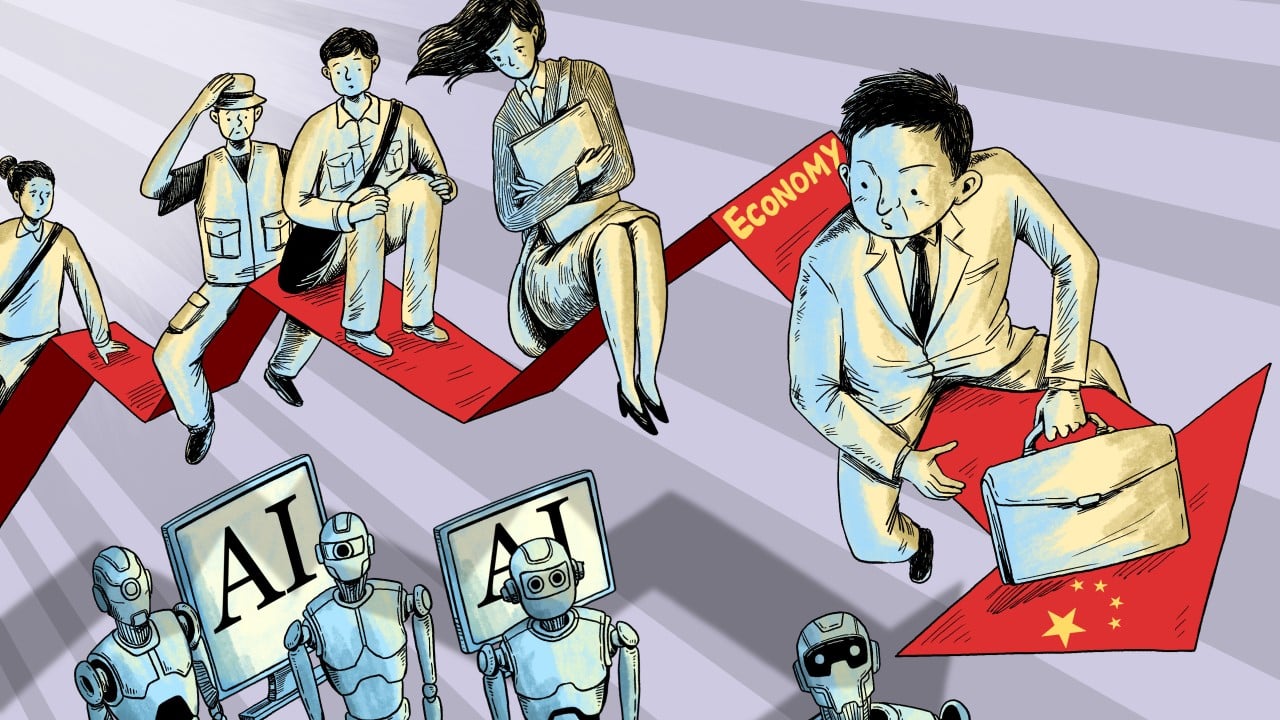
Most people look at China’s massive state-owned sectors and see a drag on innovation. They see the "Iron Rice Bowl"—that decades-old promise of lifelong job security—as a relic that can’t keep up with the lightning-fast evolution of generative AI. I think that's a fundamental misunderstanding of how the next decade of labor economics will play out. While Silicon Valley prepares for a "move fast and break things" approach to AI-driven layoffs, Beijing is quietly positioning its economy to absorb the shock in a way that might actually be more stable.
The reality is that AI doesn't just create a productivity gap. It creates a social stability gap. In a purely market-driven economy, if an algorithm can do a paralegal's job for 5% of the cost, that paralegal is gone by Monday. In China, the calculation is different. The state isn't just an observer; it’s the primary employer and the ultimate guarantor of social order. This gives China a unique set of shock absorbers that the West simply doesn't have.
The Algorithmic Threat to the White Collar Dream
For years, the narrative was that robots would take the factory jobs. We thought the "blue-collar" workers were the ones at risk. We were wrong. Generative AI is coming for the office dwellers first. It’s coming for the coders, the mid-level managers, and the content creators. In China, this hits a specific nerve because the urban middle class has spent the last twenty years betting everything on high-stakes education to secure these very roles.
When you look at the data from Tsinghua University or reports from platforms like Lagou, you see a nervous shift. Job postings for entry-level white-collar roles are tightening. Yet, the Chinese government is already pivoting. They aren't just letting the market rip. They’re leaning into "New Quality Productive Forces," a term you’ll hear a lot because it represents the shift from raw manufacturing to high-tech dominance. But here’s the kicker: they’re doing it with a heavy hand on the steering wheel of employment.
Why the State Owned Sector is a Secret Weapon
State-Owned Enterprises (SOEs) in China aren't just companies. They're social welfare vehicles. When AI starts automating administrative tasks in a massive firm like Sinopec or China Mobile, those companies don't just dump 10,000 people onto the street. They have the "political task" of maintaining employment levels.
You might think this sounds inefficient. From a pure profit-and-loss standpoint, it is. But from a systemic resilience standpoint, it’s a masterstroke. By using SOEs as a buffer, China can integrate AI at a pace that doesn't trigger mass civil unrest. They can retool, reskill, and shift workers into new roles within the same massive organizational umbrella. It's a managed transition rather than a chaotic collapse.
- Cross-departmental shifting: Moving workers from automated clerical roles into AI-supervision or human-centric service roles within the state ecosystem.
- Gradual adoption: Intentionally slowing the rollout of certain labor-replacing techs to match retirement rates.
- State-funded reskilling: Massive investment in vocational training that is directly tied to the specific AI tools being deployed.
Compare this to the US or UK. There, the transition is "every man for himself." If your job is automated, you’re left to navigate the gig economy or hope for a government retraining voucher that might not lead anywhere. China’s centralized control means the retraining is the job.
The Myth of the Agile Startup vs The Reality of Big Data
There’s a common trope that "freedom equals innovation." While that’s great for the initial spark of an idea, AI is a game of scale and data access. China’s regulatory environment is increasingly designed to force data sharing between tech giants and the state. This creates a feedback loop that benefits the overall economy even if it hurts individual company margins.
The "algorithm" in China isn't just something that recommends videos; it's being integrated into the "Social Credit" and "Smart City" frameworks. This means the government has a real-time pulse on economic friction. If a specific sector is getting hammered by AI automation, they see the data instantly. They can adjust tax incentives, shift state investment, or pump liquidity into regional projects to mop up the excess labor. It’s a level of macro-management that Western central banks can only dream of.
Human Capital and the 996 Culture
We can't talk about China and AI without mentioning the work culture. The "996" lifestyle (9 am to 9 pm, 6 days a week) is brutal. But it has created a workforce that is incredibly resilient and technically literate. As AI tools become more prevalent, the workers who survive are the ones who treat these tools as power-ups rather than threats.
I’ve seen this firsthand in the tech hubs of Shenzhen and Hangzhou. Engineers aren't complaining that AI is writing code; they're using AI to write three times as much code so they can move on to the next project. There’s a certain "hustle" built into the DNA of the modern Chinese worker that acts as a natural defense against being replaced. If you can outwork the machine—or better yet, work the machine harder than anyone else—you stay relevant.
The Real Risks Nobody Mentions
It’s not all sunshine and state-planned efficiency. The "Iron Rice Bowl" is under immense pressure. Local governments are buried in debt. They can’t afford to subsidize every "zombie" job forever. If the AI revolution happens too fast—if the productivity gains are so massive that human labor becomes truly redundant—even the CCP will struggle to keep the lid on.
There’s also the "lying flat" (tang ping) movement. Younger generations are tired. If AI makes the ladder even harder to climb, more people might just stop trying. That’s the real "AI shock" China faces: not a lack of tech, but a lack of hope among the youth who feel the game is rigged by algorithms they can't beat.
Navigating the Transition
If you're looking at the global economy and wondering who wins the AI race, don't just look at who has the best LLM. Look at who has the most stable social structure to survive the transition. China is betting that its blend of high-tech authoritarianism and state-guaranteed employment will provide a "softer landing" than the West’s "sink or swim" capitalism.
To stay ahead, you need to stop thinking about AI as a tool you use and start thinking about it as an environment you inhabit. For businesses, this means looking at China not just as a market for chips, but as a laboratory for how a massive society re-engineers itself around automation.
- Watch the SOEs: Their hiring patterns are the true bellwether for Chinese economic health.
- Follow the data laws: Beijing’s control over data is their primary lever for managing AI's impact.
- Ignore the hype, watch the infrastructure: China is building the physical world (power grids, data centers) to support the digital one.
The "Iron Rice Bowl" isn't dead. It’s just getting an upgrade. The bowl might be made of different materials now—silicon and code instead of steel and grain—but the underlying logic remains. The state will do whatever it takes to keep the bowl full, even if a machine is the one doing the pouring. Keep your eyes on the regional policy shifts in provinces like Guangdong, where the friction between high-tech manufacturing and labor displacement is being tested in real-time. That's where the future is being written.