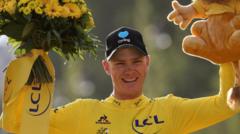
The longest-running guessing game in pro cycling is officially over. Chris Froome has finally said the word.
"Yes."
With that single syllable, dropped casually at a promotional event in Barcelona ahead of the Tour de France start, the 41-year-old closed the book on a career that radically altered the sport. It wasn't the triumphant lap of honor he wanted. A brutal training crash last August left him with five broken ribs, a fractured spine, a collapsed lung, and a life-threatening pericardial rupture.
He didn't choose the exit door; the asphalt chose it for him.
But let’s be honest. The Chris Froome who dominated global cycling didn't retire this week. That rider vanished on a windy afternoon in 2019 during a time-trial reconnaissance at the Critérium du Dauphiné, slamming into a wall at 30 miles per hour. What we've witnessed since then has been a long, painful, and often uncomfortable postscript.
Understanding Froome's departure isn't just about looking back at an old champion. It's about recognizing how his golden era created the hyper-calculated, high-cadence world that modern stars now rule.
The Calculated Brutality of the Sky Era
We don't talk enough about how much people hated watching Chris Froome ride a bike, or how brilliant he was for ignoring that hate.
During his peak years with Team Sky between 2013 and 2017, Froome won four Tours de France. He didn't do it with flashy, romantic attacks. He did it by staring intently at his stem, monitoring his power meter, and spinning his legs at a freakish 100-plus RPM. It was mechanical. It was clinical. It drove traditionalists insane.
The French public openly distrusted him. They booed him on the climbs, threw urine at him, and constantly questioned his data. The skepticism reached a boiling point in 2018 over an adverse analytical finding for salbutamol, an asthma medication. Sky threw millions at the legal defense, and Froome was cleared just before the Tour. But the damage to his public image in mainland Europe was permanent.
"I said I would never dishonour the yellow jersey and my results would stand the test of time," Froome said back then. "To win any race based on a lie would – for me – be a personal defeat."
Love him or hate him, the numbers don't lie. He didn't just win four yellow jerseys. He seized the 2011 and 2017 Vuelta a España titles and took the 2018 Giro d'Italia. For a brief window in 2018, he held all three Grand Tour trophies simultaneously. Only a tiny handful of human beings have ever reached that level of absolute sporting sovereignty.
The Sylvan Adams Drama and the Cost of Legacy
The biggest mistake fans make is remembering elite athletes as static pictures. We want them to retire at the absolute peak, riding into the sunset. Froome refused to do that. He wanted to race.
After Team Sky evolved into Ineos and moved on to younger talent, Froome signed a massive, multi-million-dollar deal with Israel-Premier Tech in 2021. He was desperate to prove he could get back to the top. He never did. His best post-crash result was a gritty third place on Alpe d'Huez during the 2022 Tour de France. Aside from that single flash of brilliance, he spent his final years buried deep in the peloton, finishing over an hour behind the leaders.
It got ugly. Sylvan Adams, the billionaire owner of Israel-Premier Tech, didn't hide his frustration. He publicly complained that Froome wasn't providing "value for money" after missing selection for the 2023 Tour squad. Adams argued that Froome wasn't brought in to be a PR tool; he was paid to be a leader.
It was a stark reminder of the pro cycling meat grinder. Yesterday's legend is today's line item on a spreadsheet.
How Froome Built the Modern Peloton
The irony of Froome's retirement happening right as Tadej Pogačar hunts down a historic Giro-Tour double isn't lost on anyone. Pogačar and Jonas Vingegaard look like completely different riders than Froome. They attack from 60 kilometers out. They race on pure instinct and raw aggression.
But don't get it twisted. The modern generation thrives because Froome and Team Sky normalized the absolute optimization of the sport.
- Marginal Gains: Sky pioneered the focus on customized mattresses, identical nutrition plans, and exact cooling protocols. Today, every single WorldTour team copies this blueprint.
- Pacing Strategies: Froome proved that chasing down explosive, emotional attacks with a steady, calculated power output is mathematically superior.
- The Power Meter Dictatorship: The kids dominant today grew up training entirely by the numbers that Froome made famous.
If you want to understand where the sport goes next, watch how teams manage rider longevity. The ultimate takeaway from Froome's late-career struggle is that the human body can only take so many high-speed impacts before the biological clock accelerates.
Froome will spend this July riding in a Skoda sponsor car instead of a team presentation. He's already talking about launching a foundation to develop young African cycling talent, a nod to his own roots growing up and racing under a Kenyan license before switching to Great Britain.
If you're a young endurance athlete or a student of the sport, don't look at Froome's anonymous finishes over the last few seasons. Look at how he managed pressure, how he revolutionized training metrics, and how he built an era of dominance through sheer, unyielding stubbornness. That's the real blueprint.