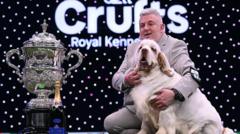
The roar inside Birmingham’s Resorts World Arena wasn't for a flashy Poodle or a manicured Afghan Hound. It was for Bruin, a heavy-boned, slow-moving Clumber Spaniel who just upended the power dynamics of the world’s most prestigious dog show. By securing the Best in Show title at Crufts 2026, Bruin did more than win a trophy. He signaled a hard pivot in the judging circuit away from the "glamour coats" that have dominated the green carpet for decades. For the first time in years, the Kennel Club's top honors went to a breed built for the thicket rather than the salon.
This victory is a calculated shock to the system. While the casual observer sees a charming, sleepy-eyed spaniel, the industry sees a correction. For years, critics have argued that Crufts had become a beauty pageant for "ornamental" breeds, losing touch with the functional skeletons and working temperaments that define canine excellence. Bruin’s win is a return to the heavy hitters.
The Weight of the Win
To understand why a Clumber Spaniel winning is a statistical anomaly, you have to look at the history of the Gundog Group. The group is usually a battleground for Golden Retrievers and Irish Setters—dogs with high energy and cinematic movement. The Clumber, by contrast, is the "heavy infantry" of the spaniel world. They are low to the ground, massive in the chest, and possess a lumbering gait that judges often overlook in favor of faster, flashier competitors.
Bruin’s handler didn’t try to make him look like a sprinter. They leaned into the breed's stoic, methodical nature. In the final ring, while other dogs were vibrating with nerves, Bruin stood like a rock. This stability is exactly what the 2026 judging panel was hunting for. There is a growing movement within the international dog community to reward "functional health" over extreme grooming. A Clumber Spaniel, with its deep flews and heavy brow, is a difficult dog to keep in peak condition without showing signs of lethargy or structural weakness. Bruin was immaculate, proving that a high-mass breed can be just as fit as a lean Greyhound.
The Politics of the Green Carpet
Behind the scenes at Crufts, the atmosphere this year was tense. The show has faced mounting pressure from animal welfare groups regarding the health of brachycephalic (flat-faced) breeds and the extreme coat standards of others. By elevating a Clumber—a breed that is rare and requires a highly specific type of care—the Kennel Club is making a statement about preservation.
They are moving the spotlight away from the popular "designer-adjacent" breeds and back toward the heritage sporting dogs of the British Isles. It is a protective measure. When a breed wins Crufts, puppy inquiries for that breed typically spike by over 100% within forty-eight hours. By choosing a Clumber, the judges are directing the public’s attention to a breed that isn't for everyone. It’s a "gatekeeper" win. A Clumber Spaniel is a shedding, drooling, high-maintenance worker that requires an owner dedicated to the craft of dog ownership. This choice discourages the "impulse buy" culture that often follows a Best in Show victory for a more manageable-looking breed like a Toy Poodle or a Beagle.
Breaking the Poodle Monopoly
For the last decade, the Poodle—in all its sizes—has been the "safe" bet at Crufts. Their coats allow for a level of sculptural precision that no other breed can match. They are the high-definition athletes of the dog world. But this year, the Poodle’s dominance felt brittle. The crowd was looking for something more grounded, more "dog-like."
The shift started in the preliminary rounds. Judges were penalizing dogs that showed signs of "excessive styling" where the hair masked the true topline of the animal. Bruin’s coat, while clean and well-feathered, did not hide his anatomy. Every muscle movement in his shoulders was visible. This transparency is becoming the new gold standard. Veteran breeders in the wings were whispering about the "return of the bone." They wanted to see substance. Bruin provided it in spades.
The Mechanics of a Champion
When Bruin moved, he covered ground with a "rolling" gait that is unique to the Clumber. It isn't fast. It shouldn't be. The breed was designed to move through dense undergrowth where a faster dog would get stuck or injured.
- Substance: The dog must have a massive head and a heavy body without appearing obese.
- Expression: The "pensive" look is a requirement, but the eyes must be clear and healthy.
- Topline: A straight, strong back that doesn't dip under the weight of the dog’s own mass.
Bruin hit all three markers. His win wasn't just about his look; it was about his temperament. In the final minutes of the broadcast, as the cameras were inches from his face and the applause reached a crescendo, he didn't flinch. He sat. He waited. He looked at the judge with a level of indifference that can only be described as regal.
The Breeder’s Long Game
This wasn't an overnight success. Bruin’s lineage traces back through decades of careful, often unprofitable breeding. Clumbers are not a "money" breed. They have small litters and require significant health screening for hip dysplasia and eye issues. Most Clumber breeders are hobbyists who do it for the love of the history.
The win for Bruin is a win for the "slow-growth" movement in dog breeding. It’s a rejection of the high-turnover kennels that produce dogs based on current Instagram trends. The breeders behind Bruin have spent years focusing on respiratory health and skeletal integrity. Seeing that rewarded on the world stage is a validation of the long game. It tells the community that you don't have to breed a dog that looks like an alien to win. You can breed a dog that looks like a dog.
The Commercial Fallout
While the purists celebrate, the commercial side of the dog world is scrambling. Companies that specialize in grooming products for long-haired breeds are seeing the writing on the wall. The trend is moving toward "wash and wear" dogs, or at least dogs whose grooming is secondary to their structure.
We are likely to see a shift in marketing. The "Crufts Effect" usually dictates what kind of dogs we see in television commercials and luxury brand campaigns for the next two years. Expect to see more heavy-set, earthy breeds in the spotlight. The aesthetic of 2026 is officially "Heritage Grit."
This shift also puts pressure on other dog shows, like Westminster in the United States, to follow suit. If the world’s biggest show is moving away from the "frosted and sprayed" look, the rest of the circuit has to decide if they will adapt or become relics of a previous era.
The Quiet Power of the Underdog
The Clumber Spaniel has often been called the "retired gentleman’s dog." It is an unfair characterization that suggests they lack the fire of a hunter. Bruin proved that fire doesn't always look like a barking, jumping mess. Sometimes, fire looks like a 35kg spaniel who refuses to be intimidated by a stadium full of people.
His victory is a reminder that excellence doesn't always have to be loud. In an industry that has spent far too long chasing the "wow factor" of neon coats and frantic movement, a slow-moving dog from the English countryside just reminded everyone what a real champion looks like. The era of the "show pony" dog is ending. The era of the animal is back.
Pet owners who were previously obsessed with the high-maintenance look of the Bichon or the Oes are now looking at the Clumber with fresh eyes. They see a dog that can sit by a fire but also hike through a forest. They see versatility disguised as lethargy.
As the lights dimmed in the arena, the message was clear. The judges aren't looking for the dog that can perform the best tricks or hold the most elaborate pose. They are looking for the dog that best represents its ancestors. Bruin isn't just a winner; he is a living museum of a breed that nearly disappeared during the World Wars. His win is a survival story.
Look at your own dog and ask if they could do the job they were originally bred for. If the answer is no, you’re looking at the reason why Bruin won.