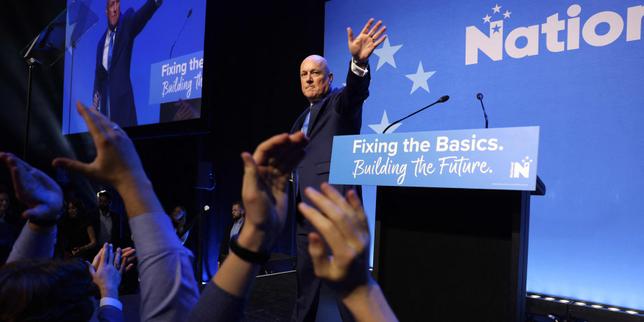
When a conservative prime minister in New Zealand asserts that a government can still be formed despite razor-thin legislative election results, the real contest shifts from ballot counting to coalition mathematics. Headline coverage typically treats a leader's confidence as either a reliable forecast or empty spin. Both readings miss the structural mechanics of New Zealand's electoral system. Forming an executive after a tight vote is not a matter of personal willpower alone; it is an optimization problem governed by seat thresholds, party list overhang rules, special vote counts, and bilateral bargaining power among minor parties.
This analysis provides a structured blueprint for evaluating post-election government formation when legislative margins are narrow. It separates verifiable institutional rules from analytical hypotheses, maps the causal chains that standard news reports overlook, and details the operational trade-offs facing a prime minister trying to lock in a durable majority.
The Structural Blind Spots of Standard Election Reporting
Conventional reporting on close legislative elections in New Zealand tends to collapse a multi-stage institutional process into a single binary story: incumbent confidence versus opposition doubt. That framing creates three analytical distortions.
First, it conflates preliminary vote tallies with final parliamentary seat allocations. Under Mixed Member Proportional representation, seat counts depend on the party vote share above a five percent threshold or winning at least one electorate seat, alongside any overhang seats created when a party wins more electorate seats than its party vote entitlement warrants. Preliminary tallies exclude special votes—such as overseas ballots, hospital votes, and out-of-district declarations—which often shift final seat distributions by a seat or two in tight contests.
Second, it treats a prime minister's public assurance as proof of coalition stability. In a proportional system where no single party routinely commands an outright majority, a prime minister's claim of viability usually signals an opening bargaining position rather than a signed agreement. Minor parties have strong incentives to test their leverage before committing to confidence and supply or formal cabinet participation.
Third, it ignores the cost function of legislative survival. Securing fifty percent plus one of the seats on paper is necessary to take office, but governing requires holding that majority across budget bills, contentious social legislation, and external shocks. A one- or two-seat cushion turns every backbench absence, illness, or ideological defection into a potential confidence crisis.
Fact Versus Hypothesis in Post-Election Bargaining
To keep the analysis grounded, known constitutional and electoral mechanics must be separated from educated hypotheses about specific negotiations:
- Known institutional fact: New Zealand uses a unicameral House of Representatives with a nominal size of 120 seats, subject to adjustment when overhang occurs, and governments require the confidence of a majority of members to remain in office.
- Known institutional fact: Under Mixed Member Proportional rules, a party's overall seat share is driven primarily by its nationwide party vote, provided it clears the statutory threshold or wins an electorate seat.
- Educated hypothesis: When election margins are tight, minor coalition partners use public ambiguity during early post-election days to extract policy concessions, ministerial portfolios, or committee chairs that they could not win in a landslide scenario.
- Educated hypothesis: A prime minister who projects immediate certainty is attempting to anchor market and voter expectations while keeping rival bloc-building options off the table.
The Four Pillars of Coalition Viability Under Thin Margins
Evaluating whether a conservative prime minister can build and sustain a government after a narrow election requires examining four interlocking pillars. Weakness in any single pillar can turn a nominal majority into a fragile minority or a failed negotiation.
1. The Arithmetic of the Majority Cushion
In parliamentary systems with thin margins, raw seat count behaves nonlinearly. Moving from a four-seat majority to a one-seat majority does not reduce stability by seventy-five percent; it can eliminate margin for error entirely. If a government holds a one-seat majority and one governing MP resigns, dies, or votes against the whip on a confidence motion, the executive loses its floor control immediately unless cross-bench support or paired absences prevent defeat.
The second limitation of a razor-thin majority is legislative throughput. Bills that require broad consensus or face unified opposition require strict attendance discipline. Whips must track travel schedules, health issues, and constituency obligations with precision, because every vote carries disproportionate weight.
2. Bilateral Leverage and Veto Players
When a prime minister relies on one or two smaller parties to cross the majority line, each partner becomes a veto player on policies central to its identity. This creates a bottleneck in coalition talks: the smaller party's leadership faces a trade-off between securing tangible policy wins or cabinet roles and risking voter backlash if it appears either too compliant or obstructionist.
In game-theoretic terms, a small party holding the decisive seat enjoys bargaining power far larger than its vote share. Even if two minor parties share a broad ideological orientation with the prime minister, their policy priorities rarely align identically. One partner may prioritize fiscal restraint or regulatory rollbacks, while another focuses on targeted social rules, resource policy, or constitutional questions. Reconciling those demands without alienating the prime minister's own core voters is the central negotiation challenge.
3. The Cost Function of Policy Compromises
Every concession granted to secure a coalition partner carries an economic and political cost function. Concessions are rarely free; they alter future fiscal space, regulatory predictability, or party cohesion.
- Fiscal cost: Targeted spending commitments or tax adjustments narrow the room available for debt reduction or broader budget priorities during tight economic cycles.
- Reputational cost: Abandoning campaign pledges to satisfy a coalition partner can erode trust among swing voters who backed the prime minister for a specific platform.
- Cohesion cost: Accepting policies disliked by conservative backbenchers or donors increases internal friction, raising the risk of public policy splits mid-term.
A prime minister's claim that a government can be formed implies that the leadership believes the total cost of these concessions remains below the cost of losing office or forcing a stalemate.
4. Institutional and Electoral Buffers
Several structural mechanisms shape how a thin-margin government operates once formed. Confidence-and-supply agreements allow a smaller party to back the government on money bills and no-confidence votes without taking cabinet posts, preserving some distance while providing baseline stability. Formal coalition agreements bind partners more tightly to shared policy programs and cabinet solidarity.
Special votes act as an early stress test right after election night. Because preliminary results can shift seat counts slightly once special ballots are tallied, any deal struck before final certification must account for potential one-seat swings in either direction.
Cause-and-Effect Chains Standard Coverage Misses
Competitor coverage often treats events as isolated updates rather than linked mechanisms. Tracing the causal chains reveals why early confidence does not guarantee smooth governance.
How Tight Results Alter Bargaining Timelines
A decisive election victory compresses coalition talks because the dominant party holds most of the cards. A close election stretches the timeline because seat totals remain fluid until special votes are counted and each party recalibrates its leverage. When a prime minister states early that a government can be formed, the immediate causal goal is to project momentum and reassure financial markets and party members that the path to office remains open. That public certainty can nudge hesitant partners toward the table, yet it does not remove their ability to demand high prices behind closed doors.
Why Thin Majorities Amplify External Shocks
A government with a comfortable majority can absorb a localized scandal, a ministerial resignation, or a sharp economic dip by relying on numerical cushion and time to recover. A government operating on a knife-edge majority faces a different causal dynamic: an external shock quickly becomes a floor-vote problem. If an MP is suspended from caucus or leaves the party, the government's arithmetic changes overnight. Every external event tests both party discipline and the loyalty of coalition partners who are constantly calculating how association with the government affects their standing for the next election.
Tactical Sequence for Assessing Coalition Formation
Analysts, investors, and policy teams tracking a post-election negotiation can apply a five-step sequence to separate signal from noise:
- Audit the post-special-vote seat map: Verify final seat allocations rather than relying on preliminary election-night projections, checking specifically for overhang seats and one-seat swings.
- Identify the minimum winning coalition: Map the smallest combination of parties that reaches a parliamentary majority, and note whether any single partner is mathematically indispensable.
- Catalog non-negotiable red lines: Separate rhetorical campaign talking points from policies where a minor party would face existential backlash from its base if it yielded.
- Distinguish confidence-and-supply from coalition roles: Assess whether prospective partners seek ministerial portfolios, policy vetoes, or conditional support on budgets and confidence motions.
- Stress-test floor arithmetic against defections: Model how the government's majority holds up if one or two MPs are absent or break ranks on a contentious vote.
Limitations and Analytical Risks
No framework can predict closed-door political bargaining with certainty. Private personalities, long-standing rivalries between party leaders, and unannounced compromises often shape agreements in ways public seat counts cannot capture. Furthermore, a government that looks fragile on paper can sometimes govern longer than expected if opposition parties are divided or if coalition partners conclude that triggering an early election would hurt their own seat prospects.
Conversely, a coalition that looks mathematically viable on day one can unravel mid-term if economic growth stalls, inflation bites, or ideological fault lines widen over legislation. Analysts should treat any assessment of coalition durability as conditional probability rather than a fixed outcome.
Strategic Recommendation for Decision-Makers
Do not take a prime minister's post-election assurance of government formation as proof of a settled or low-friction administration; treat it as an opening bid in a high-leverage negotiation where final seat counts, partner demands, and floor arithmetic still need to be reconciled. Track the exact terms of the final agreement—specifically confidence-and-supply commitments versus cabinet integration, fiscal concessions, and one-seat vulnerability on key votes—before adjusting medium-term policy or investment assumptions.