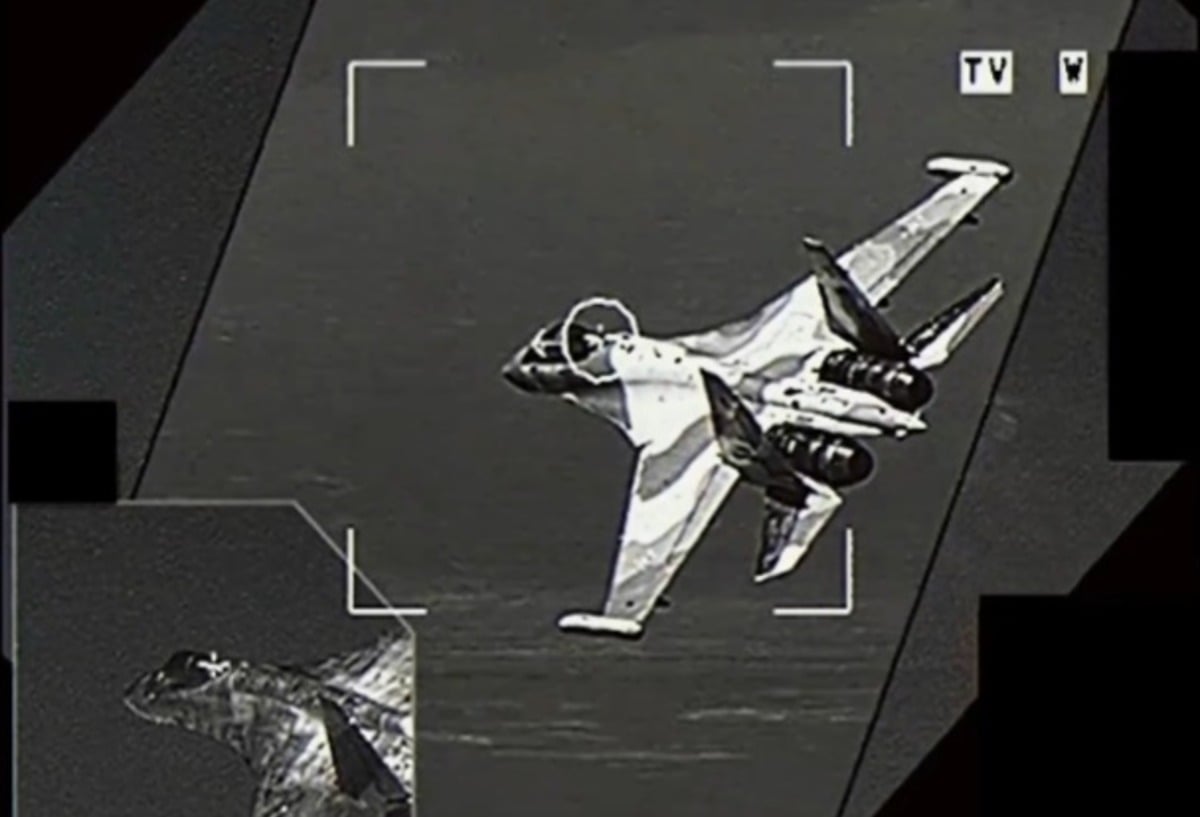
French Air Force Rafale fighters operating out of Šiauliai Air Base in Lithuania scrambled eleven times in a single week to intercept Russian military aircraft, culminating in a tense face-off with Moscow’s premier air superiority fighter, the Sukhoi Su-35S. Flying without radio contact or filed flight plans, the Russian formations represented an aggressive escalation in testing NATO’s northern flank. While standard air policing missions usually encounter isolated reconnaissance assets, recent intercepts revealed heavily armed strike packages. The spike in frequency and the integration of frontline air-combat assets underscore a deliberate Kremlin strategy to strain NATO’s localized readiness while projecting strategic defiance during high-profile diplomatic summits on the Russian mainland.
Escalation in the Baltic Corridor
The Baltic Air Policing mission has long been a routine dance of shadows. Western fighters intercept Russian transports, long-range bombers, and intelligence-gathering platforms skirting international airspace limits. The events of early June 2026 shattered that predictable cadence.
French Armed Forces spokesperson Guillaume Vernet confirmed that the sudden surge in scrambles forced French Rafale pilots into the air eleven times in a seven-day window. The peak of this activity materialized when a pair of Rafales met a mixed Russian formation consisting of six aircraft. This was not a passive intelligence mission. The package included an An-30 reconnaissance aircraft, Su-24 and Su-34 strike bombers, heavy transport aircraft, and a protective escort provided by the Su-35S Flanker-E.
The inclusion of the Su-35S alters the tactical equation entirely. As Russia’s most capable non-stealth air-to-air asset, the Su-35S is optimized specifically to hunt other fighters. By placing their top-tier air superiority platform directly in the path of NATO quick-reaction forces, Russian commanders signaled a willingness to move past symbolic posturing toward active combat simulation.
Anatomy of a High-Stakes Intercept
When the alarm sounds at Šiauliai Air Base, French pilots have minutes to reach their aircraft, start the twin Snecma M88 engines, and climb into the overcast Baltic skies.
[Šiauliai Air Base, Lithuania] ──(Scramble)──> [Baltic Airspace Intercept Point]
                                                      │
                                           ┌──────────┴──────────┐
                                           ▼                     ▼
                                    [French Rafale]       [Russian Su-35S]
                                    • Lightweight multi-   • Heavyweight air-
                                      role platform          superiority platform
                                    • Thales RBE2 AESA     • Irbis-E PESA radar
                                    • METEOR BVRAAM        • Thrust-vectoring
                                      capability             agility
The physical confrontation between a lightweight multi-role fighter like the Rafale and a heavyweight air superiority platform like the Su-35S highlights contrasting philosophies in military aviation. The Russian jet relies on sheer physical scale, massive fuel reserves, and two Saturn AL-41F1S engines that deliver exceptional low-speed agility via three-dimensional thrust-vectoring nozzles. Its N035 Irbis-E radar uses a high-power passive electronically scanned array to burn through electronic countermeasures at extreme ranges.
The Rafale counterbalances this raw physical power with a low radar cross-section, sensor fusion, and the Thales RBE2 active electronically scanned array radar. During these intercepts, French pilots frequently utilize the TALIOS targeting pod to visually identify and lock onto non-compliant aircraft from long distances before moving to a wing-to-wing escort position. The objective is not dogfighting; it is a clinical demonstration of discipline designed to force the intruding aircraft back into international corridors without pulling a trigger.
Proving Capabilities on the Margins of War
The timing of these eleven high-intensity intercepts is far from accidental. Western defense analysts noted that the operational spike directly coincided with the annual St. Petersburg International Economic Forum. Historically, the Kremlin utilizes synchronized displays of military assertiveness to project an image of absolute security and regional dominance while hosting international delegates.
Beyond political theater, the tactical composition of the intercepted flights points to an alarming shift in Russian training doctrines near NATO borders.
- Suppression of Enemy Air Defenses: Intercepts from late May revealed Russian Navy Su-30SM2 fighters carrying live Kh-31 anti-radiation missiles. These weapons are designed to seek out and destroy ground-based air defense radars.
- Strike Packaging: The mix of Su-24M and Su-34 strike platforms operating alongside electronic intelligence assets mimics the exact strike profiles used by Russian forces in the Ukrainian theater.
- Proximity Probing: By sending mixed packages close to the airspace of Estonia, Latvia, and Lithuania, Moscow forces NATO to activate its tracking systems, effectively mapping out Western radar blind spots and response times.
This pattern of provocation matches recent hybrid warfare activities along the European frontier. Border guards in Finland, Latvia, and Estonia have recorded a sharp rise in military drone incursions and persistent GPS jamming that disrupts civilian aviation across northern Europe. The air incursions represent the loudest component of a broader campaign to destabilize the region's sense of security.
The Logistics of Air Policing Fatigue
For the French detachment currently holding the Baltic Air Policing rotation, the operational tempo strains both human and mechanical assets. Quick Reaction Alert missions demand that ground crews and pilots remain on standby around the clock, fully geared, in close proximity to ready-to-launch aircraft.
Scrambling eleven times in a single week induces profound pilot fatigue and accelerates airframe wear. Each launch requires rapid acceleration and high-altitude climbs that consume valuable engine hours. For air forces operating finite fleets, an extended period of heightened alert in the Baltics drains logistical reserves that would otherwise support domestic defense or long-term modernization efforts.
Sweden’s recent integration into NATO adds another layer to this air defense matrix. During the June 2 intercept, Swedish Air Force JAS-39 Gripen fighters joined the French Rafales to shadow the six-ship Russian formation. While the coordination demonstrates alliance cohesion, the necessity of deploying multiple nations' fighters to handle a single Russian package demonstrates how effectively Moscow can dictate the operational rhythm of regional defense forces.
The Gray Zone of Aerial Miscalculation
The primary danger in the Baltic corridor is no longer the threat of a planned, surprise invasion. The immediate risk lies in the razor-thin margin for error during these visual intercepts. When an armed Su-35S, utilizing thrust-vectoring maneuvers, operates feet away from a Western fighter while flying without radio communication, a single mechanical failure or pilot miscalculation can trigger a mid-air collision.
If a Russian jet crashes after an aggressive maneuvering incident with a French Rafale, the political fallout would instantly challenge the collective defense mechanisms of the alliance. Moscow has routinely proven that it views international airspace as a legal gray zone where it can test the limits of Western restraint. By choosing to escort these strike packages with air-superiority fighters rather than unarmed transports, the Russian Aerospace Forces are signaling that they no longer view these encounters as routine diplomatic frictions, but as active touchpoints on a contiguous European front.



:max_bytes(150000):strip_icc()/how-many-types-of-dwarfism-are-there-2860725-v1-8dae2c531b4b47d9ae36ae404d3308a0.png)