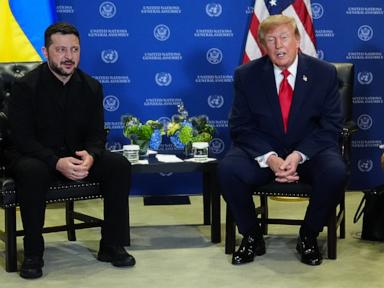
In a quiet corridor of the diplomat-heavy hotels in Warsaw, a Ukrainian delegate adjusts his tie for the third time in ten minutes. His phone vibrates against the mahogany table. It is not news of a breakthrough. It is a social media post from Washington, broadcast to millions in an instant, dismissing the leader of his warring nation as a salesman who always walks away with tens of billions of dollars.
The room feels suddenly colder. For a deeper dive into this area, we recommend: this related article.
For nearly three years, the arithmetic of foreign policy between the United States and Ukraine was defined by a predictable, if agonizing, routine. Kyiv pleaded for survival; Washington weighed the risks of escalation, debated appropriations, and eventually delivered steel, ammunition, and intelligence. The alliance was framed in the lofty architecture of democratic defense.
Then the rhetoric shifted, and the temperature plummeted. To get more details on this issue, detailed reporting can be read at NBC News.
The Shift in the Echo Chamber
Geopolitics rarely turns on a dime; it drifts, gathers momentum, and then violently shifts weight. What we are witnessing is not a mere tactical disagreement over troop deployments or aid packages. It is a fundamental renegotiation of the global script.
When Donald Trump publicly mocked Volodymyr Zelenskyy on the campaign trail, signaling an immediate desire to wrap up the war within twenty-four hours while taking a noticeably softer tone toward Moscow, he was not merely posturing for domestic rallies. He was signaling a structural break in American foreign policy. The message was loud, deliberate, and impossible to misinterpret in Eastern Europe: the blanket guarantee has expired.
To understand how high the stakes are, step away from the podiums and turn off the news broadcasts. Picture an artillery commander in the Donetsk region. He does not read policy white papers. He counts shells. Every night, his quartermaster hands him an inventory that dictates whether his battery fires twenty rounds or two. When Washington hesitates, or when the political consensus in America fractures into public disdain, that inventory drops.
Silence on the front line is not a diplomatic pause. It is a fatal vulnerability.
The Miscalculation of the Deal
There is a comforting illusion in the idea that long, brutal conflicts can be resolved like real estate disputes. Draw a line down the middle of the floor, split the difference, shake hands, and move on.
It sounds pragmatic. It sounds clean.
It ignores human nature and history.
When American rhetoric softens toward the Kremlin while taking sharp swipes at Ukraine's leadership, the strategic calculus in Moscow does not tilt toward peace. It tilts toward patience. Why settle for a fraction of your strategic goals today when waiting out an election cycle or a shifting political tide in Washington might deliver the entire table tomorrow?
The friction between the incoming or prospective American administration and the Ukrainian presidency exposes a dangerous paradox. Washington views aid through the lens of transaction, debt, and domestic political fatigue. Kyiv views aid through the lens of existential survival. You cannot negotiate easily across that chasm because the currencies being spent are entirely different: one side is spending political capital, while the other is paying in blood and territory.
The Cost of the Cold Shoulder
Consider what happens next when an ally begins to feel isolated.
When assurances grow thin, nation-states do not simply surrender. They grow desperate. They adapt. A Ukraine that feels abandoned by the Western superpower is not a nation that quietly folds its cards. It is a nation forced to recalculate its survival strategies in ways that could make the region far more volatile.
- Sovereignty becomes non-negotiable, pushing local commanders toward higher-risk operations deep inside enemy lines.
- European neighbors, sensing the retreat of the American security umbrella, scramble to build fragmented, localized defense coalitions.
- Adversaries across the globe watch the draft in the room, taking precise notes on how long American commitments truly endure when domestic political winds shift.
This is not just about two men—a former reality television star turned political powerhouse and a former comedian turned wartime president—clashing in the media. It is about the credibility of an entire international order built after 1945. If the guarantee of American support can be flipped like a light switch based on personal grievances or quick-fix promises, then alliances everywhere lose their currency.
The Human Geometry of Strategic Drift
In Kyiv, the air raid sirens sound with a monotonous regularity that has long since ceased to shock the locals into panic. People step into subway stations, pull out their phones, and scan the headlines from across the Atlantic. They look for signals not in formal state department briefings, but in off-hand comments, late-night posts, and campaign rally quips.
There is a profound, quiet tragedy in watching your nation's survival become a partisan football in another country's election cycle.
When American leadership eases up on Russia, it isn't an abstract diplomatic maneuver. It reverberates in the freezing trenches of Pokrovsk. It echoes through the shattered windows of Kharkiv. It whispers through the corridors of power in Beijing, Tehran, and Pyongyang.
The tie is finally adjusted in that Warsaw hotel room. The delegate puts his phone face down on the table. The meeting goes on, but the atmosphere has fundamentally changed. The trust that took years of blood and diplomacy to build can unravel in a single season of political theater, leaving a cold, unpredictable world in its wake.

